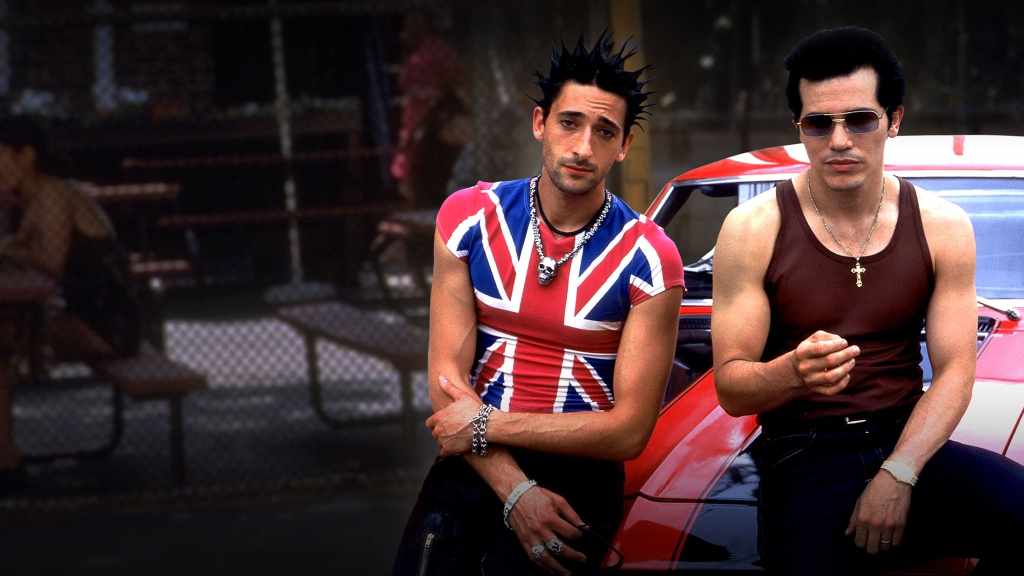
When Summer of Sam opened in Cannes in 1999, it immediately divided opinion as it was critiqued for its density and alleged failure in imitating a Scorsese-esque epic, as well as for its ostensibly exploitative, graphic approach to sexual content, which perhaps touched a nerve with some critics. To this day this movie stands as a mostly overlooked opus in Spike Lee’s catalogue, tucked between some of the more well known early works of his like Do the Right Thing, Malcolm X and He Got Game (together with some more not so well-known yet still fundamentally amazing pieces like Mo’ Better Blues, Jungle Fever or Girl 6) and 25th Hour. And here I am, twenty-five years on, telling you that not only is it a criminally underappreciated piece of cinema, but also one that is both fundamentally misunderstood and incredibly relevant today.
At the time of its release, Summer of Sam was immediately pegged as a post-Scorsese piece, perhaps owing to the fact that movies like Goodfellas and Casino have left a mark on the popular culture and influenced many other filmmakers to follow suit (A Bronx Tale comes to mind almost immediately). And you probably wouldn’t be too far off if you assumed that Spike Lee also drew immense inspiration from this trend. After all, with a movie like Clockers under his belt, which at one point was being developed as a vehicle for Scorsese to direct, it would have been natural to assume at least a degree of influence the post-Scorsese wave would have exerted on Lee as well.
However, having delved into Lee’s work a bit more over the recent months, I have come to strongly believe that there is no such thing as an accident when it comes to a Spike Lee movie and that the filmmaker himself is unlikely to commit to anything—be it style, theme or a narrative device—just because it’s trendy and cool. Spike Lee makes narrative and aesthetic choices exclusively to fit the thematic messaging driving the movie, which should immediately dissuade any prospective critics from dismissing a movie on the back of the filmmaker’s competence in making these choices. Sure, you may not like what these choices are, and you may emerge fundamentally un-entertained from a movie like Summer of Sam, but that’s mostly on you. Because Spike Lee doesn’t play the entertainment game. He’s not an audience pleaser; at least he wasn’t one in 1999. He’s a cine-activist and a cine-preacher out on a mission to win the hearts and minds of his audiences and to open their eyes to causes he was passionately defending and/or advocating.
Therefore, it is perhaps important to ask why Summer of Sam exist in the first place, especially since it looks like an overt departure from what Spike Lee had been consistently interested in. From She’s Gotta Have It to He Got Game, without a single exception, Spike Lee’s cinema revolved around the many trials and tribulations of Black Americans, often venturing into realms that are both rarely talked about, like shadeism and intracommunal stratifications among Black Americans (School Daze), the crisis of fatherlessness (Clockers, He Got Game), or the systemic racism and sexism the entertainment industry had been seemingly built upon (Mo’ Better Blues and Girl 6). In fact, the latter theme he explored immediately after Summer of Sam in another criminally underseen masterwork, Bamboozled.
And then, seemingly out of nowhere, Lee turns his gaze away from the Black American experience and weaves a thoroughly dense and complex multivariate narrative concerning Italian Americans and their relationship woes underpinned by Catholic guilt, all set against the backdrop of the summer of 1977 when David Berkowitz terrorized the streets of New York. Which is where I immediately begin scratching my head because I have placed sufficient trust in Spike Lee’s work to expect there is a reason for everything he does. Why set a movie in 1977? Why tell me a story about a sexually repressed guy (John Leguizamo) who cannot stay faithful to his wife? Why show me a born-and-bred New Yorker who puts on a fake English accent, wears a Union Jack t-shirt and adopts an essentially foreign culture as his own? Why cut to Berkowitz himself every fifteen minutes as he screams into a pillow in fits of impotent frustration only for him to succumb to his urges and head out for the streets in search for victims to murder?
Arguably, these might be questions critics would have asked themselves at the time and judging by the consensus they mostly arrived at, they may have not been necessarily inclined to lend Spike Lee as much rope as I have. Sure, the movie is overwhelming and oppressive with the way it hurls these questions at you and with the way it cuts between these seemingly disparate narratives, all leaving the viewer disconnected from the flow and utterly discombobulated… because Scorsese would have focused the story on someone specific and used them as a conduit for the viewer. Meanwhile, Lee seems to have disregarded this possibility and chose not to let us get too close to Vinny (Leguizamo), Ritchie (Adrien Brody), Dionna (Mira Sorvino), Ruby (Jennifer Esposito) or even Berkowitz himself (Michael Badalucco), let alone use any of them as an equivalent of the Mookie character in Do the Right Thing. And that might be because, in line with how I often interpret Spike Lee’s works which employed similarly wide-angle perspectives, Lee isn’t half as interested in exploring what his characters do or the changes they undergo, as he is in using them as pawns in a game of themes. They are all intentionally shallow and their stories willfully fragmented because Lee is on a mission here and he’s trying to tell us something that perhaps transcends the parameters of the primary sphere of the narrative.
I think Summer of Sam is a sermon, rather than an oddly misshapen Scorsese-esque target board for critics to hurl abuse at. In fact, many Spike Lee films are cinematic attempts at cultural preaching, therefore it should come as no surprise that this particular movie can be interpreted as one as well. Hence, everything we see in Summer of Sam is a tool working in service of a message the preacher wants us to leave with and ponder on the way home. And it just so happens that this culturally relevant message not only isn’t confined to the period the film is set in, nor that it particularly refers to the era contemporary to the filmmaker, but it is perhaps most relevant today. Twenty-five years after the film’s release. Forty-seven years after Son of Sam’s brief reign of terror.
Contrary to the critical consensus of the time accusing Spike Lee’s opus of lacking focus or heft to grapple with all those sub-narrative layers and its myriad characters all seemingly vying for those precious seconds in the limelight, Summer of Sam requires this chaos to advance what I believe is its primary message of denuding America in a veritable crisis of identity. Similarly to how I view Do the Right Thing as a societal diorama where characters are stencilled stand-ins representing entire communities and thus adding to a critical analysis of the state of play in America of the time, when you zoom out and assume a similar perspective here, Spike Lee’s alleged Scorsese rip-off becomes an intricate collage of ideas and voices all working together and alerting the viewer that Spike Lee’s homeland is in a state of utter despair. Moreover, that it has been so for decades and that now, in 2024, you’d be able to see that not only not much has changed, but that many issues Lee identifies have been since vastly exacerbated and allowed to run amok.
Summer of Sam shows Ritchie, a character who lacks his own identity, assume one completely alien to him. He hides who he is, which includes his own sexuality, and pretends to be someone else. Vinny tells himself he’s a good Christian and a husband while his actions tell otherwise. He cheats and lies pathologically and incessantly. The female characters in the film are equally troubled as Dionna lacks agency completely and lives only to please her husband Vinny. Ruby puts on a mask of an accessible sex object while secretly yearning for connection. Even Berkowitz himself seems to evoke some pent-up frustrations that spill over at random because he is incapable of controlling himself. All these people live lives of utter desperation as they evade establishing eye contact with themselves whenever they look in the mirror, if they do so at all, because they all wish to be seen as something they’re not.
Does it look and sound familiar now?
Don’t we all live in a world where everyone—and I do mean everyone—projects an image of themselves upon the world while living a life completely detached from the image they impart on the world at large? We hide behind avatars and statements signaling what we think the world around us wants us to make as opposed to ones that are true to what we think and feel. We are de facto slaves of our own curated self-image, courtesy of social media and the simple fact that much of our engagement with the culture at large takes place through the gateway of our smartphones. Spike Lee describes a similar world, both in 1999 and 1977, as his characters behave exactly like we would now. It is a stark realization to find just how true to life the conversation between Jennifer Esposito and Michael Imperioli is—throwaway as it may be to anyone focused on finding that Scorsese angle—where Esposito’s Ruby is asked head-on whether she strips for a living or maybe acts in porn, all because she is an attractive woman. When she admits to doing no such thing, Imperioli’s character sums her up by suggesting she’s “giving it away for free,” as though her value was tied inextricably to both her physical beauty and the access to her body she allows other men to have. in 2024, she’d be asked if she has OnlyFans, or if she could send this guy some nudes.
The world described by Lee in Summer of Sam is symmetrical to the one we inhabit now and I can only imagine, though I was merely a teenager in 1999, that it is also a world Spike Lee recognized then. And it would probably be true for 1977, a prehistoric time from where I’m sitting. It is a world populated by zombies devoid of identity, roaming the world in search of validation, fame or notoriety as ersatz commodities standing in for genuine meaning and contentment, all driven and enabled by the advent of mass media (and now social media) keen to sensationalize events and allow people to hide behind personalities completely discordant with one’s they already have. It is a movie about what happens when we allow “the idiot box” (as it is termed in Bamboozled) to dictate the terms of cultural discourse. It anthropomorphizes the futile and most importantly warped pursuit of fame as Berkowitz himself, who upon being caught, seems almost overjoyed because now the world would see and remember him. Tragically, it did so because the name Berkowitz has entered the cultural lexicon immediately thereafter.
That’s what I think has been mostly overlooked—and if noticed, underplayed—when Summer of Sam was released upon the unsuspecting public twenty-five years ago. It has been incorrectly identified as a Scorsese wannabe which bit more than it could chew, while it was a scathing sermon on the death spiral in which the entire Western Culture was at the time, and where it continues to this day. Unabated and, if anything, accelerated by the nascent of social media which turbocharged the fundamental notions of cultural echo chambers and tribal herd mentality that in the film climaxed in the scene where Ritchie is brutally beaten. We now live in a world where such lynchings happen every minute, online, and it is something Spike Lee’s movie inadvertently (or perhaps completely lucidly, as I choose to see it) prophesized.
However, Summer of Sam is equally a piece on what’s not in the frame. I may have already pointed out that the filmmaker’s gaze shifts away from the Black Community, but it doesn’t mean he has lost interest in championing this cause. On the contrary, it is important to remember that Spike Lee is not a prisoner of happenstance, and that his work is nothing but deliberate. And the Black Community gets a mention in the movie anyway, as Lee inserts himself into the film as a news reporter—an agent of sensationalist mass media—so I think it is fair to say that by not focusing directly on Black Americans he focuses on them even more profoundly. And that’s because a good part of the filmmaker’s message relating to America’s process of losing its identity in pursuit of notoriety and hedonist self-aggrandizement has to do with the fact that while these characters struggle with their issues and while Americans spend their evenings glued to the idiot box following Berkowitz’s killing spree, entire sections of the country continue in abject poverty. Crime in neighborhoods inhabited by minority groups is through the roof. Drugs are everywhere. In fact, people get gunned down every day in New York, but they never get a mention in the news because the victims are not white. Meanwhile, Berkowitz’s victims were. Therefore, by not being explicitly about race, Summer of Sam equally is just as potent an indictment of America’s societal underpinnings as Do the Right Thing or Clockers. You just have to look beyond the frame and do some thinking on the side. But it’s nonetheless there.
Consequently, it is my strong belief that now, twenty-five years on from its initial ill-fated release, Summer of Sam remains a movie you should find time to watch. And it surely helps that, unlike many of his films from the era, it is available to stream on Disney+ so I can only invite you to put your thinking cap on and immerse yourself in the lurid universe of Spike Lee’s cine-activism. You may not like the way this movie might make you feel, but that’s to be expected. As I said in the opening, Spike Lee is not an entertainer. It’s not his job to make you feel good about yourself having watched one of his movies. He’s America’s cinematic conscience: here to educate, enlighten and guide and sometimes the only way to do so is to put the audience well outside of their comfort zones and allow them to experience something profoundly disconcerting and requiring at least some heavy lifting to be done by the viewer after the credits have rolled.


 Flasz On Film
Leave a reply to Uncut Gems Podcast (July 2024 Round-up) – Flasz On Film Cancel reply