
When it comes to Pixar-produced animated movies, over the years I have devised a simple sorting methodology to both help me rank them against one another and to perhaps recommend them accordingly to those poor souls who would ask my opinion on what they should watch next weekend. Thus, I see Pixar movies as broadly belonging to either of the two categories: movies for kids that adults can get a lot of value from (Monsters Inc., Toy Story and sequels) and movies for adults that kids can get a lot of value from (Soul, Wall-E). Now, I could be facetious and introduce the third category of Pixar movies that work for nobody in particular (think Cars or The Good Dinosaur), but they most likely fit in the category of movies made with kids in mind in the first place anyway.
However, this sorting mechanism is entirely manufactured and indeed the mission of all Pixar films is to produce entertainment for the whole family. These movies are specifically engineered, designed and fine-tuned—call it art by committee, if you will, or just well cared-for high-calibre entertainment for the masses—as four-quadrant blockbusters. They are movies everyone should be able to enjoy, optimized to reduce the sub-demographic of the audience likely to respond with “this movie is not for me” when asked what they think about a new Pixar movie to as close to zero as humanly possible. Therefore, although those recent efforts like Luca, Onward, Elemental or Lightyear cannot perhaps be slotted easily into one of those subcategories I choose to deploy, they still lean towards one of those directions even if they attempt to straddle the middle of the road and simply exist as entertainment for all.
What is even more interesting is that in contravention of the age-old logic—rooted in the idea that a compromise leaves all parties disappointed with the result—the concept of a Pixar movie successfully designed to entertain everyone is not a compromise, but rather what is termed in the team management space as a win-win. It is a positive inverse of a compromise where a solution to a problem is found where all parties can emerge satisfied, which is where movies like Luca, Finding Nemo or Inside Out truly stand out as they elevate the tried-and-tested Pixar gimmick of giving nouns feelings into a family-oriented experience where all parties can emerge enriched, excited and entertained.
Therefore, the bar for Inside Out 2 was set astonishingly high. It wouldn’t have been enough for Kelsey Mann (who, having risen through the corporate ranks at Pixar comes to replace Pete Docter in the director’s chair) to phone one in while trying to follow up one of the most successful movies of 2015 and one of the most profitable Pixar productions in general. Inside Out 2 was tasked with the impossible mission of squaring the circle and providing more of the same while also giving the audiences a distinct feeling of watching something new, fresh and engaging.
Long story short, they succeeded in this mission and gave us a summer movie that the whole family can get behind and—this is a promise you can to the bank—which will offer incredible rewatch value when it hits Disney Plus later this year. Somehow, this theoretically unoriginal idea of revisiting the gimmick of “what if feelings had feelings” was a mine still holding incredible riches that at no point felt repetitive or tedious. Which is, I suppose, what you should expect if you imagine that there is more to it than what was explored in the first movie, and which all pertains to the concept teased towards the end of Inside Out—the concept of puberty.
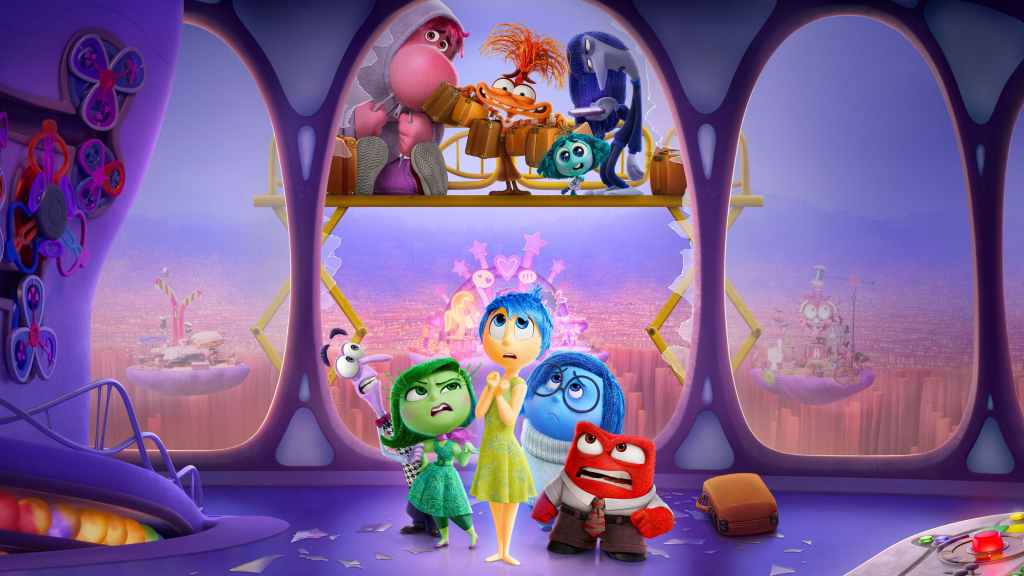
In 2024, Riley (voiced by Kensington Tallman) turns thirteen and with this transition comes a flurry of changes you and I will know in intimate detail. Teenage years are a mess and this is beautifully boiled down and visually represented with a core idea of adding new emotions to the cast we have known from the previous film. Thus, to complement Joy (Amy Poehler), Sadness (Phyliss Smith), Disgust (Liza Lapira), Anger (Lewis Black) and Fear (Tony Hale), all primary emotions driving the simplified emotional console inside Riley’s child brain, the movie introduces more complex ideas like Embarrassment (Paul Walter Hauser, though I am not sure you’d recognize him from muted grunts alone), Ennui (Adelé Exarchopoulous), Envy (Ayo Edebiri) and Anxiety (Maya Hawke), the latter of whom takes over the new and improved machinery of teenage emotional control panel that is out of whack and completely uncalibrated as far as Joy and other stalwarts are concerned.
Naturally, an adventure ensues because Riley is about to go through a hockey skills camp which will test her inner core beliefs and strain her friendships, all the while in her head a battle shall take place where Joy and her fellow primary emotions will be temporarily banished into the back of Riley’s mind together with Riley’s hitherto established simple sense of self telling her she’s a good person. Simples. Joy will have to rally the troops and make sure Riley finds herself… only to realize that the person Riley finds may no longer be the same.
As you might expect, Inside Out 2 averages out to an incredibly solid piece of entertainment that rides the line and delivers a spectacle that works equally for that ten-year-old viewer and their parent, specifically on the back of its core emotional connection to ideas and themes all parents and pre-teens should be able to relate to in equal measures, such as alienation or the confused notion of trying to fit in and stand out at the same time. And it is all perfectly seasoned with what Pixar knows how to do best, which is a medley of visually clever ideas that distil familiar concepts into intriguing and narratively functional tropes. In the first movie we had Joy, Sadness and the Imaginary Friend attempt to board the Train of Thought, and here we have all the emotions take a trip down the stream of consciousness. An earworm song makes a comeback, anxiety asks where she can put her stuff (because she comes with emotional baggage) and the idea of a sarcasm is an actual chasm. Sar-chasm. Get it?
Much like The Super Mario Bros Movie, Inside Out 2 promises good old-fashioned fun with no strings attached and very little in the way of innuendo so frequently polluting movies developed by Pixar competitors. Dreamworks, you know I am looking at you right now… don’t you? However, in contrast to that equally inoffensive piece of four-quadrant entertainment which rattled the box office a year ago, this here offers quite a bit more beyond just the thrills and chills of looking at your beloved video game characters being goofballs and executing on a hero’s journey archetype. Naturally, this is all still here in some guise—I wouldn’t expect anything less from a Pixar product—but the value it offers ventures into places The Super Mario Bros Movie simply could not access. It is a borderline incredible achievement in coming together as a team of professional entertainment product engineers and building a spectacle that—while still identifiable as a marketable product designed with revenue-building in mind—evokes a strong and perfectly legitimate emotional response in everyone who isn’t a jaded too-cool-for-school edgelord and facilitates an experience you’d be hard-pressed to find again this summer on the big screen.
Inside Out 2 is a movie that induces familial bonding between those who choose to venture out and see it together. It sure worked wonders for me and my little ten-year-old who’s just about to turn that corner and invite so many extra emotions into her headspace. I must admit I never expected a sequel to facilitate such an experience. It only goes to show that Pixar folks have never forgotten how to orchestrate those spectacles that engage across the entire societal spectrum. And, if anything, I don’t think it has anything to do with the idea of filmmakers tapping into widely accessible concepts as opposed to evoking personal storytelling, a topic that has been the subject of a recent controversy. Some personal stories work, some don’t. Some require a warm-up, and others immediately enter a home video rotation every parent is incredibly familiar with.
Inside Out 2 just works. And I fully expect to see it at least fifty times over the course of the next twelve months because something tells me I’ll be walking past the TV while this is on a lot.







Leave a Reply