
The career of one M. Night Shyamalan is a fascinating specimen and potentially a subject for a rather intriguing monograph. Well, there already is one titled “The Man who Heard Voices, or how M. Night Shyamalan Risked His Career on a Fairy Tale.” I haven’t read it, but at this point I might as well, since it turns out Shyamalan is one of my formative film directors, and one I have written about a lot, from the way his cameos are tools of authorial control and the way his movies function as anthems for environmental activism to the way he critiques the pharma industry and the billionaire class, and most importantly how all his movies are expressions of character self-actualization, which I believe to be his primary driving force.
He’s been through a lot and the aforementioned book, published in 2006, wouldn’t even touch the sides of how much of a rollercoaster ride Shyamalan’s career has been over the years. He was called a wunderkind, a joke, a one-trick pony, a master of the twist, a tired shtick. And his movies are definitely an acquired taste. They’re not for everyone and they require the viewer to attune to the way Shyamalan directs actors, dispenses exposition, generates dread and how—with incredible ease, no less—he can turn an otherwise gimmicky genre conceit into a fable-like construct capable of ensnaring the viewer with its thematic earnestness and deliberate aesthetic focus.
But we’re not here to write a song about M. Night Shyamalan, are we? We’re here to dispense a few words about The Watchers (released as The Watched in the UK and Ireland), which is a movie written for the screen (adapted from a novel by A.M. Shine) and directed by M. Night Shyamalan’s daughter, Ishana. Having written and directed a number of episodes of The Servant, a show where her father was both the showrunner and one of the executive producers, Ishana Night Shyamalan has decided to make the leap into feature filmmaking and at this point—if you are appropriately inclined—you might be a little cross with me for effectively sidelining a young female voice and instead spending not one but two paragraphs of this text discussing her father’s work.
I know. This is deliberate. And that’s because I have serious problems with Ishana Shyamalan’s debut feature and many of them relate to her father’s influence over her work. Or better yet, to the fact she is flying so close to M. Night Shyamalan that I wouldn’t be surprised if it hadn’t been ghost-directed by him, or if he hadn’t been there editing the screenplay and doing whatever he could to shape this movie into a Shyamalan-like product. Which is what annoys me even more.
Now, on some level it is to be expected for a descendant of a famous, or more specifically stylistically singular, filmmaker to be (1) automatically and immediately compared to their parent or that (2) their filmmaking sensibilities would be somehow informed by said parent and their work. You don’t have to look very far to find a great example of just that in Brandon Cronenberg whose work (Antiviral, Possessor and Infinity Pool) effectively functions as a stylistic and thematic extension of what David Cronenberg had been into for the last couple of decades. Therefore, who am I to criticize the fact that Ishana Shyamalan’s debut feature looks and smells like an M. Night Shyamalan production, especially since her father is producing it and most likely retains quite a lot of influence on the project?
Well, it all has to do with what I believe is a stark betrayal of what all (without exception) movies Shyamalan ever tackled are about and what they speak to—the theme of self-discovery and pursuit of understanding the world on your own terms. From The Sixth Sense all the way to Knock at the Cabin and Old, Shyamalan’s movies have always retained a subtle thematic melody nested within their narratives that suggested the filmmaker felt passionately about the idea of pursuing your own path, making sense of the world and comprehending the magic and wonder other people either failed to notice or were wholly ill-equipped to explore. And yet, somehow, I sat down to watch a movie written and directed by Shyamalan’s daughter that suggests that not only was he on board with her blatantly following in his footsteps, but also that he must have tacitly, if not openly, endorsed this pursuit of hers, at the cost of developing her own agency and artistic personality. While knowing what it was like to fight tooth and nail to become a singular filmmaker, which ran counter to his own parents’ expectations of him, M. Night Shyamalan was OK with Ishana becoming his little obedient clone.
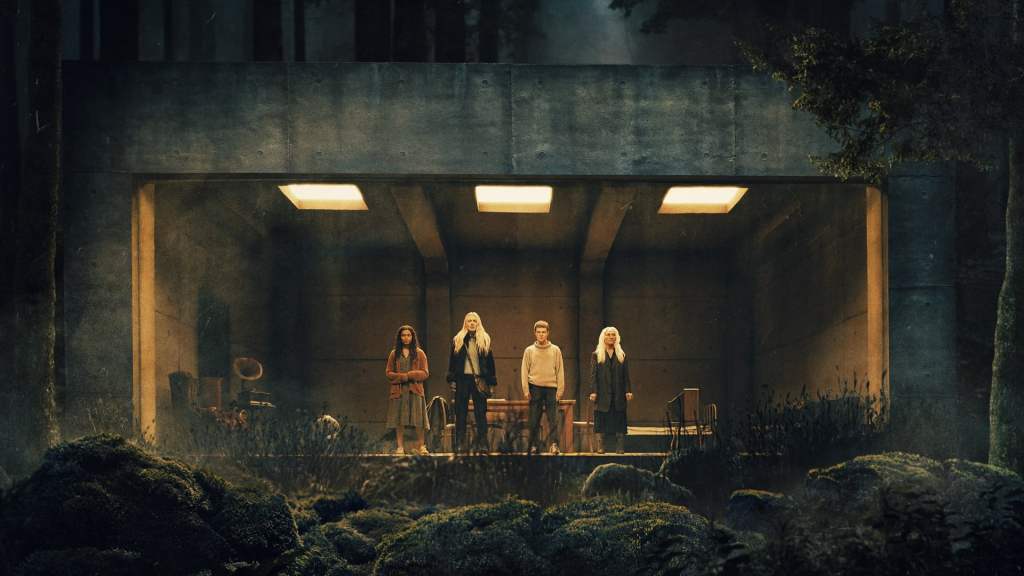
Which is what The Watchers suggests is the case. In short, Ishana Shyamalan’s feature debut is a movie I’d have expected from her father right around the time he was falling off the cliff of his early popularity with The Happening and Devil, the latter of which he only wrote the story for and produced. It’s a stylized, idiosyncratic fable revolving around a central gimmick of a house in the forest. Sorry. They call it the Coop. In fact, the characters in the film introduce all such concepts and ideas in the same manner, as though they were implying it was knowledge passed down through generations of oral storytelling. In any case, we find ourselves on the shoulder of Mina (Dakota Fanning), a pet shop employee asked to take a caged bird up to the Belfast Zoo. But she loses the way and finds herself in a thick forest where the road suddenly disappears and where the aforementioned Coop is found. Inhabited by a trio of other people (Georgina Campbell you may remember from Barbarian, Olwen Fouéré and Oliver Finnegan). There, Mina finds out there are rules to surviving in this forest, which she is told is inhabited by cruel creatures referred to as The Watchers. Sorry, they call them The Watchers. Nobody is allowed out after dark. And there are some other rules, too, left behind by a so-called Professor. Sorry, they call him The Professor. So, naturally, Mina figures she doesn’t fancy spending the rest of her days in a deep dark forest and thus an intrigue is hatched because they will all have to somehow evade The Watchers and escape this clearly haunted forest in the middle of nowhere in Ireland.
And by the way, if you think the name Mina seems familiar, it is. Mina also works through some unresolved childhood grief of losing her mother and eventually becoming estranged from her sister Lucy. Oh, how nice! A Dracula reference! Isn’t that clever?
Ugh!
This movie! This movie…
Look, I’m not going to beat around the bush here and I will just tell you I nearly walked out of the cinema. The only reason I didn’t had to do with the fact I am a glass-half-full kind of guy and I held out hope the movie would magically turn a corner and come back in stride on the back of a final act twist where all my gripes and criticisms would be recontextualized and I’d be made into a fool for doubting Ishana Shyamalan’s directorial genius, clearly a part of her genetic makeup.
No such luck, though. The Watchers is tedious and frustratingly unoriginal. And yes, a twist does come. Revelations are made. The identity of The Watchers is explained, and many aspects of the narrative are hence recontextualized and redefined, just as I’d expect from a run-of-the-mill Shyamalan-like product. Problem is that the movie is still garbage and I can’t pretend not to have wasted a hundred minutes of my life. That’s an equivalent of what nine cigarettes do to your life expectancy, so here I am telling you to skip this movie, go to your local corner shop, buy a pack of Marlboros and chain-smoke nine of them outside the shop. It’s a better use of your time. At least you may get slightly high from all that nicotine.
That’s where The Watchers has brought me. To openly endorse smoking as a viable alternative to watching this utter piece of drivel written and directed by someone who is either completely consumed by a desire to impress her father by mimicking the most obnoxiously blatant elements of his filmmaking identity or wholly kept under the thumb of a parental figure who wouldn’t allow his progeny to forge their own path and instead insisted on his daughter becoming a husk to be used as a torchbearer of his legacy. And I don’t know which option I hate more, to be perfectly honest.
What I do know however is that The Watchers is a complete and utter shambles. A shameless failure of a movie that frustrates and bores instead of exciting and intriguing the viewer with its allegedly cool central gimmick flanked by a succession of twists and turns. It is nothing but a dense medley of ideas, terminology and style Ishana’s father would have been all over exactly fifteen years ago… when his indulgences were already overstaying their welcome with general audiences. Sadly, Ishana doesn’t have a string of successes behind her belt like The Sixth Sense, Unbreakable and Signs to effectively go into hiding for a while and emerge like a phoenix from the ashes. She is now in an incredibly vulnerable position as she is a filmmaker who decidedly lacks her own identity and who has now directed such a terrible stinker that I—a person who always looks for reasons to like and defend a movie—would rather recommend you take up smoking instead of watching it.
And I somehow cannot help but blame her dad for it. I know, I know. What about Ishana’s agency here? Look, someone should have stepped in and maybe suggested it wasn’t a good idea to make this movie, or to make it in this way. And that someone should have been her dad… who executive produced it. That’s why I think it is fair to at least partially hold M. Night Shyamalan responsible for this mess because—in the absence of any other safety measures—he should have been the voice of reason and stopped this travesty from happening by gently implying that by aping her father’s filmmaking sensibilities Ishana can ever only be the second-best M. Night Shyamalan. But she can always be the best Ishana Night Shyamalan if she pursues her own journey. I hope to God it is not too late for her to do so because Hollywood is a place where a failure is hardly tolerated and where young female filmmakers still enjoy only a fraction of trust their male peers do, despite decades of concerted efforts, awareness-raising and such.
Here’s hoping Ishana Night Shyamalan can recover from this calamity and we can soon forget about The Watchers, a movie that may be a serious contender for the title of the worst film of the year.
Oof.
 Flasz On Film
Leave a comment