
The Oxford English Dictionary defines “Oscar bait” as a “(in later use often depreciative) film or film performance which appears specifically intended to earn awards or critical acclaim.” The term traces back to at least 1942 and has since been adopted as a slur within the cinephile community. But not all Oscar bait has been created equal. In fact, the parameters of what constitutes awards bait have shifted over time together with the evolving tastes of the – vastly composed of ageing white men – Academy of Motion Pictures Arts and Sciences and related film industry bodies.
Hence, it’s a bit of a chameleon term that requires a temporal reference because what used to be edgy and cool at one point may have become baity at other times. We used to roll our eyes at war dramas or tear-jerking festivals of schmaltz like Terms of Endearment while lauding method acting or gritty bouts of realism; whereas now these ideas have become snacks with which to lure awards votes out of their burrows. It’s a shifting landscape.
What is more, the parameters of what constitutes awards bait may be also shifting geographically, as people-pleasing mechanics may differ across cultures. Which is what I’d honestly expect, come to think of it. Therefore, I’d for instance consider white-people-cure-racism tropes to be specifically geared towards American audiences, even if they could work elsewhere too. But at the same time, such movies may do very little in some other jurisdictions. What I think pleases general audiences in older age groups particularly well in Britain – after all, this would be a secondary definition of Oscar bait I’d be happy to deploy – are period-set inoffensive comedies with a message, typically concocted by filmmakers with a strong background in stage direction. Which is what Wicked Little Lies is.
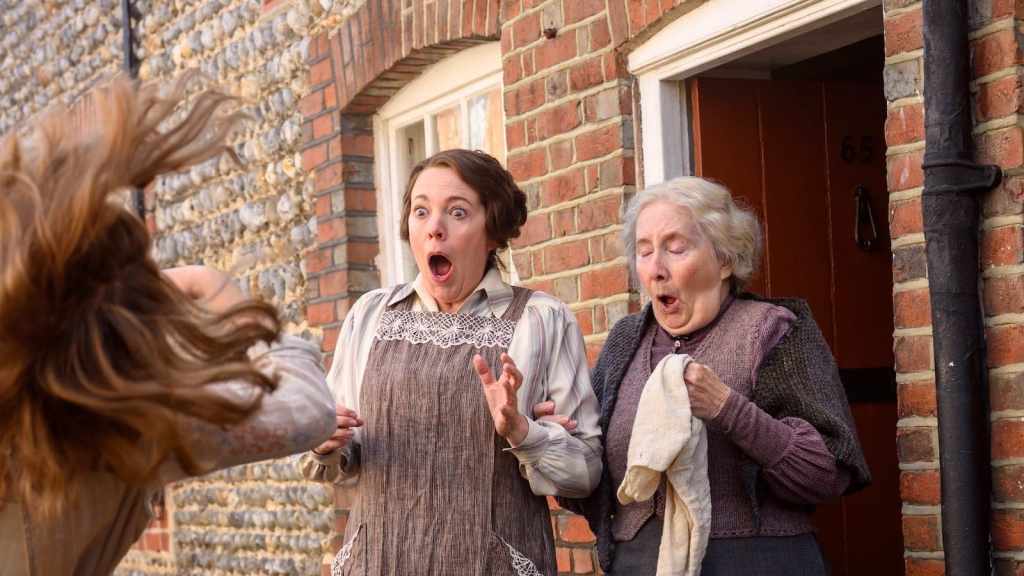
Directed by Thea Sharrock (Me Before You, The One and Only Ivan) and written by Jonny Sweet (Johnny English Strikes Again, Greed), this movie attempts to retell the stranger-than-fiction story of a scandal that took place in the 1920s England where a local community of Littlehampton was brought to a brink by a scourge of poison-pen letters. The movie takes form of an Agatha Christie-esque sleuth narrative mixed a little bit with a courtroom drama, where we shadow Rose (Jessie Buckley), a foul-mouthed Irish expat accused of sending filthy letters to her next-door neighbour Edith (Olivia Colman), and later on to many other inhabitants of the town. As events escalate and Rose finds herself in prison, it becomes a matter of personal principle for a local female police officer Gladys (Anjana Vasan, by far and away the highlight of the movie, by the way) to enlist the help of other local women and solve the mystery, which involves upsetting a whole host of traditional English men (such as Edith’s father played by Timothy Spall, Gladys’ bosses and peers and so on) in an apparent display of post-Suffragette defiance against well-entrenched patriarchal norms upon which Littlehampton seems to have been built.
That’s more or less the movie – a canonically inoffensive piece that wouldn’t be out of place as a stage production with its strong reliance on energetic and wordy dialogue. And had it not been for the fact that the script is replete with expletives, nobody would remember it a week later.
Remember Summerland from a few years ago?
Exactly my point.
Look, unless you’ve grown up in a massively conservative household and in a way identify with Edith’s character, then I suppose Wicked Little Letters will present itself as a rebellious piece of storytelling because it may be the first time ever you will hear the “c-word” out loud. Who knows, it might feel liberating. Maybe you’ll even swear a little in your car (while keeping your voice down, of course) on the way back home, just to feel extra naughty. Maybe that’s why this movie seems to hit so well with the middle-age-to-older-to-nearly-terminal demographic? You tell me. Because if you look past the obscenities – most of which will feel relatively tame to anyone who has ever seen any other movie, and they may even feel cute and innocent if you grew up on a steady diet of Quentin Tarantino and Robert Rodriguez – there’s not much edge hiding underneath otherwise. In fact, this movie is about as edgy as The King’s Speech was with its little scene where Colin Firth has his “mini-Oscar moment” and says the f-word a few times, while trying not to blush. But it is somehow portrayed as though it was an honestly audacious piece of storytelling that uses its linguistic promiscuity in service of the story or the experience the same way Armando Iannucci used it in The Death of Stalin, or In the Loop. It’s not one of those things. Underneath Jessie Buckley’s flowery lines there’s only a never-ending expanse of Sunday roast entertainment for pensioners that is saccharine enough to send the entire country into a diabetic coma. It’s just. Not. That. Good.
Suffice it to say that Wicked Little Letters is a layer cake made of awards-bait schmaltz covered in chocolate ganache laced with chilli. Nothing too hot. Not with ghost pepper or habanero. Just regular mixed chilli you’d pick up in a little baggie at your local Sainsbury’s. It’s hot enough to make your gran go “Oh, that’s a bit sassy to put spice in the chocolate, isn’t it? I’ve never had that before! Elmer, have you had the cake? It is scrumptious and the ganache is tingly.” Kill me now. I bet if I took the audience I saw this movie with to see The Exorcist, or Bad Lieutenant, there’d be casualties in the cinema, maybe a few dozen of sphincter failures and at least a handful of walkouts (or crawlouts). This stuff is only edgy if you think not making your bed on a Saturday morning is somehow tantamount to criminal rebellion and refusing to put milk in your afternoon tea is a symbol for sticking it to The Man that would make Gandhi nod in tacit approval.
Give me a break.
Wicked Little Letters is the perfect example of awards bait made in Britain that plays extremely well into the proclivities of its target audience, none of whom would have ever been expected to step more than two inches outside of the conservative norm. It’s a bizarre piece of Iannucci wannabe-ism that falls apart like a cheap suit the minute you become comfortable with profanities festooning the narrative and unveils itself as a sanitized and theatrical piece of rather heavy-handed commentary about feminism and the glacially shifting social norms within the British cultural landscape. And it’s all dressed up in a period setting which will undoubtedly help your nan get on board with the movie because she might be fond of Jane Austen and stuff like that.
In all honesty, I think someone should say something. Movies like Wicked Little Letters tend to get a free pass because they don’t look like your bog-standard American Oscar bait, which is expected to still, in the third decade of the twenty-first century (you heard me correctly; and if it makes you feel old – good) involve solemn drama about white people fighting slavery or method acting in service of progressive themes, enacted within carefully delineated parameters of liberal middle-class normalcy. Somehow, pretending to be Armando Iannucci while having very little guts to back up the raunchy dialogue with anything remotely discomforting to your average pensioner is enough to earn widespread acclaim these days.
It seems to be enough to get your ageing nan in a politically minded mood when Olivia Colman, Jessie Buckley and Timothy Spall recite saucy lines at each other while unfolding a generically bent narrative about the feminist struggle. I’m sure it’ll get her to talk about this movie as she’s queueing for lemon yum-yums at the Waitrose bakery stand. That’s about as much Iannucci-esque edge you can expect from the visionary minds behind one of the Johnny English sequels and that Jojo Moyes adaptation your aunt could not shut up about back when her book club was working through it.
At the risk of repeating myself: give me a break. Now I have to revise my rating down from two and a half stars because the simple fact of writing whatever this is down on the page made me dislike this movie even more. See what you made me do?


 Flasz On Film
Leave a reply to Huilahi Cancel reply