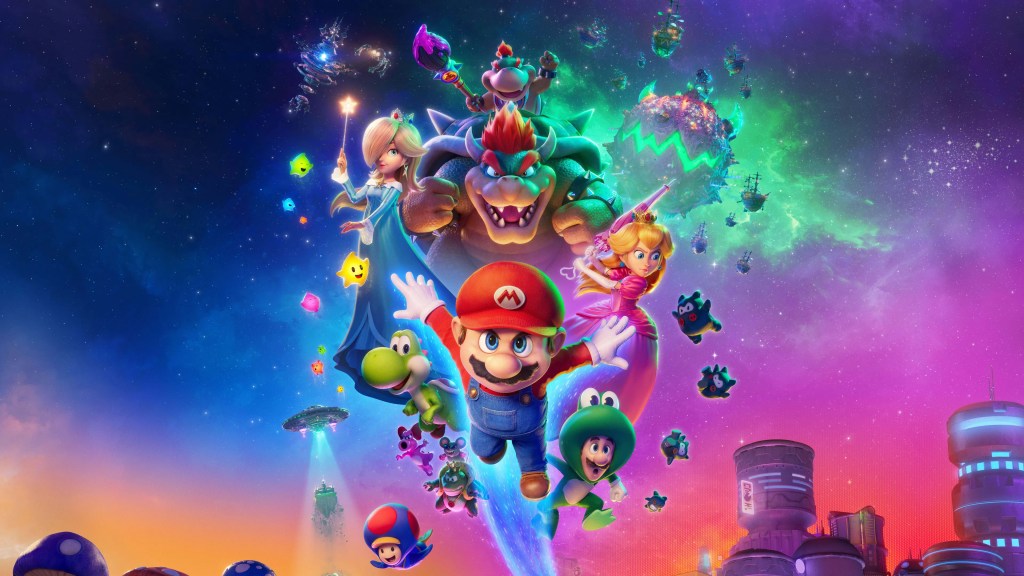

When The Super Mario Bros Movie came out in 2023 and went on to gross in excess of one billion dollars, its success didn’t look groundbreaking in the least. Perhaps because of its four-quadrant appeal and a rather Disney-esque approach to storytelling, the movie directed by Aaron Horvath and Michael Jelenic from a script written by Mattthew Fogel registered as a family-oriented animated movie aiming to challenge the joint supremacy of Disney and Pixar in this space. However, it was in many ways a watershed.
Mathematically speaking, it takes two points to draw a straight line and establish a slope of the function, while it takes at least three to establish a trend. Well, there’s quite a bit more nuance and sophistication to this process but that’s the bare minimum, at least as far as its usefulness to the point I am about to make is concerned. And this relates to the long journey the canonical video game movie has been on for the last thirty-or-so years.
In fact, it seems quite poetic to look back through history and see that it has taken exactly thirty years for video game movies to reach this watershed, and that the thirty years in question separate two distinct adaptations of the same Nintendo game. The 1993 Super Mario Bros, the first ever adaptation of a video game into a theatrically-released Hollywood movie, was a massive financial failure that only later grew to become a bona fide cult classic. Although it was followed with a handful of false dawns—Mortal Kombat and Resident Evil were largely successful but failed to establish a cultural foothold big enough to sustain a long-lasting trend—only in 2023 did we see a video game movie crack that mythical billion-dollar barrier. But its success also didn’t come out of nowhere as the world had been primed before in what I think should be called “The Sonic Moment.”
After a massive pre-release backlash relating to how the iconic Sonic the Hedgehog was about to look like on screen, the 2020 movie ended up a sizable success. It was then followed with two even more successful sequels and a TV show Knuckles. Although some commentators could see the fan rejection of Sonic’s initial look as an example of online toxicity laid bare, it also illustrated what people likely wanted to see and influenced the direction of travel for future movies in this space. This was a crucial development: audiences didn’t want a cinematic re-imagination of their beloved video game titles, or the kind of “cinematification” that had been tried in the 1990’s: video game movies made darker and edgier, saturated with lore and built around staple stories concocted with very little creativity, and only seasoned with recognizable game elements. They wanted to see movies made to look like the games they recognized, movies that celebrated the gaming culture and the experience of playing them. Thus, Sonic went from looking like an edgelord hybrid to a creature everyone could recognize. And the same happened to the Mario Brothers.
One of the many reasons why The Super Mario Bros Movie was such a stunning success was reflected in the title alone. It was a a “movie” made out of a game not a movie based on a game. It celebrated venerated game mechanics, included clear references to well-known and cherished titles like Mario Kart and Donkey Kong and most importantly didn’t try to adapt any of it into what it should look like on the screen to pass as a “real” movie. Instead, it made them all integral to a simple hero’s journey set in the colorful world everyone could recognize and opted for a familiar animated aesthetic. This is all it took to break the video game movie curse, or so it would seem.
That is because, as I remarked before, it takes at least three data points to even begin a conversation about a trend being formed. Sonic the Hedgehog primed the waters. The Super Mario Bros Movie made a billion dollars. Also, A Minecraft Movie made its own mark by inching close to the billion dollar mark while it also made its mark and entered the meme culture too. But the movie we need to look at and the real bellwether is The Super Mario Galaxy Movie because its success or failure will determine whether what we are looking at is another false dawn or a genuine cultural beachhead.
Everything seems to be pointing to the possibility that video game movies are going to become genuine moneymakers in Hollywood because The Super Mario Galaxy Movie is already on its way to count among the most financially successful films of the year. And it is my belief that the filmmakers and producers within the Nintendo-Illumination-Universal triumvirate knew this was the mission from the get-go. Not only does the movie look as though it understood the source of its own phenomenon, it also knows that what it needs to do to grow into a cash cow is to follow the Marvel formula for building a shared universe.
First of all, the film immediately does two things: it reconnects the viewers with characters they remember from their previous adventure while also bringing a few more well-known characters from the world of Nintendo games. In addition to Mario (Chris Pratt), Luigi (Charlie Day), Peach (Anya Taylor-Joy), Bowser (Jack Black), and Toad (Keegan-Michael Key), we are introduced to Rosalina (Brie Larson), Bowser Jr (Benny Safdie) and Yoshi (Donald Glover), who are once again thrust into a familiar and predictable journey that younger viewers will have no problems comprehending. As the title suggests, we are going to see them embark on a mission to save Rosalina from Bowser Jr, who has built a secret planet somewhere out there and needs Rosalina’s magical powers as an energy source for a planetary weapon of destruction, all in hopes of winning his father’s approval. To succeed, our heroes will need to enlist the help of a brand-new character as well (whose introduction is much more important than meets the eye), Fox McCloud (Glen Powell), a Han Solo-esque rogue pilot with a penchant for bravura.
If it looks quite a bit like a carbon copy of Star Wars, that’s because it is and it is all purposeful. In fact, the entire movie is a conglomeration of tropes and references pulled from the most successful and iconic Hollywood movies, like Jurassic Park, Frozen, Moana, or The Lord of the Rings and many others. And we’re not even talking about deep cuts here. These references are impossible to miss and thus will play well to all four quadrants of the general public. The Super Mario Galaxy Movie is here to entertain the young, the old, men and women, and everyone else in between with its familiar storytelling, colorful aesthetic and nuance-free action capitalizing on iconic gaming mechanics.
Who this thing might not entertain though are those who expect novelty out of this experience… the same novelty that was absent in The Super Mario Bros Movie as well. This is integral to the recipe for success in my estimation—the understanding that the movie needs to appeal to fans of the game by granting them an opportunity to inhabit the gaming experience and also make them look forward to firing up their Switch once they-re back home from the cinema. Nothing else.
Well, almost. What The Super Mario Galaxy Movie is here to do in addition to furnishing a fundamentally entertaining movie-going experience with no strings attached is to sow the seeds of a shared universe. While the previous movie introduced Donkey Kong as a character, this movie gives us that Fox McCloud and teases him as a cool offshoot who might end up leading his own Star Fox movie at some point in the future. In fact, this is enough to plant seeds of hope in the hearts of Nintendo fans who have already begun talking about Luigi’s Mansion or who would be the best fit to play Wario in a hypothetically upcoming movie. The audience has been therefore prepped for the emergence of the NCU—the Nintendo Cinematic Universe.
And honestly, it might come just at the right time to challenge the MCU, the currently ruling blockbuster royalty that has grown fat and frail while simmering in its own unchecked opulence. It might just be that the era of the comic book movie is entering its Lebensabend and we might be witnessing the arrival of its successor, an all-encompassing cultural takeover of the video game movie spearheaded by Nintendo’s high-polish products and accompanied by myriad others that are inevitably bound to follow, lured by the seductive fragrance of box office dollars.
The future might therefore see superheroes slowly retreat to the safety of the small screen, much like westerns did way back in the day, to make space for The Legend of Zelda, scheduled to land in 2027 and a number of other family-slanted adventures all bringing iconic video games to life. Granted, we will still see video game adaptations of the more established kind (like the upcoming Mortal Kombat II) but it looks as though the Mario brothers have shown everyone the way while also staying ahead of the pack by dropping in extra characters and leaving loose ends for other movies to pick up. Hence, it might be a matter of time before we see a crossover culmination movie like The Avengers, and something tells me it might be The Super Smash Bros Movie.
Consequently, it honestly doesn’t matter if The Super Mario Galaxy Movie breaks new ground in terms of storytelling at all. Superhero movies also relied on tried-and-true templates while prepping the ground for a cultural takeover, with a few notable exceptions. They had a job to do and the job was to entertain masses, endear new audiences to comic book characters and satisfy the fanbase by respecting what they cared about. And their formula largely consisted of pulling recipes from other successful movies and dropping superheroes into them while building a mosaic of interconnected plot threads all working towards a climactic crossover.
So, while I think my patience wore thin towards the end of the film, I couldn’t help but admire the big picture conceit underpinning the experience of watching The Super Mario Galaxy Movie. It was overall fun, colorful and breezy, which was both expected and fundamentally satisfying despite the fact that the movie did not have an original bone in its body. By including many cultural references, nods to the actual video games and their mechanics and offshoot characters, the Nintendo-Illumination-Universal guys laid a solid enough foundation for other films to come and grow the Nintendo shared universe, which might come to intimidate both the primacy of comic book movies and the safety of four-quadrant Disney-Pixar juggernauts. Say what you want but the trend has been established. And it points up towards the stars. The future might after all be pixelated.

 Flasz On Film
Leave a comment