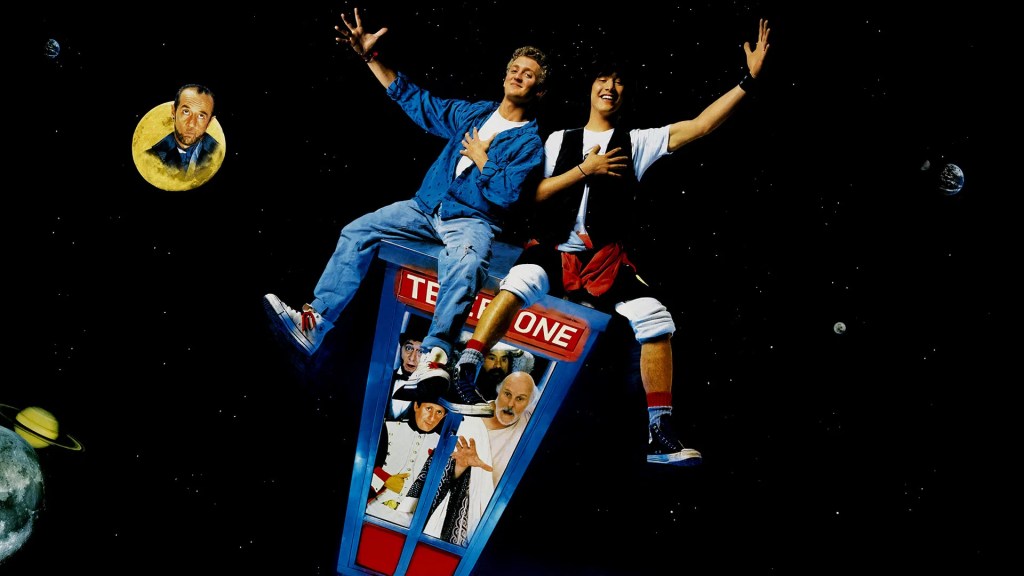
Believe it or not, Bill & Ted’s Excellent Adventure came vanishingly close to being dumped onto cable TV instead of being released theatrically. The movie, directed by Stephen Herek and written by Chris Matheson and Ed Solomon, was in post-production when the production company owned by Dino de Laurentiis that oversaw the project went bust. Thankfully, Nelson Entertainment and Orion Pictures picked up the slack eventually. Though, it took a while for the creators to find home for their movie, specifically because major studios didn’t believe that a comedy about a pair of lovable slackers traveling through time to prepare a kickass history report was going to hit. And it didn’t help that Solomon and Matheson knew what they had—test screenings for youngsters corralled in malls were a hit.
Eventually in February 1989, after a year-long delay, Bill & Ted’s Excellent Adventure saw the light of day and it won audiences over while discombobulating critics. For many reasons—and some of them might be a good topic for a separate conversation—this little movie became a cultural touchstone, a formative hangout movie for adolescent Gen-X-ers who saw themselves a little in Bill (Alex Winter) and Ted (Keanu Reeves): two slackers who had big diffuse dreams and no determination to make them happen and who were convinced that they didn’t want to end up like their parents. It was a vibe comedy germinated outside of the mainstream bubble, unburdened by industry templates or storytelling staples. Critics didn’t know what to make of the fact that the movie had no conflict and that its stakes did not build towards an action-laden set piece akin to what you’d find in all successful comedies of the time. Bill and Ted did not have to face a Stay Puft Marshmallow Man or save the town from an invasion of gremlins. All they needed to do was to prepare an oral history report to dissuade Ted’s father from sending Ted to a military boarding school. And to achieve that goal, they boarded a time-traveling phone booth supplied by a futuristic guide Rufus (played by George Carlin because the filmmakers didn’t have it in them to ask Eddie Van Halen to do it; which he later said he would have agreed to) and went on that titular excellent adventure through time and space where they convinced, coerced or downright kidnapped many notable historical persons, like Socrates, Napoleon, Beethoven and Sigmund Freud. And the fun they had was shared by audiences the world over.
However, what is rarely talked about in the context of Bill & Ted’s Excellent Adventure is that on top of becoming a serendipitous nexus of comedic styles, a rare full positive and kindness-driven buddy comedy and an impromptu inspiration for stuff like Dumb and Dumber, Beavis and Butt-head, Clerks or Dude, Where’s My Car, is that it was a movie with an intriguing and incidentally nearly perfectly executed time travel logic. In fact, Bill & Ted’s is almost never mentioned in this context and when it is, the comments quickly revert back to the film’s hangout vibes and cult appeal. And that’s probably because the movie never really draws attention to itself in this regard.
In contrast, in Back to the Future, we hear all about how time travel works, what ramifications it might entail and how messing with past events might influence the future. Indeed, it is the premise of the entire movie as we follow Marty McFly as he tries to get his parents to fall in love and make sure he won’t disappear at the end of the movie. In later instalments we learn more about alternative timelines and parallel universes, as Doc Brown lays the science out in plain English.
In The Terminator we hear some techno-jargon about time travel as well. You also have Looper, Predestination, Tenet and other films that anchor their entire story frameworks around their own rules of time travel, which they do or do not choose to enforce and explain depending on context. And then, there’s Primer, a film often referred to as the gold standard of time travel logic that doesn’t ever break its own rules and insists on scientific accuracy (such as it might be) at all cost. But Bill & Ted’s Excellent Adventure is almost always omitted from the conversation about movies that deal with time travel in a respectable manner. Which I think is a grave omission in its own right.
If you look past the vibes, the unbridled positivity brimming from the characters and the episodic sketch-like structure of what happens to them when they embark on their journey through time, you’ll notice that the movie strictly obeys what I refer to as the linear logic of time travel in movies. And it is first experienced in the opening act when Bill and Ted meet their future selves outside of a convenience store. There’s no mumbo-jumbo about preserving the space-time continuum or trivia about butterfly effects and alternative timelines. They just give each other some advice that will come in handy later and get on with their own journeys through time. This clearly suggests that we will never see any of that BTTF urgency where something would go wrong and the boys would have to go through time to fix what they accidentally modified. No, no and thrice no.
In fact, the way this movie treats time travel is as though it didn’t formally exist as an action performed on behalf of or by the characters. In other movies where we often start in the future and then go back to the past to change it, which makes the viewer feel as though the past had been different before the characters arrived in it to make changes to it. In Bill & Ted’s Excellent Adventure the past had always had Bill and Ted visit ancient Greece or a Napoleonic War battlefield. It’s just something that happened naturally, which includes kidnapping Socrates and other folks and then returning them. The movie just assumes that at some point a few thousand years ago, two strange-looking dudes who spoke an alien-sounding language arrived, took Socrates away for a few minutes and then returned him, no questions asked. The adventure took place in the future that needed to wait a few millennia to play out. I can only imagine what Freud, Socrates and Napoleon would have told their friends upon their return. I bet they sounded mad when they told stories about shopping malls, water parks and fully stage-ready history reports, not to mention jail breakouts. However, logically, there’s no debate about establishing new timelines or hopping between dimensions. The movie simply assumes that there’s only one timeline where all these events happened when they did and in the manner that they did, as though to infer a deterministic view of the universe… in which time travel of the Back to the Future kind is not possible because everything is predetermined.
Furthermore, the characters make stunning use of their own time travel rules and showcase that ideas travel through time even faster than people. In a key scene where Bill and Ted stand outside the police station, the pair determine that they need a key to break their friends out of jail so they make a decision to remember to go to the time machine later on, go back in time a few days, steal the keys from Ted’s dad and plant them behind a sign. They then promptly proceed to find the keys where they had left them before they even got to place them… because events from the past happened and events from the future we don’t get to see because the film ends before they go to the time machine to place those keys. They make use of this logic a few more times in the same set piece, which works absolutely amazingly and looks as though it contorted its own rules while actually obeying them to the letter.
It’s quite frankly perfect how Bill and Ted make use of time travel and how everything fits that logic of a single predetermined timeline through which the characters move only in one direction while their thoughts and ideas are free to flow in other directions. Well, it’s almost perfect. And this is because at the beginning of the film we see Rufus address the camera directly and tell us how he needs to go back in time to set these two guys on an adventure. While I realize that his remarks are here for the viewer, they make little sense in the context of the world of the movie in which Rufus is perfectly aware of time travel as well. So he knows that he will go back in time and prompt Bill and Ted because he most probably read in historical sources about it. After all, the pair are revered in the future so it only follows that their lives would have been chronicled appropriately… which means that Rufus shouldn’t need to address anyone and make a big deal out of going back in time and just get on with it. But it would probably leave some viewers discombobulated. That’s of course assuming that the viewers would care about the story and its time travel rules, which they most likely didn’t since—as I already remarked—the movie never registers as a worthy entry in the canon of great movies about time travel.
And it honestly should. Bill & Ted’s Excellent Adventure might not draw attention to itself when it comes to its sci-fi element. In fact, it’s there mostly to help the screenwriters stitch comedic setups together and therefore it was most likely not paid attention to by the filmmakers themselves. They just plopped it there to serve them as a narrative tool and a bit of a get-out-of-jail-free card, and only incidentally they crafted a movie that is almost as strict about its own time travel logic as the likes of Primer without trumpeting around town about it. Thus, I believe it’s time for us to acknowledge that Bill & Ted’s Excellent Adventure is way smarter—even if by serendipitous accident—than meets the eye. In addition to its great hangout vibes and stoner appeal, it became a cultural node that converged multiple strands of 80’s comedy by picking and choosing what Solomon and Matheson saw fit—from buddy comedy elements to Mel-Brooksian skits and SNL-like absurdism—and crafted a time travel adventure built on almost impervious logic. And if it hadn’t been for Orion Pictures and Nelson Entertainment, this film might never have existed. Of course, according to its own logic, it always had.

 Flasz On Film
Leave a comment