
Following the massive critical success of Corpus Christi, which was nominated for the Best International Picture Oscar in 2020 and lost to Bong Joon-ho’s Parasite, Jan Komasa’s trajectory towards international recognition was set. Although much smaller, his follow-up movie The Hater also garnered positive vibes on the international festival circuit.
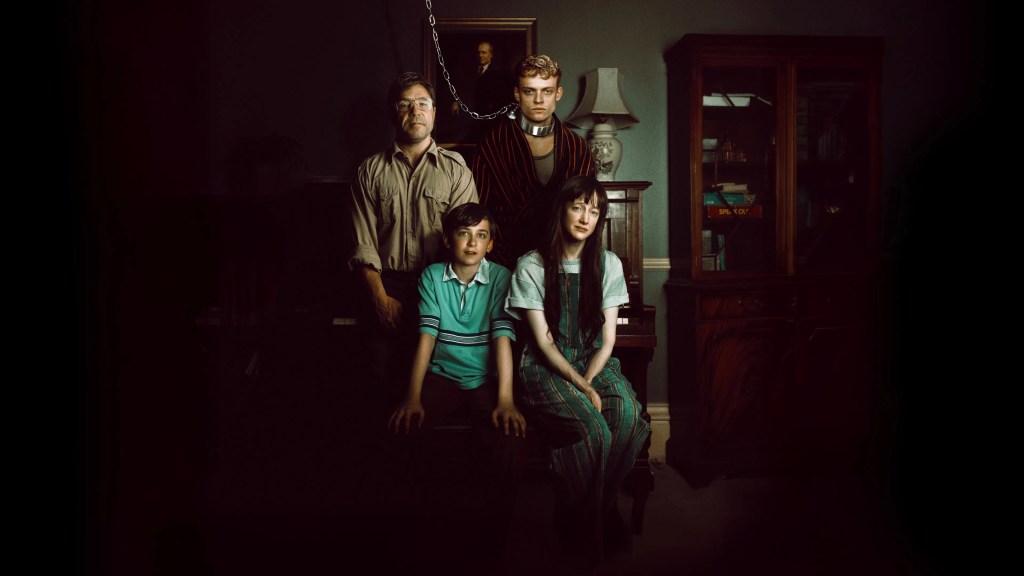
Therefore, when Jerzy Skolimowski brought to him the screenplay written by Bartek Bartosik for The Good Boy, which was written in Polish and set in Poland, the filmmaker decided to rewrite the story and shoot it in English, as if he felt that he was ready to appeal to wider audiences and meet them where they were. The Good Boy (also known as Heel) was shot in Yorkshire and starred Stephen Graham, Andrea Riseborough and Anson Boon after Naqqash Khalid (director of In Camera) was brought on to localize the story and rewrite it for English-speaking actors. Interestingly, this is Komasa’s de facto English-language debut as the movie premiered at the 2025 TIFF ahead of his other film Anniversary which had been mostly shot ahead of it but ended up delayed by industry-wide strikes.
Nevertheless, this doesn’t change the simple understanding that Komasa’s movie deserved to be transported from the Polish arthouse to an international one, as in contrast to Corpus Christi, the story it was telling was nowhere near as bound to its initial Polish setting. What could be dubbed as a take on A Clockwork Orange told through a stylistic lens reminiscent of Michael Haneke or Michel Franco (New Order, Sundown) is a film that is likely going to resonate because the values it touches on transcend national borders. In it, a teenage delinquent Tommy (Boon) is nabbed off the street after a night of debauchery by a stranger (Stephen Graham) and wakes up in an austere-looking basement, chained to a wall. Thus, his ordeal of re-education and social rehabilitation begins where Tommy would have to confront the sins of his past and—oftentimes with the aid of a carrot-and-stick-based guidance rooted in all kinds of brutality—learn to respect others and atone for his many misgivings.
This all adds up to an experience that balances at the razor-thin interface between a satirical black comedy, an austere thriller and a dark fairy tale cushioned by its strong thematic messaging. And with that the viewer is left in a state of elevated suspense because Komasa endears them to Tommy’s journey from a feckless yob to abused prisoner and later to a seemingly reformed youngster while working incredibly hard to make sure they’d be conflicted about developing positive feelings about him at all. This stylized tale that meshes Burgessian ambitions of commenting on the moral degradation of youth and the ethical ambiguity of forced rehabilitation is thus an exercise in skillful manipulation of the kind we have seen in Kubrick’s adaptation of A Clockwork Orange and such works of Michael Haneke as Funny Games and Caché, whose spectres the filmmaker evokes with a clear intent to teach both the characters and the audience a lesson. He’s not here to voyeuristically indulge in psychological (and physical) abuse, but to deliver a message regarding the thin line separating the idea of imposing a strict framework of values to impede unrestrained behaviour of young delinquents from unmitigated abuse.
Consequently, The Good Boy becomes a rather inspired character study that is rich in themes and experientially rooted in psychological horror. Much like Haneke and Franco, Komasa purposefully refrains from embracing visual realism. This way the viewer is never forced to question whatever logic the story adopts, because it fundamentally makes very little sense. The horror of its subject matter, though, remains tactile. Komasa leaves the audience with complex ideas and asks them to grapple with them while seeing the story deliver its own conclusions. This is perhaps why The Good Boy ultimately works and succeeds in its mission, as it persistently toys with tonal and moral ambiguity. In fact, you could argue that the movie gaslights the audience much like Tommy is gaslit into submission as a captive-turned-adoptive son. We can never be truly sure if we are supposed to root for Tommy’s escape from his captors, or if we are supposed to pity that strange family unit living in seclusion somewhere in Yorkshire.
But that’s mostly the point. What we draw from this experience is supposed to tell us something about our own values rather than to make definitive statements about what the filmmaker was deliberately trying to leave us with. As I said, just like Haneke, he remains purposefully distanced enough from the subject matter to enable to viewer to comfortably take sides in this debate. And in doing so, this narratively simple de facto scaled-down retelling of the core elements of A Clockwork Orange leaves enough room for a subtle meta-commentary on the idea of making value-based observations on this matter. This visually controlled and emotionally oppressive story full of dramatic nuance and stylized ambiguity is best seen as a narrative Rorschach test where there are no right or wrong answers. They are all instructive and the realization that this movie is such a test should be enough to enlighten the viewer about something profoundly important.
A movie about a teenager chained to a wall and beaten into submission by an emotionally-repressed man who seemingly keeps his entire family under a magical spell as well is watching and judging the viewer as much as the viewer is watching and judging the characters. Which is exactly what Michael Haneke would have done if he had directed The Good Boy instead of Jan Komasa, who is revealing himself to be a studied disciple of Haneke’s brand of moral hyperbole and perhaps putting himself forward as a potential torchbearer of his legacy.

 Flasz On Film
Leave a comment