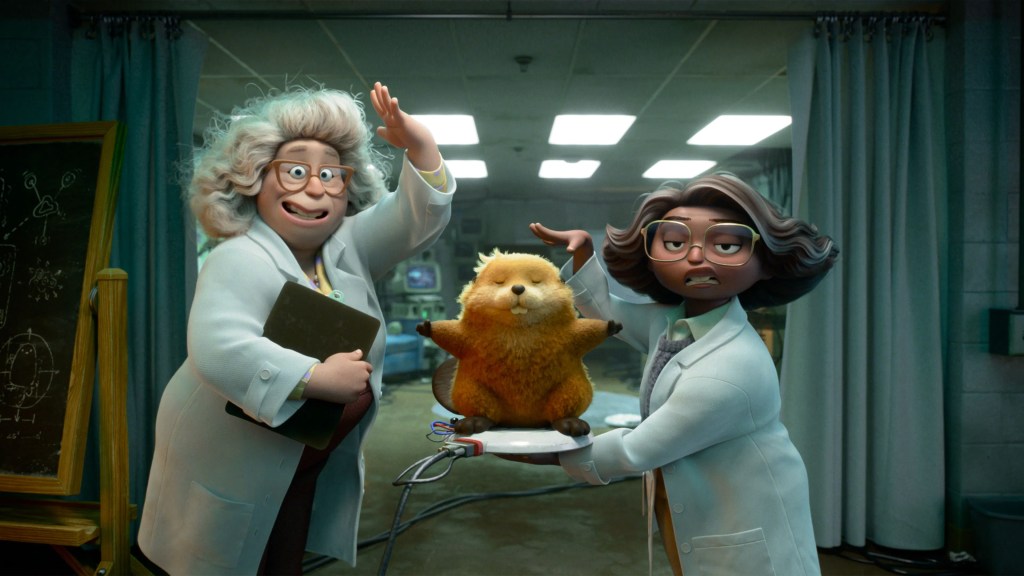

After the commercial failure of Elio last year Pixar head honchos announced that from then on their movies would be carried by universally appealing stories. This was code for “no more movies like Luca, Elio, Turning Red, Lightyear or Elemental.” Even Pete Docter, the currently serving Chief Creative Officer of the studio, claimed that they weren’t intending on “making therapy,” likely because in the current highly polarized market inclusion of themes relating to the immigrant experience or hinting at queer ideas would alienate staunch conservatives whose box office dollars these wildly expensive movies require to turn a profit.
Now, it was my opinion that Elio was a great movie for the whole family, with or without its controversies, and it only failed because Pixar chose not to put any sizable weight behind its marketing. It was unceremoniously dumped last summer. And it seems to me that despite the marketing effort underpinning the release of their new product Hoppers is markedly better, it is still not a movie they particularly believed in. After all, it was released at the tail end of winter while its natural habitat—native to a big piece of animated four-quadrant counter-programming to mainstream blockbusters of the season—should be summer. But this is when Pixar is planning to release Toy Story 5, a movie they clearly have bigger plans for and whose marketing budget likely eclipses the coffers of Hoppers by a large margin. And it is a big mistake because Hoppers deserves to be seen.
In fact, I’d be happy for this film to enter the word-of-mouth sphere of grassroots marketing under the moniker of “Avatar that your family can actually enjoy.” You don’t have to think very hard to connect the dots—and the movie makes this connection itself at some point—but the central idea underpinning the story is ripped verbatim out of James Cameron’s playbook for environmentalist cinema starring Space Smurfs. It concerns a young adult girl Mabel (voiced by Piper Curda) who is on a crusade to save a glade where she used to go with her late granny from being destroyed by a careerist mayor Jerry Generazzo (voiced by Jon Hamm). In order to achieve this goal, she uses new “body hopping” technology developed by her college professor which allows her to transfer her consciousness into a body of a robotic beaver and makes her way to the glade hoping to find animals willing to relocate and stop the ruthless mayor from building a beltway over their shrinking habitat.
As I said, you don’t need a PhD to see just how close in terms of plot and themes this movie is to Avatar. And I would go a few steps further and suggest that Hoppers is actually miles better than any of the three Space Smurf movies. For one, in true Pixar fashion—and you have to congratulate these folks, even if the movie lacks a discreet authorial stamp and is by all accounts an entertainment product—the story is strikingly engaging, simple and flavorsome. It’s incredibly easy to get behind Mabel, grab onto her shoulder and just get lost in the various antics involving the numerous animal characters populating the movie. the Pixar-esque mechanics of their world, which has been a mainstay in their products since as early as Toy Story and A Bug’s Life, does a lot of the heavy-lifting when it comes to endearing the younger audience members, while the clearly outlined thematic beats are here for older viewers to latch onto.
Even though Pixar leadership have stated clearly that they’d give potentially controversial ideas a wide berth, Hoppers still manages to smuggle some personality within its character work. Mabel is a Japanese-American youngster and is most definitely written in a way that many young adults would see themselves in her struggle. A socially-conscious Gen-Z-er, Mabel is terminally frustrated with constantly feeling powerless and invisible, and most importantly unable to exert any lasting influence over grownups who seem bent on destroying the planet she is supposed to inherit together with her young brethren.
Thus, all these constituent elements—lush world-building, well-outlined character templates, environmentalist message and a compelling plot—add up to a family-friendly equivalent of Avatar that also happens to be nearly completely free of the ballast that movie carried. It turns out that we simply don’t need intricate politicking or braindead McGuffins—unobtainium says “bonjour”—to build a lasting and potent thematic driving force upon which the plot would be draped. And as far as the plot itself is concerned, it also turns out that simplicity is king. Hoppers breezes through pseudo-science and simply assumes that the audiences will get it without dragging them through superfluous tutorial sessions and gratuitous exposition dumps. All we need to know is that Mabel cares about the glade, her consciousness can be transferred into a robot and that conveniently, when she’s inhabiting her beaver avatar, Mabel can speak to animals.
And the rest is just plain old fun where Pixarite world-building is allowed to flourish in a similar vein to Finding Nemo and others “what if [X] had feelings” gigs the studio has become regarded for. We learn all about different animal kingdoms, the intricacies of interspecies dynamics and even—during a climactic finale—we get to witness a flying shark. Which is not at all ridiculous, I assure you.
What really matters here, though, is that Hoppers aka Avatar with beavers taps effortlessly into something that Cameron’s movies failed to find, which is a relatable humanist message that also happens to be free of pathos. In fact, I’m prepared to go out on a limb and suggest that Hoppers does a far better job at changing minds than Cameron’s movies ever could.
For once, the movie just bounces along and doesn’t obfuscate with its tech-first ideas. This is not one of those Pixar movies that also want to flex continuously and remind viewers just how much computing firepower goes into creating some of these animated shots. I think we might be past that and it’s enough for the story to speak for itself. Hoppers is still beautifully animated and kinetically edited together but at no point its technical obligations distract from following Mabel’s crusade.
Furthermore, Hoppers, by dint of actually trying to appeal to all audiences and succeed as a piece of wholesome family entertainment, leaves the viewer with an uplifting message. Sure, what underpins the plot is a clash of ideologies, but the take-home message is one of co-operation and mutual understanding. If I had to choose between ways to introduce a youngster to ideas relating to saving the planet and paying attention to the environment we share with countless animals, plants and other humans, I would definitely go for the manner in which Hoppers goes about it all, as opposed to the radically militant concepts espoused in Avatar that younger audiences might not get the nuance of despite being technically the target audience for the movie.
Finally, and this is truly important, you could watch Hoppers twice in the time required to watch Avatar: Fire and Ash and not lose a single shred of thematic depth or the girth of visual world-building. It turns out it is after all possible to put together an epic story about people inhabiting avatars that is precise, succinct and fundamentally entertaining. And it took folks at Pixar to prove it.
Therefore, all I can do is renew my call for everyone to head out to the cinemas and watch Hoppers, a movie that Pixar might not have believed in enough to give it a prime summer spot and one that out-avatars Avatar movies at their own game.



 Flasz On Film
Leave a comment