
Not only did Tobe Hooper’s eponymous The Texas Chain Saw Massacre spawn a franchise and contributed to invigorating the subgenre of slasher horror, but it also—most crucially—inspired throngs of aspiring filmmakers to pick up a camera, go on location and start rolling. It was a masterclass of rogue moviemaking that used its lo-fi 16mm aesthetic both as an engine of authenticity—thus making the events in the movie look and feel disturbingly realistic—and as proof that a lot could be accomplished with very little. All that mattered were creativity and perseverance.
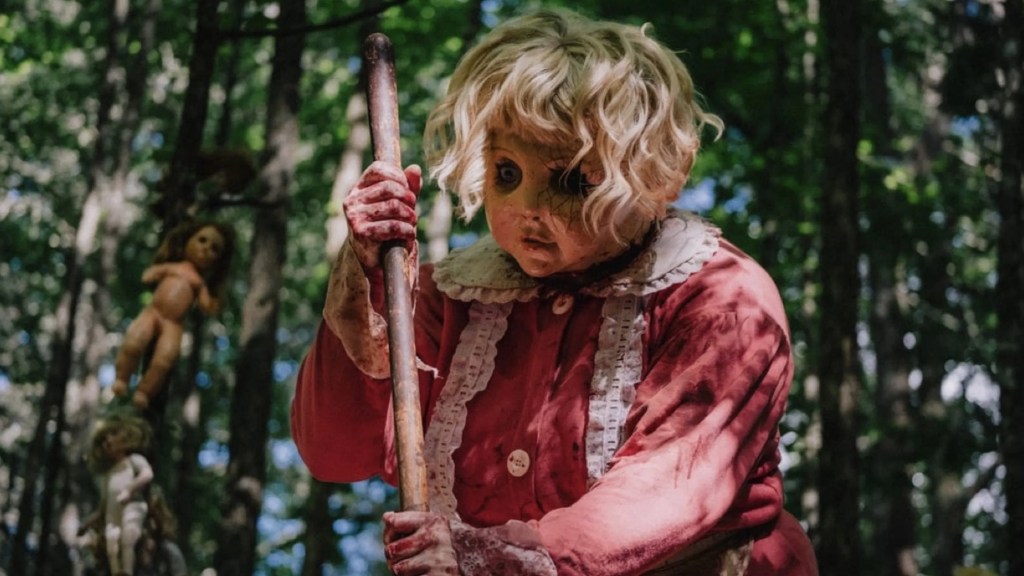
Fifty-two years on, along comes Dolly. Directed and co-written by Rod Blackhurst (who’s probably best known for producing Amanda Knox and recently writing Night Swim) this lean, tight and gritty little movie functions as a full-blown love letter to Tobe Hooper’s legacy. As expected, the premise is simple: a couple (Fabianne Therese and Seann William Scott) head out into the wild to get some much-needed quality time together only to stumble upon what looks like a graveyard of dolls. Little do they know that this little patch of the forest far from the beaten track is home to a dangerous and disturbed individual who wears a porcelain doll mask (played by wrestler Max the Impaler) and tortures, mutilates and murders those unfortunate enough to find themselves in the area. Thus, a fight for survival begins.
It does not take too much mental horsepower to establish a very strong link between Dolly and The Texas Chain Saw Massacre. A decrepit house in the middle of nowhere. A deranged mask-wearing villain. Hooper-esque gritty aesthetic. Clear exploitation vibes. Narrative simplicity. And most of all, a clear willingness to upset and disturb the viewer by choosing to go places that many mainstream horror flicks give a wide berth.
Furthermore, much like Hooper’s 1974 masterpiece, Dolly is hardly indulgent and unnecessarily graphic. Though occasionally things can get incredibly violent, the filmmakers attempt to capture the kind of unsettling magic that Tobe Hooper tapped into and lean heavily into the notion of overwhelming the viewer by way of sensory overload. Sure, their movie does feature a good handful of well-deployed special effects that might be tough for some viewers to stomach, but what the movie truly succeeds in is crafting an atmosphere of entrapment. We are stuck in a confined space, right on the shoulder of the protagonist, as she’s left a the whim of an unusually strong and completely deranged lunatic keen on doing despicable and degrading things to her.
This is almost exactly what The Texas Chain Saw Massacre achieved: a strikingly authentic atmosphere of total envelopment underpinned by mental torture, suggestive imagery and an overpowering threat of incoming brutality. Dolly comes rather close to replicating this singular confluence of immediacy, authenticity and visceral horror, thanks to its commitment to narrative simplicity and the proficiency in utilizing the filmmaking format. The fact this movie was shot the way it was—on 16mm and with looping in the sound in a way reminiscent of rogue exploitation classics like The Last House on the Left—isn’t merely an artistic statement or a way to visually approximate Hooper’s aesthetic. It is a powerful blunt instrument with which to bludgeon the viewer and give this movie the best chance it has to conjure horror. Not quite horror of outright fright but rather of subcutaneous dread.
As a result, the experience of watching Dolly is aptly overwhelming, creepy and intense. In fact, what’s on display here doesn’t even touch the sides of indulgence in graphic violence displayed in movies like Bring Her Back, Terrifier or Raw and yet viewers are bound to squirm uncomfortably in their seats. Such is the power of this Hooper-esque authenticity that the filmmakers tapped into. Between the house design, conceptual characterization of the main antagonist and the suggestive deployment of exploitation tropes, the movie adds up to a rather exhilarating experience, even though it’s not without flaws.
In some way, it almost feels as though the director was subconsciously afraid of intensity he’d unleash on unsuspecting audiences if he committed fully to this in media res grit and authentically experiential horror-making. This is the only way I can explain why a film as short as this one—just over eighty minutes start-to-finish—is broken down into a number of chapters. This decision serves only to deflate the rapidly building intensity and offers the viewer a few seconds of respite every seven or eight minutes; and the narrative structure itself doesn’t really support it. It’s either that or the filmmakers thought that introducing chapters made the movie look a bit more professional and serious… while the magic was in a rough and ready authenticity of watching something that could have been found by the side of the road. Either way, this decision indicates that while their hearts were in the right place, they weren’t quite certain how to best leverage what Dolly had to offer.
Thus, Dolly lands just a few notches down from genuine greatness. Although not many movies truly come close enough to match Tobe Hooper’s genius, it is by all means a valiant effort. An honestly intense and creepy piece of exploitation theatre that makes great use of its limited budget and—without relying on any topsy-turvy gimmicks like In a Violent Nature did or attempting a Ti West-esque pastiche of the genre—stands proud as an example of a slasher film that understands its tradition and leans into sensory discomfort rather than setting up a kill-a-minute franchise… which still might organically spawn because horror movies of this kind are almost always sufficiently fertile to allow it.
 Flasz On Film
Leave a comment