
After a nine-year-long hiatus Gore Verbinski has made his way back behind the camera to direct a brand-new feature titled Good Luck, Have Fun, Don’t Die. Written by Matthew Robinson (probably best known for writing Love and Monsters as well as directing The Invention of Lying) this movie attempts to wrap its head around an array of societally-relevant problems—from social media addiction to cloning and a gloomy prospect of a wholesale AI takeover—by way of constructing a sci-fi adventure story set in a stylized dystopian hellscape. I can only assume that the overarching mission driving this project was to give the public a movie they could have fun with while also leaving them with something to chew on, thanks to the satire the filmmakers were intending to inject into the thematic epidermis of the film. But it just does not work at all.
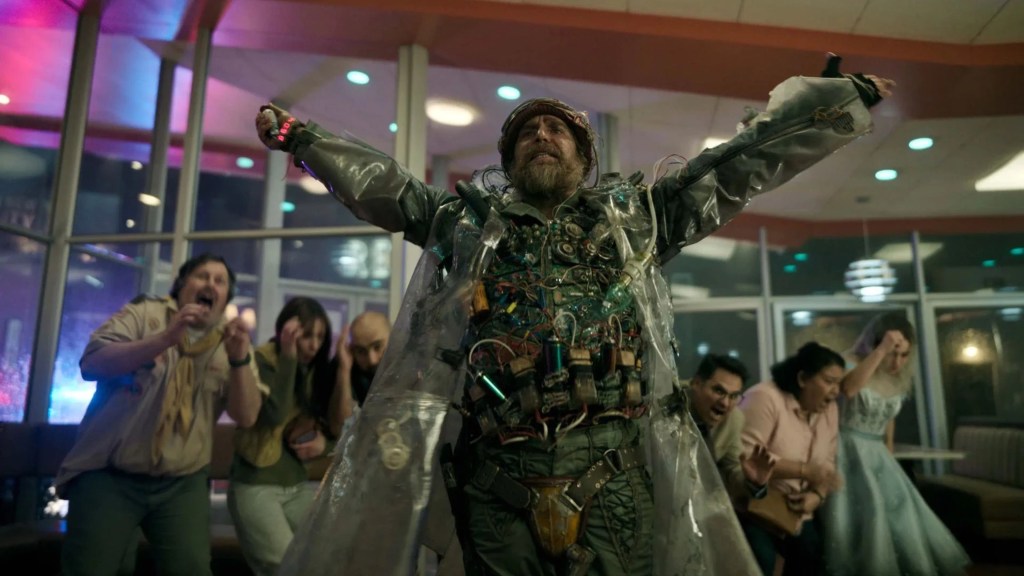
Imagine the following scenario: a man dressed as though he had unsuccessfully auditioned for a stage revival of 12 Monkeys or Brazil (that’s Sam Rockwell) walks into a diner and announces to the crowd that he has come from the future and that he requires a number of volunteers to join him on a mission to save the world. After some huffing, puffing and banter suggesting that it isn’t the man’s first rodeo and that he might be on a Groundhog Day-esque time loop bender, a team is formed comprising of: a pair of teachers (Michael Peña and Zazie Beetz), a lonesome middle-aged woman Susan (Juno Temple), a reluctant young adult allergic to technology (Haley Lu Richardson) and a few stragglers, most of whom end up dispatched for plot reasons at some point in the story. The fellowship then proceeds to find a house in which it is alleged that a little boy is building a powerful AI and the time traveler’s mission is not to stop him in his tracks (because apparently the AI will emerge elsewhere as a natural consequence of the natural order of things) but to install a key safety update concocted by tech engineers of the future. Which means that at some point during the climax we would be looking at a struggle to dramatically insert a USB stick into some kind of device. Which we do.
While the troupe makes their way out of the diner and through progressively more ridiculous obstacles, the filmmakers find time to flash back into the lives of key team members, in order to (1) enlighten us about their importance to the story, (2) foreshadow the use of certain skills, devices and other McGuffins, and (3) inject the film with direct satirical commentary about the world at large and a small handful of technology-related issues. In effect, the movie becomes a quasi-anthology movie built out of a small number of episode of Black Mirror wrapped around a narrative core that wants to bring all these ideas together while also delivering a climactic adventure and hogtied using plot as butcher’s twine.
Thus, you might surmise that Good Luck, Have Fun, Don’t Die is trying to do a lot. Indeed, you would be right. You could even say that in isolation some of its ideas or stylistic devices might be considered quite intriguing. After all, there must be something to be found in a movie described by the filmmaker himself as a product of inspirations drawn from Repo Man, Dog Day Afternoon and Akira. But you would be wrong because all those inspirations, ideas and wrinkles are completely devoid of nuance and delivered as surface-level tableau meant for viewers to point at the screen and say “hey, this diner scene looks a little bit like when Al Pacino robbed a bank in Dog Day Afternoon” or “I thought that the final act with a boy tapping into his keyboard and the girl fighting a bunch of cables in slow motion reminded me of Akira.”
While apologists would likely call it “maximalist” or “dense with ideas,” I don’t think I’m ready to refer to Good Luck, Have Fun, Don’t Die as such. In fact, I’d say that it’s less “dense with ideas” than it is just “dense.” It is honestly nothing more than a kitchen sink, an over-long exercise in flinging poop at the wall and seeing if any of it would stick. To give you a good enough understanding of what I felt watching this abomination, I can only refer you to a visual of a fifty-something Gen-X-er who grew up in a boomer-derived idyll of tech-free suburbia and then developed a wholehearted distrust of anything new and digital when the digital revolution took off and the world accelerated so aggressively that it left him behind in the dust, shaking his fists in impotent frustration. Then, imagine that this discontented Gen-X-er would eventually adopt, against his will, some of the new technological advancements and shape his entire worldview and opinion of others, especially younger cohorts, based on uncorroborated snippets of opinion disguised as fact delivered to him through his Facebook feed and through the one news outlet he chooses to believe. And now imagine that the worldview shaped inside the mind of this frustrated Gen-X-er was used as a thematic basis for any and all thematic conversations encapsulated within Good Luck, Have Fun, Don’t Die.
What we have here is a tightly-packed collection (or rather an unstructured pile) of dog whistles and buzzword-laden rough concepts aimed to lampoon what the filmmakers think the world is currently like. After all, dystopian satires project into the future (or into abstract universes) what their authors currently identify around them while blowing them out of proportion sufficiently to detach the conversation from realism, but not enough to sever this connection completely. It’s a tight balancing act when done right. And it’s one that the filmmakers might not have known existed because they took a bunch of sensationalizing headlines, base-level commentary about technology and critiques of social media and ballooned it all so comprehensively that the movie became ridiculous, shallow, tedious and nearly unwatchable. Perhaps fifteen years ago when some of these concepts were still fresh enough, we would have been able to get away with superficial commentary rooted in anxiety. But now? Not a chance.
Unless this movie is aimed at fifty-somethings who would nod in silent approval at scenes in which teenagers behave like zombies controlled by their phones, kids killed in school shootings and cloned by their well-to-do parents occasionally deliver ads completely unprompted, or when relationships falter because someone chooses to live in an undisclosed virtual reality, anyone who has actually left their house, spoken to people and looked around them would know that this anxiety-riddled satire is nothing but pure hogwash. It looks poignant and serious only to those who would probably agree that “teenagers are addicted to TikTok” and “Millennials don’t have kids because they are terminally online while wasting money on avocado on toast and Netflix.” This is the depth of the thematic conversation Good Luck, Have Fun, Don’t Die has on offer. Basic, dense, cacophonous and most importantly tedious. And it didn’t even have to be that because it honestly wouldn’t have taken much to nix a handful of the myriad bullet points used to put the story together and lean into some of them more audaciously. There’s a conversation here about the simulation theory and how our reality might already be The Matrix. Equally, there’s something the movie could have said about technology manipulating us in more than just broad strokes.
In fact, I’d be able to swallow a piece of rough satire written by old people whose idea of what young people are like is wholly informed by what they would read about them in algorithmically-delivered Facebook posts and sensationalizing tabloid articles if the movie was fun to sit through and the experience somehow added up to something. But it does not.
With every single passing minute—each filled with new ideas, concepts, sight gags, cultural references and thematic nodes that barely gelled together—I felt the opposite: a growing urge to leave the cinema and watch paint dry instead. I imagined that the way this film came together must have surely involved prolonged round table meetings where a bunch of people locked themselves away for hours at a time and shouted ideas at each other, only for everyone to clap in approval and think of ways of incorporating them all. Can we have a cloning agency? Of course. We have to comment on school shootings and make at least five minutes of the film look a little bit like The Stepford Wives or Get Out. We need a bald boy from Akira. Can we have toys from Toy Story in there too? What about a random giraffe-cat hybrid? Naturally. But can we have a unicorn? No. This would cross the line. Unicorns are too much. What were you thinking?
As a result, Good Luck, Have Fun, Don’t Die is an infuriatingly tedious movie operating on such a nuance-free level that I wondered for a brief second if it had been written by an algorithm, prompted by that Gen-X-er angry at the world because technology has left him behind. But I’m probably wrong about that. It was made by people. People who thought they were doing something smart. Who engineered what they saw as a modern satirical spectacle that probes our relationship with technology and might force us to rethink our trajectory.
Unfortunately, it just won’t work because maximalist dystopian satires of the kitchen sink variety are scarcely successful. Those that do work succeed on the back of their nuance and detailed conversation embedded underneath the seemingly superficial mess. And it’s most definitely not enough to breath depth into such a dense scenario if all you can muster are broad generalizations, sensationalist headlines, rage bait and random pop cultural references that don’t even work together. Instead of inspired deconstruction of our relationship with technology, AI, social media and each other, Good Luck, Have Fun, Don’t Die is nothing but Play-Doh that was left on the window sill on a sunny day—a shapeless blob that is completely unrecoverable, impossible to have fun with and therefore destined for the bin. It makes Everything Everywhere All at Once, a movie I passionately derided, look well made and insightful in comparison. Slop is what it is.

 Flasz On Film
Leave a comment