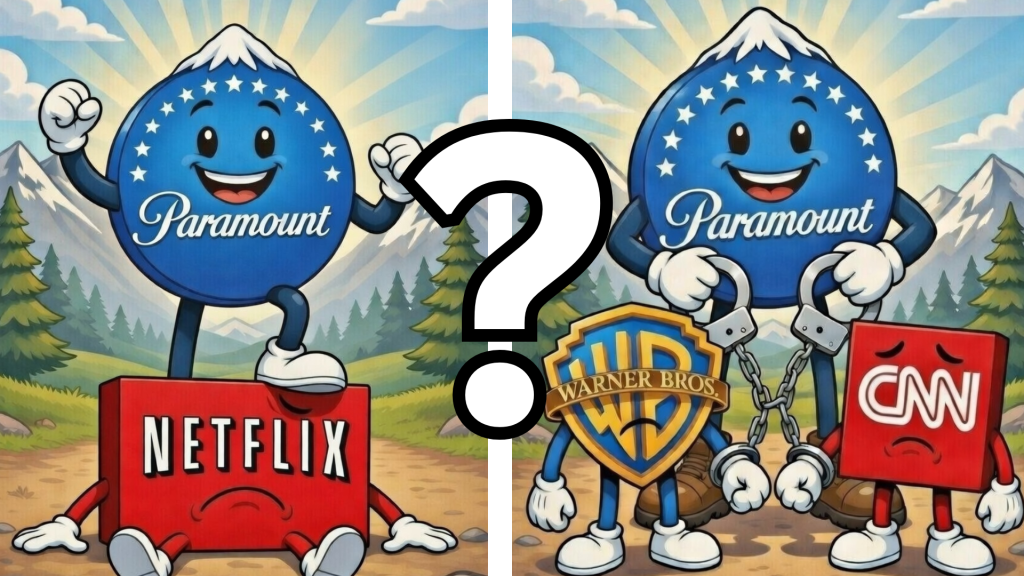
This Thursday Variety and other trade outlets reported that it was all over. The chamber drama about the future of Warner Bros Discovery arguably came to an end when the Netflix leadership announced they were withdrawing their bid having surmised that matching Paramount’s offer of $31 per share made the deal no longer financially attractive.
This announcement sent ripples through the industry and at least in some circles sighs of relief were heard. After all, crippling uncertainty was temporarily replaced by a more targeted fear of what’s to come. Hollywood is no longer petrified by the idea of having to rationalize which of the two evils was lesser: the prospect of seeing the industry disrupted by Netflix, a streaming giant who sees cinematic exhibition as outdated (despite their continuing assurances that they would not upend WB’s business model), or the possibility that Paramount Skydance while acting to look like a saviour of cinemas would seek to undermine freedom of expression by dint of their affiliation to the Trump administration.
It is now abundantly clear, especially in light of comments surfacing in the press, that the current US administration overtly favoured Paramount’s bid. Although the publicly discussed reasons surrounding the threat of the Netflix deal triggering concerns about fair competition in the streaming market were definitely valid and would have most likely triggered antitrust proceedings in the event the deal had gone through, The White House sure looks as though they wouldn’t make as much of a fuss if Paramount were to win. Now the waiting game starts and the nearest weeks and months will help us understand just how deeply political this merger has been. In fact, it may have been brought about either at the request or with tacit approval of the Trump administration even before Netflix officially entered the fray because Paramount had made an unsolicited offer as far back as September 2025, which forced WB to auction their business to satisfy their fiduciary duties towards their shareholders. It is now clear, based on comments from CNN staffers and people close to the deal, that it has long been Trump’s vengeful mission to eliminate CNN as his adversary, by whom he claims to have been always treated unfairly.
So, in contrast to what’s reported in the press, the saga is far from over. In fact, the real drama might be just beginning and it will be painted in purely political colours. While the US administration saw the Netflix bid as problematic because it would definitely brush against antitrust guardrails in the streaming space, very little is being said about what Paramount merging with WB would do to the current market division in the theatrical environment. Based on their recent box office records and release slates, the combined entity would have generated around 30% of last year’s box office revenue while eclipsing Universal and Disney’s output in terms of numbers of releases. The post-merger space would split the market neatly between Disney, Universal and the new Paramount Skydance Warner Bros Discovery entity (for which they would need to find a new name because the alternative is frankly ridiculous), while leaving only a small piece of the pie to be divided between smaller players like Sony, Amazon MGM, A24, Netflix and others.
In the long term, we might be looking at smaller distributors and film producers being eked out of this space, financially undermined by infinitely bigger and more powerful oligarchs and eventually swallowed whole in hostile takeovers when sufficiently weakened. Therefore, this merger should be looked at from the perspective of competition laws and when it does, the fight will become political. You can probably expect that the push against the deal will come from the blue side of the political spectrum, while the GOP would press against it using most likely their entrenched culture war tactics. It might become a war between an possible incoming constriction of the freedom of expression in the media space and “Trump-deranged wokies” wanting to dismantle one of the foremost pillars of American projection of culture and influence, the film industry, by allowing it to fall into the hands of disruptors whose values are far from what they’d paint as traditionally American.
In the medium term, Paramount’s self-described mission of saving the industry might prove orthogonal to reality owing to conflicting messaging coming out of their midst. On one hand, Paramount Skydance pledged to increase their slate to a whopping 30 new releases each year. On the other, they promised to produce savings by trimming redundancies in their post-merger corporate structure. Because Ellison’s team promised to keep WB’s movie business intact, these efficiencies would most likely be found in removing staff from support departments like finance, legal, or HR as well as sales, distribution and marketing. Logically speaking, it would make sense to keep Paramount and WB as separate organizations producing movies whose distribution and marketing would then be handled by a single unified entity under the post-merger umbrella. But the promise of increasing output while also likely having to make cuts in places responsible for marketing this output just does not track at all. Achieving more with less rarely works. And although many executives today think that productivity can be increased by waving a magical AI wand, the reality of it happening and increasing long term sustainable productivity remains elusive. You’d be surprised just how many senior leaders running reputable companies believe that AI is a button you press to make a magic money tree sprout into existence and get their shareholders to stand up and clap.
Finally, in the immediate future, uncertainty is unlikely to dissipate. The deal will take months to clear and political and regulatory opposition is certain. This means that until the takeover is formally agreed and legally rubber-stamped WB might mothball a number of projects, delay some others, freeze their plans and effectively slow down. Which would be quite devastating given that their recent results were more than respectable. So as Paramount wants to be seen as saving the industry, this action might immediately turn into the exact opposite: fewer releases, fewer indie acquisitions and less revenue. Meanwhile, opinion-creating heavyweights at CNN might already start looking for a landing zone from what will become a reformed and more right-leaning entity because it might be a matter of time before their new overlords would install someone less critical of the Trump administration at the helm, much in the vein of what happened at CBS where Barri Weiss was appointed as Editor-in-Chief.
Thus, despite brief respite from uncertainty, even more uncertainty seems to be in store for this unfolding saga. Hollywood might become a brand-new epicenter of culture wars and the net result will either lead to further market consolidation, continued threat to the movie distribution and exhibition and even setting up a dangerous precedent where a potential breach of competition laws will not be decided on the grounds of the law but rather along the lines of behind-the-scenes political affiliation with the US administration dreaming of transforming itself into an absolute monarchy.



 Flasz On Film
Leave a comment