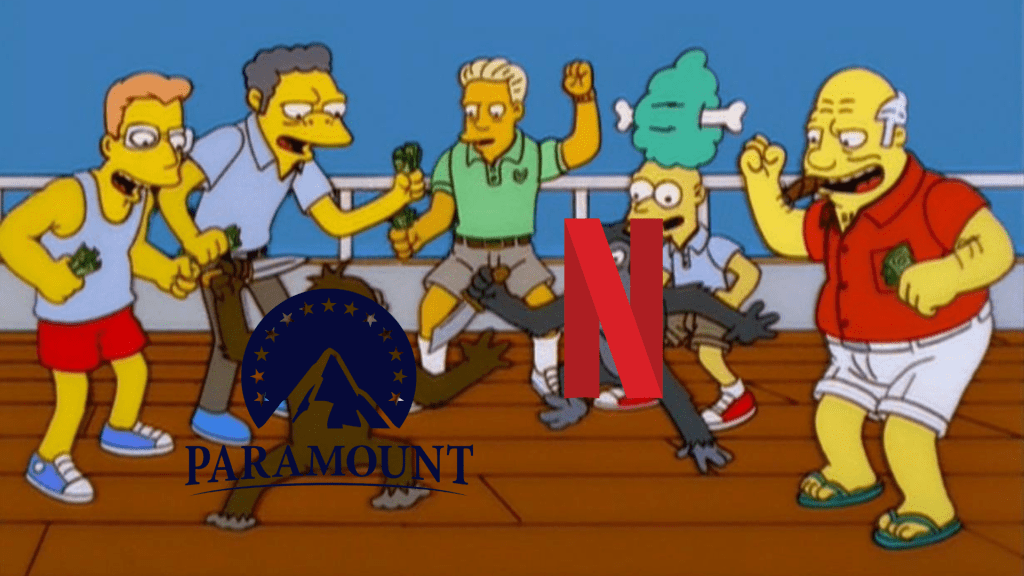
To an outside observer, the slowly unfolding drama involving the fight between Netflix and Paramount Skydance over the future of Warner Bros is at best a single melody hidden within the overwhelming cacophony of the relentless news cycle, or perhaps even a clear-cut case of what kids would call a nothingburger. After all, why should we care about who ends up owning WB? Why do some people take stances in this fight and how does it even stack up to such news items as the resurgent American imperialism, Iran slowly boiling over, or Putin’s growing territorial ambitions?
That’s right—in the grand scheme of things, the bidding war between Netflix and Paramount doesn’t matter anywhere near as much as the scandal surrounding the release of the Epstein files or Trump’s immigration raids. But it matters nonetheless.
Ever since it was first reported in early December 2025, I followed this case with interest, predominantly because I saw Netflix’s ambition to acquire WB initially as a bid to ensure their survival in the long term (because in contrast to other streamers Netflix relies solely on streaming as their core business) and later as a possible threat that their disruptive business practices could spell disaster for theatrical exhibitors. Even though Ted Sarandos, Netflix CEO, has continually assured the public that their intention was to keep the 45-day release window (for how long, nobody really specified or committed to anything, though), inside sources have spurred rumours that their plan was to eventually reduce it to 17 days. Three weekends in total.
Therefore, Paramount’s counter attempt at an all-cash hostile takeover was seen by some as a beacon of hope. After all, Paramount is one of the big Hollywood stalwarts so it surely looks as though their intention would be to preserve the business model in Hollywood by ensuring that WB would be run like a normal studio. Or so it would seem.
As time went on and more information surfaced, it became much clearer that the ongoing conflict—and as of this moment, WB shareholders are scheduled to vote on the takeover on the 20th of March 2026 and push the matter towards a resolution—has taken political colours. Or maybe they have always been there, but only now it has become impossible to overlook.
Recently, James Cameron sent a letter to lawmakers lobbying for them to do what they can to stop the Netflix takeover because it would, in his opinion, put throngs of people out of work, because the downstream effect of this acquisition would see theaters closed and the business model potentially completely upended. He expressed his support for Paramount to buy WB instead. This immediately precipitated a response from Mark Ruffalo who took to social media to criticize Cameron for backing a bid that could see a consolidation of power in the industry.
And this is where I think we need some context because this bit matters. First of all, if you haven’t been paying attention to this saga, the fact that a guy like Mark Ruffalo vocally took sides in this debate should be an immediate symptom of politicization of this matter. He is an outspoken progressive and an inveterate opponent of the Trump administration, which is important to what’s unfolding.
For context, I have been able to rationalize why exactly Netflix would want to buy out WB and precipitate a de facto consolidation of the industry. Deals like that are always disruptive as they result in one of the players gaining orders of magnitude of sway in the business (like that time when Disney bought Marvel Studios, Lucasfilm and eventually Fox) potentially brushing against antitrust regulations, which is also why I could understand where the resistance towards this deal originated as well. What took me a while to tease out was why Paramount would jump out of line and launch a counter-bid, other than reasons of pure opportunism. Blood in the water attracts all sorts of predators.
But there’s more to it. Soon after the tug-of-war between Paramount and Netflix began, it became clear that Paramount’s backers are politically affiliated with the Trump administration. Jared Kushner’s company was at some point implicated in this deal and the CEO of Paramount Skydance, David Ellison, is also distally connected to it. His father Larry Ellison, the co-founder of Oracle is a known Trump backer. And in fact it was reported that Paramount’s takeover bid would be backed by Ellison’s shares.
So, while on its surface the idea that Paramount would try to oppose Netflix out of the goodness of their hearts or their care for the integrity of Hollywood as an industrial construct looked quite plausible, its underpinnings may have been partisan. The question was why. Why would the Trump government and their supporters care about this takeover in the first place? And if direct orchestration is not explicitly found, why and how are these political interests seemingly converging this way?
This is where we enter tinfoil hat territory because none of the following has ever been explicitly stated. However, it remains plausible that the current US administration is more supportive of Paramount taking over WB Discovery because ownership of CNN is also on the table as part of the acquisition package. This would mean that, if successful, Paramount Skydance would own CBS and CNN, two massive news media outlets, which would also constitute a sizable consolidation of ownership in this space.
Now, ownership does not immediately translate to editorial control, but it nonetheless becomes a possibility that the Paramount leadership—likely supportive of the Republican government at the moment—could eventually interfere. At the same time, many MAGA Republicans and their supporters have long seen Netflix as a bastion of “wokeness.” It only takes a few minutes of interacting with red-cap Roganites, MAGA-adjacent redditors and X-bound trolls to see that patterns of criticism towards Netflix are frequently political and leaning towards culture war dog whistles like woke casting etc. In fact, President Trump himself has recently called for one of the Netflix executives to be fired for her allegedly anti-Trump comments.
Therefore, come 20th of March the matter will reach an important fork in the road because the way I can see it currently, there is no objectively good outcome in sight at all. Either Netflix will be allowed to triumph, which might pose a real threat to the longevity of the film industry as we know it, or Paramount will and the downstream effect might include increased consolidation of power and influence of right-leaning forces over the news media space. Either way, regular people will be the ones paying the price because either job losses will follow on the back of Netflix’s disruptive move-fast-and-break-things attitude or a viable path towards Trump-supporting forces asserting control over the disbursement of information will be carved out. Neither outcome guarantees catastrophe, nor neutrality. One path centralizes power in a streaming hegemon whose incentives differ radically from legacy Hollywood. The other consolidates traditional media institutions under ownership structures inevitably entangled with political economies. The risks are different—but real in both directions.
It seems that the words Varys uttered to Ned Stark in The Game of Thrones hold true here as well and so I will leave you with the following: “Why is it always the innocents who suffer most when you high lords play your game of thrones?”
Quo vadis, Hollywood?


 Flasz On Film
Leave a comment