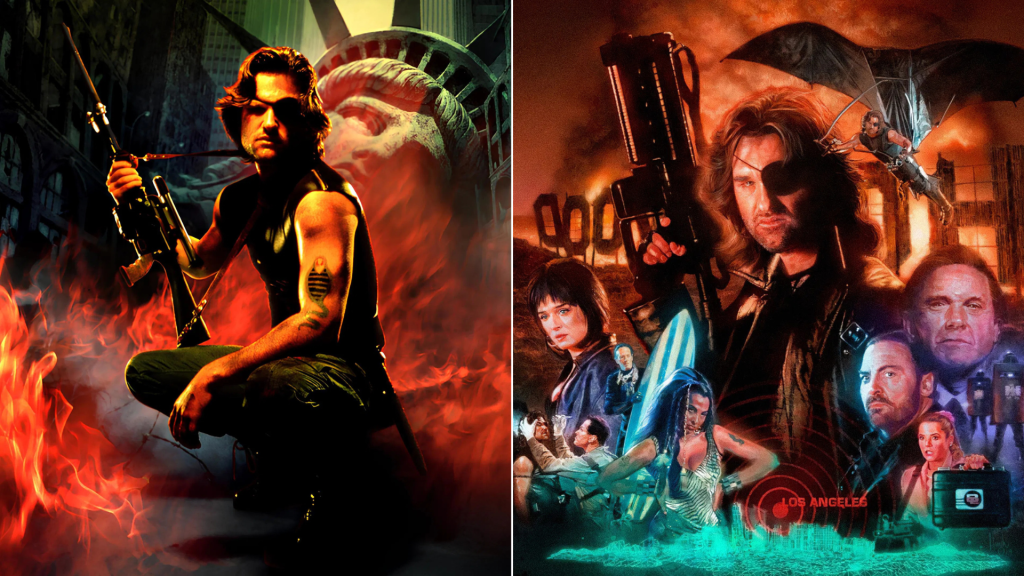
The 1981 Escape from New York remains an all-time classic of rogue genre filmmaking in the eyes of nearly all fans of John Carpenter’s work. One of his rare success stories that combined both financial return at the box office and critical acclaim, this movie introduced into the pop cultural canon one of the most recognizable 80s characters, Snake Plissken (played by Kurt Russell) and successfully capitalized on the clout of Walter Hill’s The Warriors while also forming a lovingly crafted piece of homage to Carpenter’s favourite genre of western. After all, Plissken’s characterization is largely based on Clint Eastwood’s The Man With No Name, the narrative is—among others—a confection of western tropes, and a few recognizable western stalwarts like Ernest Borgnine and Lee Van Cleef agreed to lend John Carpenter their performances, too.
But although the movie was well received and grew a cult following on home video, its footprint remained mostly tethered to what critics identified as the film’s escapist mission. It was a piece of entertainment not to be thought about or pontificated over too much. Plissken was a cool character steeped in stoic machismo—and he’s likely the inspiration behind the main character in the Metal Gear Solid series of video games—and Escape from New York as a whole lent itself to be seen as a mosaic of movie trivia for those willing and able to connect the dots to James Bond movies, 1960s sci-fi and the aforementioned westerns. But that’s it. Carpenter’s movie became a cultural item on the back of its succulent world-building, animated character development and camp-adjacent storytelling, but—at least at the time surrounding its release—very little attention was paid to the possibility that Escape from New York had something to say. Which it did because Carpenter, as those in the know will be able to attest to, has always been a socially-conscious storyteller and his movies frequently reflected grander societal anxieties. Underneath its genre garb Halloween harboured a conversation about middle-class America and its fear of the sexual revolution; They Live was a tinfoil hat-wearing eat-the-rich satire (which turned out to be way more prescient than anyone gave it credit for); The Thing, while overtly dealing with Cold War fears of the apocalypse, encased large-scale social distrust in a cabin fever microcosm; and Prince of Darkness dared ask difficult questions about the role of unchecked scientific discovery in bringing about our own doom.
And despite what critics alluded to—Vincent Canby warned that “the film is not to be analyzed too solemnly”—John Carpenter’s Escape from New York did make a few interesting observations, especially since the overarching message left within the movie continues to ring true today. It is important to remember that it wasn’t a movie that materialized out of nowhere in the wake of Halloween and The Fog, but it had originated as a screenplay Carpenter wrote in 1976, right when the US was still reeling from the post-Nixon political miasma. It was also inspired by the 1974 Death Wish in its original guise, but the script ended up in a drawer because no-one wanted to finance its production: too violent, nihilistic and strange.
Therefore, it ended up culturally displaced to some extent and staged its return when Carpenter was technically working on The Philadelphia Experiment in the early 80s. He ended up abandoning the project as he was unable to connect with the material. This was the moment for Escape From New York to leave the drawer and after some additional doctoring and rewrites with the help of Carpenter’s friend Nick Castle (who played The Shape in Halloween), the movie finally came together and was released theatrically in 1981. Right at the onset of the Reagan presidency, which made it unlikely for viewers to see it as a direct anti-Republican commentary, and a number of years removed from the Nixon crisis that spurred the creation of the original script. But the movie nonetheless captured something we can definitely tease out from the perspective of time.
Even though the crime-out-of-control dystopia anchoring the movie harked back to the 1970s and the big-picture setting was distinctly tethered to Cold War anxieties, Escape from New York remains continually prescient in its observations as it depicts how authoritarian right-wing forces operate in pursuit of asserting total control over their population. The world of the film, set in 1997—not-too-distant future for Carpenter at the time to make the social commentary “stick” but sufficiently removed to allow the filmmaker to include science-fiction elements whenever it was convenient—was a grim extrapolation of America enveloped in a vaguely described global conflict abroad while tightening a noose of complete domestic authoritarian control. It was a police state in which New York was turned into a self-governing penal colony while the rest of the country, as it was alluded to in the opening and in throwaway lines of dialogue here and there, was likely an Orwellian surveillance state.
The filmmaker’s own anti-establishment leanings were set against this backdrop and encased in Snake Plissken’s character. He was a guy who didn’t trust his government at all and had serious moral reservations against going into the hellscape of New York with a mission to retrieve the president and his briefcase. Thus, the viewer who chose not to listen to critics insisting on interacting with the movie purely as an escapist fantasy were able to tease out a rough cultural commentary dismantling what we can easily see now as long-standing Republican tendencies towards law-and-order-at-all-cost authoritarianism and political deflectionism using foreign policy crises as excuses to remove people’s liberties, while also clearly stating that anarcho-socialism rooted in survival of the fittest was not a viable alternative either.
In short, Escape From New York was positioned as an exercise in libertarian badassery underpinned by stoic machismo plucked out of spaghetti westerns that stood in opposition to both ends of the political spectrum. What it stood for was a little inkling of hope that genuine human decency would return to public life. The president (played by Donald Pleasence), totally emasculated and humiliated by the ruthless anarchists from whose grip he was rescued by Plissken, was offered an olive branch. Snake asked the president for a minute of his time, specifically to tease out if there is any compassion and understanding to be found behind the eyes of the Leader of the Free World, but he found none. He was dismissed with a well-rehearsed compliment, an example of politician’s gratitude. As a result, Snake played a trick on the world of big politics and destroyed the tape the president needed to use as a piece offering in pursuit of world peace. What is the point of world peace if it perpetuates and solidifies a political class that is wholly disinterested in the population they are supposed to protect, care for and lead.
However, the message—which I see quite clearly from where I am sitting now—ended up overlooked, likely because it was read as an evocation of western tropes. But it was there.
In fact, its existence is rendered so much clearer when viewed with the aid of Escape from L.A., the 1996 follow-up to Escape from New York. Funnily enough, this movie was almost completely dismissed upon its release because it was seen as a rehash of the original that didn’t add anything of import to Snake Plissken’s mythos. The filmmaker himself, who had been repeatedly asked about a follow-up to the 1981 movie, was openly apprehensive. He didn’t like what Halloween was turned into and scoffed at the idea of potentially infantilizing and undermining his movie with a sequel… until he found a way that was suitable for him and which also harked back to his own western proclivities.
Just like Howard Hawks, who revisited the template of Rio Bravo with El Dorado and Rio Lobo, John Carpenter treated his return to Snake Plissken’s adventures like a western-esque remake. Ironically, this is what drew the ire of critics and audiences who saw the movie as more of the same, but this is also exactly why Escape from L.A. adds immense value to Escape from New York and further contextualizes the filmmaker’s prescient distrust of authority. It is paramount not to watch these movies in isolation—though it might be a challenge to some to experience them back to back, because of abundant similarities—but to remember which elements persist, and which ones are different. That’s where the commentary is.
It is once again worthy of note that although Escape from L.A. looks and plays like Rio Lobo did to Rio Bravo, it is narratively speaking a sequel. Snake Plissken’s escape from New York is a part of his past, just as his other undisclosed, allegedly legendary exploits, left dangling in front of Hollywood moguls like a low-hanging potential franchise starter. But the world has seemingly changed. We no longer hear a word about a global conflict raging abroad. Maybe this is simply a byproduct of the fact that in 1996 the Cold War was no longer a primary driver of foreign policy, and was largely replaced with decentralized terrorist networks funded by a handful of rogue states. America’s enemy was not a state, but an ideology. At the same time, the country was described in more granular terms: no longer as a vague police state but rather as a well-defined Christian ethno-state founded on outright white supremacy. In Escape from L.A., the prison exclave formed in the wake of a devastating earthquake was no longer a measure to contain rampant crime, like in the 1981 film. It was not a case of putting up a wall around an out-of-control criminal underworld, but rather a convenient location to deport undesirables.
While the main narrative thrust remained largely symmetrical—from the mission to retrieve a McGuffin to setting Snake as a macho outsider capable of commenting on both the far-right dystopia of the mainland and the communist-adjacent anarchism witnessed in L.A.—it became possible to see how the storyteller’s own leanings had evolved in the fifteen years separating the two films. This is no longer a loosely-woven post-Nixon paranoia. Escape from L.A. outlines startlingly well the road map towards the far right dystopia that America is turning into right now, in 2026. What changed?
I can only surmise that three Republican terms, the AIDS epidemic and the 1992 L.A. riots must have had something to do with how the film’s social commentary has evolved. Plus, the L.A. setting allowed the filmmaker to make a few choice comments on the West Coast culture and its own self-destructive trajectory, mostly left in ancillary world-building and tertiary characters, such as a stop-over at the lair of the organ-hunting plastic surgeon and the bustling-yet-unstable sin city of downtown Los Angeles.
What matters to the overarching thematic conversation is how the bits of the narrative that remained symmetrical have evolved, like the big-picture politics and the overtly repressive nature of the state that is so unwelcoming to immigrants that it offers them a choice of being sent to L.A. or mercifully executed on the spot. These were not off-the-cuff elements of world-building or symptoms of satirical camp. Heavy-handed as it may have been seen—and Carpenter was not known for thematic subtlety either—the two Escape movies outlined a discernible trajectory towards dystopia that America would follow if Republicans were left unchecked. This is not an accident; it’s foresight in a genre trench coat. After all, it’s hard to watch Escape from L.A. now and not see the bone-chilling symmetry between the world-building depicted in the movie and how Trump’s America is being shaped currently.
Therefore, viewing Carpenter’s movies as just genre experiments rooted in nostalgia for westerns and classic cinema the filmmaker grew up watching is dangerously reductive. These action-laden sci-fi westerns where Kurt Russell gets to pretend he’s Clint Eastwood are much richer in subtext. Their anti-establishment messaging is only vestigially present in the central character, who reveals very little about himself, but it’s there. Meanwhile, the most crucial elements of their prescience is encapsulated in the world built for the purposes of these adventures. We can easily see how right-wingers find enemies within to distract from their own corruption and how these enemies change with time, depending on circumstances. The far-right dystopian playbook is laid bare when Escape from New York and Escape from L.A. are superimposed upon one another and the viewer is allowed to recognized both repeating patterns and deviations from symmetry.
Still, the take-home message persists. Much like in They Live where the answer was to expose alien ghouls and give them the finger, Snake Plissken advocates complete disobedience and distrust of authority resulting in catastrophic damage to law and order. Endangering a fragile nuclear armistice is worth it because the incoming peace would only tighten the authoritarian noose on the domestic population. Equally, the devastating technology Snake was asked to retrieve in Escape from L.A. was worth deploying instead of handing it over. The idea to launch a worldwide EMP that most assuredly knocked back humanity by a few centuries seemed like a viable alternative to an Atwood-meets-Orwell enthno-nationalist dystopia. Corny as it may have been—after all, Escape from L.A. is remembered for its surfing sequence mislabeled as shoddy and the basketball evolution of the wrestling match from the first movie—the 1996 film is required to see just how granular and well-defined the filmmaker’s social commentary was in both movies.
Sure, you might have your favourite among the two, but both films remain important. Not for their western provenance or escapism, but for what they had to say about the world as the filmmaker saw it and for what they told us would happen in the future, which is now our present. Which only goes to show that Canby’s call not to read into the movie he saw in 1981 was at the very least premature, and most likely completely misplaced.



 Flasz On Film
Leave a comment