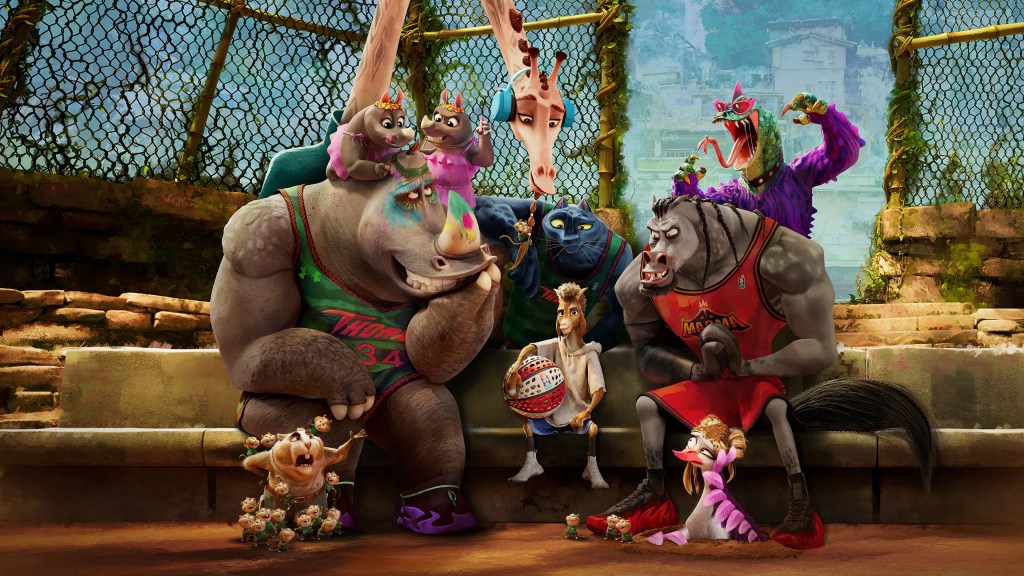

Synopsis: In a city of anthropomorphic animals, struggling diner worker Will Harris gets a shot at his dream when a viral clip of his street roarball skills earns him a place on the failing Vineland Thorns—much to the fury of his idol, star player Jett Fillmore. As the team rallies toward the playoffs, betrayal by their owner and Jett’s fear of losing her fame threaten to tear them apart, forcing both players to confront their pride and loyalty.
From the animation studio that gave the world two successful Spider-Verse movies and more importantly the last year’s cultural phenom KPop Demon Hunters, along comes GOAT, a totally inoffensive and wholly engaging piece of family entertainment of the kind you most certainly have seen before. After all, at this point it is honestly a fool’s errand to expect a big budget film aimed at all four quadrants of the viewer spectrum to try and rock the boat in any appreciable way.
And it’s fine. As long as the spectacle is appropriately calibrated to engage older kids without necessarily overwhelming the younglings too much, the visuals are nice and colorful and the story develops an emotional core—which isn’t all that difficult provided that the filmmakers don’t scoff at age-old archetypes—everything will turn out OK. That’s what GOAT is: an OK piece of family-friendly spectacle whose main selling point is its hyper-stylized visual toolbox, a clear evolution of the studio’s signature aesthetic you might remember from Into the Spider-Verse for example. Indeed, the movie is just pleasant to look at. Purposefully jittery in places, kinetic in others and aptly detached from the industry norm set by Pixar and Dreamworks, it’s just a film that is easy on the eye.
Other than that, you’ve seen it all before. An iteration of the archetypal hero’s journey where we follow a scrappy anthropomorphized goat as he gets a shot to join a professional team of appropriately spectacularized evolution of basketball, GOAT has all the makings of a well-oiled underdog sports movie. In fact, it ticks nearly all the boxes to satisfy its parameters. William is a tiny animal, hence an underdog recruited to join a team of under-performing has-beens and never-wases. The goal of winning a championship is seemingly out of reach. The opposition looks unbeatable. And then we do the traditional dance routine of winning approval of apprehensive teammates, going through the motions, developing a resolve to win at all costs, suffering a massive setback and heading towards an expectedly climactic resolution underpinned by textbook catharsis. As I said, it’s all there. GOAT is a movie that knows the playbook and crystallizes into existence to extend the tradition dating back to Hoosiers, Major League, The Mighty Ducks and Space Jam, not to mention Karate Kid and Rocky.
Is there anything at all that sets GOAT apart here? Not really. It’s an execution of a tattered storytelling standard where the filmmakers know what needs to work and where, how the beats are laid down and what the tempo must be to make sure people both recognize it and also find it worthy to stick around and see it unfold until the end. And they have no reason not to because the canonical underdog sports movie is inherently watchable and you have to work really hard to make one that doesn’t resonate as intended. And the job is even easier simply because the movie is specifically aimed at younger viewers who are less likely to have seen The Mighty Ducks or even the original Space Jam. Exhilaration is built in and organically expected.
Plus, on top of the movie being nice and cool to look at—or, as kids would say, the animation cooks or something—GOAT seems purpose-built to resonate with Gen-Alpha viewership by dint of respecting cultural touchstones, language quirks and pop cultural references. It’s Space Jam for the generation raised alongside TikTok, enmeshed in the digital experience, complete with fully internalized usage of smartphones as embedded cultural interfaces, references to online culture etc. In fact, I may have had a little out-of-body experience that temporarily induced a mild case of age-related anxiety because I wasn’t always sure if what I was witnessing on the screen was a case of young people written by old people who have chosen not to consult their teenage kids on the matter of authenticity, or a case of young people written to reflect what young people are like. This made me realize that it is after all a matter of time before my own senses become completely blunted and out of step with the times, and I won’t be able to tell the difference. Which means that if I wanted to ever write young characters without even talking to some, I’d never capture them realistically.
But that’s neither here nor there. Summing up, GOAT is a perfectly pleasurable incarnation of Space Jam-meets-Zootopia that knows its place and understands its target demographic while keeping things even enough to appeal to essentially everyone. Thus, it is a solid day out for when the kids are on their winter break from school.


 Flasz On Film
Leave a comment