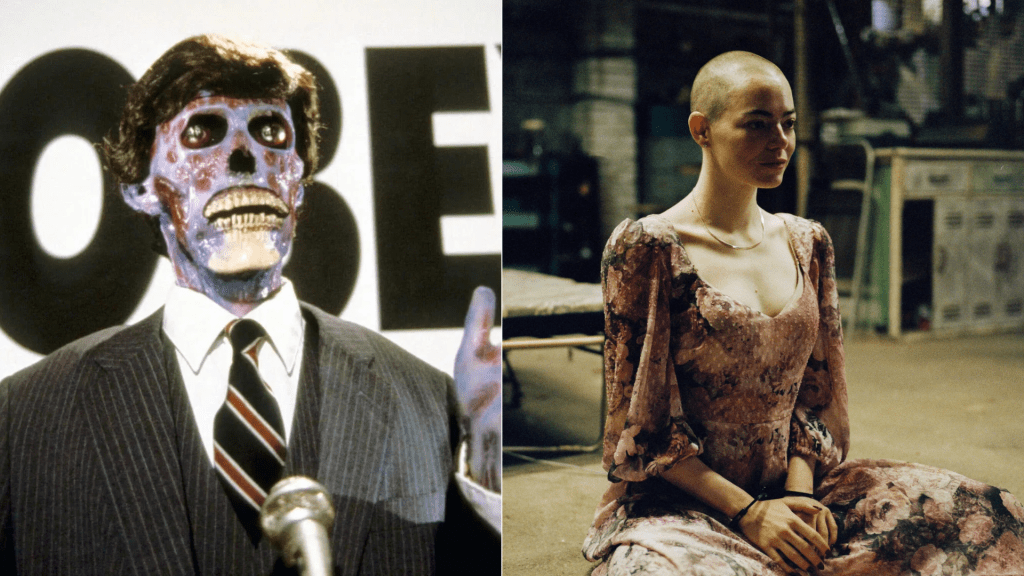
It was November 1988. John Carpenter’s They Live had just rolled out into theaters, playing across nearly fifteen hundred screens and earning a modest but respectable five million dollars in the opening weekend. With very little opposition at the box office for a few weeks—the late-year heavy-hitters Scrooged, Naked Gun and Twins would come out at the onset of December—Carpenter’s film had a decent chance to make an impact, as it mostly needed to elbow for space with the incoming Child’s Play.
But everything changed when the reviews started coming in. Among some lukewarm remarks—“watchable, although the script takes a number of unfortunate shortcuts,” wrote Jonathan Rosenbaum at Chicago Reader—scorn overwhelmed the narrative. “Once Carpenter […] makes his point that the rich are fascist fiends, They Live starts running low on imagination and inventiveness,” quipped Jay Carr at the Boston Globe. Janet Maslin at the New York Times bemoaned the film’s “flatness,” while Richard Harrington at the Washington Post accused Carpenter of “trying to dig deep with a toy shovel,” and Nick Groen at The Globe and Mail summarily dismissed the film’s “pop Orwell premise.” They Live ended up disappearing from theaters in a manner of weeks, only to be rediscovered and cherished on home video.
The cult behind They Live is not a matter of dispute here: like many John Carpenter gigs—The Thing, Prince of Darkness and Vampires—that were overlooked upon release or openly derided by the critical community, this science-fiction satire would gain a life of its own eventually. The sheer combination of the accessibility of its storytelling, quotability of its dialogue and the cool-factor ingrained in the central premise of a pair of shades unlocking the ability to “see through the code” and understand the world for what it really was played very well into the natural proclivities of general audiences. It was The Matrix of the Reagan era that capitalized on Carpenter’s counterculture anti-establishment leanings.
Though it was technically loosely based on a short story titled Eight O’Clock in the Morning by Ray Nelson, Carpenter deviated from the text sufficiently to earn the right to insert the iconic “John Carpenter’s” in front of the title as he wove a tale in which an unassuming drifter looking for work and hoping to achieve success through his hard work found out that the world was secretly run by alien overlords hailing from Andromeda. Using subliminal messaging, corrupted TV signals and other means of mind control, they kept the masses in a perpetual consumerist slumber while they secretly terraformed our planet for their own benefit. And as far as the movie’s protagonist saw it, he was all out of bubble gum so the only way forward was to kick ass.
John Carpenter’s work rarely received raves from critics—and the cantankerous scrapper with his potty mouth matching his film IQ probably never cared about their opinion either—but They Live seemed to have been dunked on both prematurely and maybe completely wrongly. It certainly looked as though those pesky analysts didn’t appreciate the idea that a measly peddler of low-rent exploitation—as many saw his work at the time—seemingly tried to make a movie with something to say. And additionally, that the stuff he had to say was laid out in the open in the movie and accessible to everyone with eyes, ears and at least two brain cells to rub together. The satire in They Live did not require a middle man to put themselves in a position of a cultural interpreter or an intellectual gatekeeper without whom the movie would remain indecipherable. The movie spoke for itself. The joke was naked, legible, vulgar. The rich were not metaphorically monstrous; they were literally inhuman.
And what it talked about most assuredly reflected the filmmaker’s own thoughts on where the world was going. In fact, Carpenter remarked once that he saw They Live as a “documentary of our time.” Now, this statement needs some qualification because the man has always been known for his propensity to self-mythologize, and filmmakers in general are often prone to hyperbole. And you might also want to apply a grain of salt or two to any statement made by anyone sitting in front of a bookcase unironically filled with UFO conspiracy books, that’s for sure (which Carpenter was when he was uttering these words). But the point still stands that Carpenter’s movies—and They Live especially—reflect an overwhelming societal anxiety suggesting that people at the highest echelons of power and influence are completely self-serving and willing to peddle lies to the public to retain status quo.
The natural response to this realization, as the movie suggested, was rebellion. In fact, the movie ended with a climax at the top of a TV station building where Roddy Piper blew up a transmitter distributing the mind-controlling signal which let aliens hide in plain sight. And, just before dying, he gave the Andromedan invaders the finger like the badass that he was. The take-home message of They Live was to fight back. To expose lies and conspiracies and allow people to rise up and reclaim their agency. But that was 1988.
By 2026, the moods have shifted. As we have moved through the intervening decades, the rebellious sentiments grounded in fundamental hope for change, which were encapsulated within Carpenter’s movie ended up slowly eroded, imperceptibly from up close. While classics like Dark City and The Matrix still spoke truth to power and championed defiance to authoritarian oversight, the 21st century would be different. Valiant goals of overthrowing the yoke of oppression or upending the system gave way to localized hope at first. Children of Men would not attempt to fix the world, but rather concentrated on the smallest victories, even too minuscule to matter in the grand scheme of things. Never Let Me Go would find humanity in sacrifice and freedom in love, but the dystopia would go on unabated. By 2013, we’d see how the Roman adage of “divide and conquer” translated into the ruling overlords inventing reasons for people to distrust one another and fragment what otherwise could be a potent force of change. The Purge series would need to go on for a few instalments before turning its attention from fratricidal carnage to anti-establishment clapback.
And by the time 2016 came along—the year of sea-change that saw Donald Trump rise to power and hatred-peddling populist voices the world over establishing a permanent presence in the mainstream of political discourse—survival was tantamount to victory. They Live would never end with its protagonist giving the aliens the finger, let alone infer a global anti-establishment awakening, if it were made then. Movies like Ready or Not, The Hunt, The Menu all suggested that the best we can humanly hope for is to emerge alive at the end of it all. Covered in blood from head to toe, hands shaking and smoking a cigarette while waiting for someone to put us out of our misery. The thought of even chipping away at the oppressive status quo completely vanished. All we could settle for was eating the rich we could single-handedly defeat, and not without ordeal.
The COVID pandemic only came as a cultural accelerant, though four years of mainstream divisive populism pouring from both sides of the Atlantic most certainly had a role to play. Between The Host, Snowpiercer, Parasite and Nomadland, oppressive systems were almost always left unperturbed. Joker offered an apotheosis of chaos and rebellion completely disconnected from hope that drove They Live or The Matrix.
Why fight, these movies asked. Why bother? We can engage in bloodshed all day and the pillars of oppression will remain where they stood, not a single crack in their marble slickness. Don’t Look Up did something earlier satires rarely dared: it removed even the fantasy that exposure of truth could alter outcomes. It told us all that we were unavoidably doomed.
In 2025 we found ourselves with at least three films continuing this cultural conversation—Eddington, One Battle After Another and Bugonia—and not a shred of culture-wide hope between them. As we fight each other, tech companies will ruin the world, says Ari Aster. The world is doomed and all we can hope for now is closeness of our kin, adds Paul Thomas Anderson, whose movie probably harks back the most to Children of Men in this regard.
Meanwhile, Yorgos Lanthimos’s Bugonia underscores how dramatically the anti-establishment sentiment has pivoted over the last thirty-six years. In fact, it is very much a spiritual successor to They Live and we can identify how far down we have spiraled by simply comparing notes. By now the media landscape has become so profoundly saturated with numerous conspiracies that whatever Roddy Piper uncovered in 1988 would have been dismissed by tinfoil pundits as cute. Jesse Plemons knew better than to believe in simple answers. He did his research. And he made the call to strike back, if only to prove to everyone around him that just because he was a loon didn’t mean he was wrong. And he wasn’t.
He didn’t have cool shades that would have uncovered Emma Stone as an Andromedan ghoul with a futuristic watch. He needed to get his hands dirty and engage in unsettling torture, which also put the audience in a completely different position. In They Live the viewer was always on the side of the guys who were out of bubble gum. In Bugonia, we were naturally inclined to disbelieve Plemons who was characterized as a crackpot conspiracist who believes in QAnon, Pizzagate and everything in between. But he was vindicated. Emma Stone’s biotech executive was an Andromedan invader after all. And we fell for her lies and obfuscation. By the time the credits rolled, instead of looking at Plemons giving the aliens the finger while exposing their conspiracies and deceit, we looked at the world destroyed by the whims of an alien race, dispassionately looking at lifeless bodies strewn haplessly all throughout the globe.
In 1988, the Reagan-induced inequality caused the culture to paint it in dystopian colours, which is exactly what Carpenter did in They Live. He told his viewers to wake up and fight before it was too late to close the widening chasm between the rich and the rest. He warned about the game being rigged, about the coveted American Dream being just a mirage, a propaganda tool keeping drones working. But his parting message was that of defiance to authority and, most importantly, hope. Now, Bugonia—which is for all intents and purposes the They Live of our generation—tells us it’s too late. The chasm is too wide. We can’t eat the rich any more. We’re too fragmented. Too distracted. Too overwhelmed. In fact, we can’t even physically access the rich at all. They just orbit well above our planet, looking down at us with derision.
They Live suggested that the truth was all that was needed. Glasses allowed you to see it, like a red pill protoplast. Meanwhile, Bugonia shows that in the intervening years and decades we have stopped trusting the evidence of our own senses. Truth became contestable. Perception and spin were all that was left. Carpenter told his story in a world that was largely governed by some rules and where systems could be overturned if the people running them were fought and defeated.
Fight is no longer an option, Bugonia infers. Systems are self-sustaining, self-healing, self-perpetuating. Nearly all modern dystopias confirm this. Resistance is truly futile because corrupt systems breed new villains to run them. They are impervious to rebellion. Aliens are not only winning—they’ve already won. But it’s important to remember—and John Carpenter would definitely agree with this sentiment—that we can always give these Andromedan ghouls the finger.

 Flasz On Film
Leave a comment