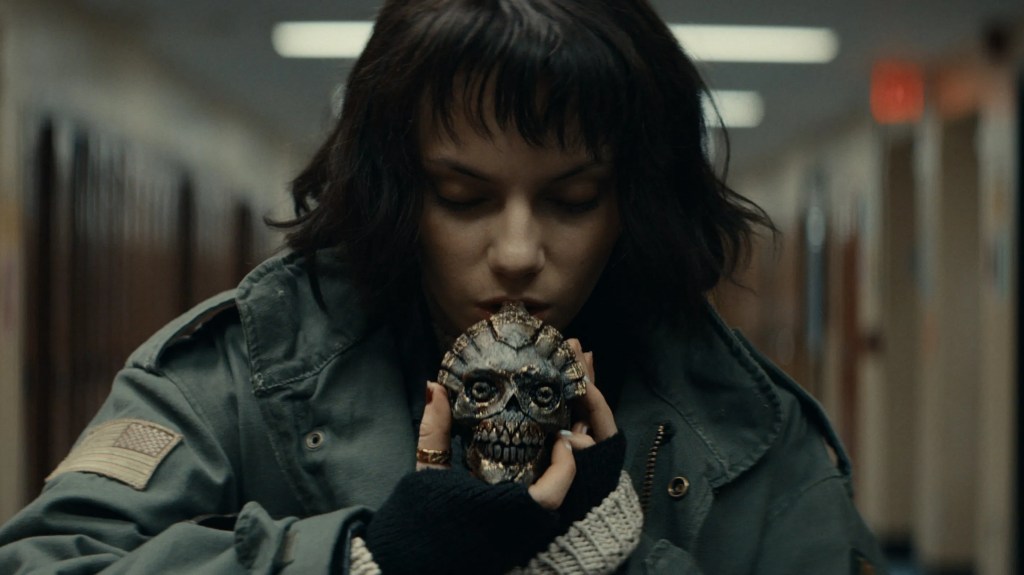

Synopsis: After a high school basketball star dies in a spontaneous, fiery hallucination, a troubled new student inherits his locker — and the sinister skull-shaped whistle hidden inside. What begins as a curiosity spirals into a series of personalized, inescapable deaths, as the teenagers uncover the artifact’s true meaning: it doesn’t summon the dead, but the listener’s own demise.
I walked into the screening of Whistle, the newest directorial effort from Corin Hardy (known for the Conjuverse offshoot The Nun), full of vim and vigor. After all, the doldrums of winter is the time for those under-the-radar genre gems, those in-and-out lean roller coasters of raw exhilaration that are just about solid enough for this time of the year and not quite A-star to fend for themselves as summer counter-programming to McBlockbuster extravagance. Unfortunately, I fell victim to that toxic combination of suggestive marketing and my own tendency to extrapolate from incomplete datasets. I assumed—silly me—that because Black Bear Pictures had put their weight behind some genre movies from the recent past that I happened to enjoy (like Longlegs, The Monkey and Immaculate), I’d be settling down for a nice and tight ninety-or-so minutes of suspense and scares. Little did I know that I was walking into a trap instead.
In fact, it didn’t take long for Whistle to show its hand. The cold-open basketball sequence left enough tells for me to figure out how the entire movie was going to play out and it was only downhill from there. It was clear as day that the filmmaker’s intention was to tap into some kind of nostalgic frequency here as the opening shots suggestively set up that recognizable 90s teen slasher revival vibe, which happened alongside establishing the key supernatural phenomenon that would become anchor of the narrative. We saw teenage banter, heard pop rock music beats in the background. And then—screeeeeech!—a non-diegetic scare! Shrouded in smoke, a figure on fire shows up in front of a guy as he scores the winning points before running into the locker rooms in fear. And—waaaahmp!—another non-diegetic score! A cacophony of violins, synthesizer noise and Jesus-only-knows-what-else jolted me once more. And again. And again. And again.
This entire movie was composed using nothing but non-diegetic tools to generate jumpscares, which only goes to show that either the story didn’t have the muscle to prod me into alertness on its own when it mattered or the filmmakers didn’t trust their own ability to deliver. Or maybe they didn’t care about putting any measurable effort in this department at all because they were instead completely ensconced in crafting what they thought was a self-aware play full of metatextual references to other horror movies that was supposed to function on a similar plane of interpretation as Wes Craven’s Scream. Well, it doesn’t. In fact, Whistle functions as a low-effort stab in this space, a derivative knock-off that is structurally and mechanically incapable of looking compelling or authentic enough to disguise its thrift store smell.
Hence, everything that happens in the movie looks a little bit like an unfunny parody: a movie that desperately wants to be serious about everything it is doing despite being too fundamentally shallow to stand firmly on the merit of its storytelling. Not unintentionally indulgent enough to cross over into camp (like The Monkey) and nowhere near as visceral to frighten and unsettle in earnest (like Smile or Smile 2). Everything is perfectly predictable and poorly concocted here. The cast of protagonists (Dafne Keen, Sophie Nélisse, Sky Yang, Percy Hynes White and others) all look and behave as though they belonged in a high school stage adaptation of The Faculty and the story itself unfolds just like an abridged adaptation of Final Destination with a slightly less outlandish gimmick. In Whistle, death isn’t a formless construct but rather a curse, but it still follows rules that are at one point shamelessly laid out by a secondary character.
Consequently, the feeling of watching Whistle consists of randomly jumping in a dissatisfied way at cheap non-diegetic scares, reacting to worn Conjuverse tropes and occasionally saying “it’s cute” when it is mentioned that a teacher played by Nick Frost was called Mr. Craven, the local steel mill is named after Paul Verhoeven, and Sky Yang in one scene looks a little bit like a low-budget re-enactment of Brandon Lee’s iconic Eric Draven from The Crow. Plus, you might derive some base pleasure from the fact that the movie does in fact play out like a mixtape of tropes pulled out of Final Destination movies, Flatliners and a bunch of other genre staples from the era. And finally, exactly two kill scenes in the film look quite cool. But two honestly interesting sequences do not make a successful movie, unfortunately. Not at this level.
In fact, Whistle doesn’t even look like a real movie with a script that someone spent time and effort putting together and populated with characters driven by anything more than plot-related reasons. It looks jarringly fake, but not purposefully so. Try to remember what the fake Stab movies-within-a-movie in the Scream franchise looked like. And then go a level deeper and imagine what a fake movie within the Stab movie would look like. That’s where Whistle lives, but within a framework of a different franchise. It’s a fake movie watched by fake characters in a fake movie that the characters in one of the Final Destination sequels would watch. It’s an unsalvageable mess that is neither scary, suspenseful, funny or upsetting. Well… it is upsetting in that I left the cinema with my head in my hands vowing right there and then to commit one thousand words towards discouraging anyone brave enough to read my work from seeing this unmitigated travesty.
 Flasz On Film
Leave a comment