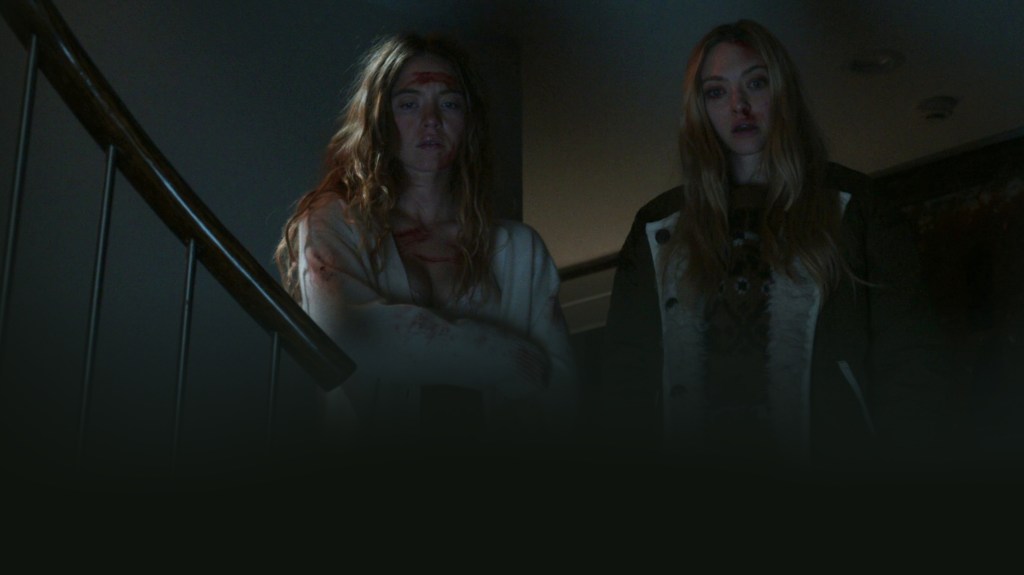
“This is how you allow her to dress for her father’s funeral,” Says Evelyn Winchester in a scolding tone to her now ex-daughter-in-law Nina at the end of The Housemaid, a late-2025 hit that has recently been made available to stream at home. Having discombobulated and frightened a small group of mourners with an off-the-cuff micro-soliloquy about the importance of teeth, she turned to her son’s widow and offered nothing but cold dismissal. Characterized to evoke rather straightforward connotations with Cruella De Vil with her short white I’m-a-socialite-and-you-are-not hair, corpse-like foundation and a piercing stare of Disney’s Evil Queen, Evelyn Winchester made it abundantly clear that she wanted to part ways with the movie in a show of unbridled dominance. Nina, briefly taken aback, only offered a zipped-up half-smile that said very little more than “bitch, what did you just say to me?”
But that was it. The film then moved onto its epilogue with a mission to establish a possibility, or—given the film’s remarkable financial success and box office staying power—a dollar-tinged certainty that a sustainable franchise could be spun on the back of it all. After all, there are more books to adapt where this one came from.
However, what irked me was that one slight moment of dramatic dissonance. Having just dealt with Nina’s violent and abusive husband in a way that he surely deserved, it was clear to me that some ends were left loose and dangling because all throughout the film we could pick up on hints and suggestions that Andrew was not the only villain in the movie. He was the Darth Vader of this scenario: a powerful foe whose defeat required two women to join forces and manufacture reality much in the way he did to keep his partner in a controlling vise before they could dispatch him in a flurry of violent struggle once and for all. But while Andrew’s violent acts, controlling behaviours and abusive tendencies were self-authored insofar as it is every human’s decision to impact upon their surroundings and affect people around them, the story left no doubt that his villainy was carefully nurtured by his mother, who—as that final remark of hers towards Nina suggested—clearly had her knives out for any and all women who would enter her golden boy son’s orbit. Thus, the movie let Palpatine off the hook and allowed Evelyn to live out the remainder of her life unbothered and likely engaged in Machiavellian tyranny over other people in her gravitational pull.
“A boy’s best friend is his mother.” Norman Bates’s words gave Janet Leigh’s character what she thought was a picture of a well-raised, if not slightly timid man, not knowing that the man in question was a violent schizophrenic about to stab her to death in the shower. A man whose controlling abuser we never get to see in action; what we are privy to is second-order effect of child abuse that likely nudged Norman Bates, inch by inch, towards complete detachment from reality, violent sexual repression and shame that pushed him to seek women to murder. For all we knew, his violent tendencies were self-authored and explained as an outward symptom of a fractured identity influenced by maternal domination. But the picture was incomplete because Bates was the only person left to answer any questions and, sadly, his answers would have always been marked by ambiguity on account of his wholly degraded mental state.
It is quite remarkable that, as far as storytelling and cultural ubiquity go, we are far more likely to notice and correctly identify villainous characters whenever they engage in direct acts of violence or abuse, be it when it relates to would-be victim protagonists or even their abusers. We can easily discern character archetypes that showcase how violent tendencies are passed onto victims or evoked in them through neglect or abuse. We can identify a brute father archetype, a repressed tyrant, a devouring mother, a jealous stepmother. We can see how Carrie White’s repressive upbringing most certainly contributed to her lashing out in the final act of Carrie. Jack Torrance’s violent tendencies and attitudes towards women are explained partly—not excused!!—by how his father treated his mother.
However, the picture seems to become more complicated and perhaps muddled when the relationship between abuser and the victim becomes partially indirect, like in the case of The Housemaid where the direct villain was the husband and his mother was the enabler. It is important to emphasize that by bidding Evelyn farewell with an ice-cold smile does not mean that the story left the “real” villain unpunished—because that “real” villain was the husband who got his comeuppance in the end—but by refusing to even suggest that a confrontation might be in order the assumption it left the viewer with was that Evelyn was not a threat, even though she absolutely was one and many women would be able to find unsettling resonance in that final scene based on their own experiences with their husbands’ (or ex-husbands’) mothers.
Even in a completely healthy scenario, a mother having to “give” her son away into the arms of another woman can be an emotionally-demanding experience. Building a relationship with her son’s partner requires a lot of trust and goodwill from all involved. Friction is always a part of the process and it doesn’t take much for animosity to brew. Thus, these indirect relations between mothers-in-law and daughters-in-law are easily strained and can devolve into pathology whenever the mother-son relationship is coloured even by smallest hints of narcissism or other forms of manipulative abuse. Enter second-order psychological warfare between two females: one an intruder attempting to “steal” a mother’s object of control and/or worship by way of establishing a healthy romantic relationship and the other a scheming tormentor grappling to remain in control and attempting to puppeteer from a distance at all cost.
This is what The Housemaid was also about (note the use of the word “also,” not “really”) in addition to being a tale of outright spousal abuse and ramifications thereof. An evocation of the evil mother-in-law archetype that complicates with additional nuance what looked like a straightforward case of a villainous sociopath being uncovered for who he was and given a taste of his medicine. It is almost as though the film didn’t want to lean into this arguably more intriguing—yet less defined—scenario in which violence is self-authored while being enabled through abusive childhood conditioning. Whether it was because it is frankly more convenient to lean onto a simplified singular archetype while only hinting at the existence of another one lurking in the shadows, it is impossible to discern. What is clear, however, is that the story itself leaves enough room for the viewer to infer sufficient detail to tease out a conversation about the blurry and foggy cultural minefield about co-authorship of violence, second-order effects of manipulation and narcissistic abuse, and the fickle nature of personal agency in this complex differential equation.
After all, the point still stands that we are agents capable of effecting change on the world around us and therefore Andrew was wholly accountable for violence and abuse towards all women partners in his life. But it is important to remember—especially while beginning to understand the devouring and manipulative nature of his relationship with his mother—that embedded early-years value reinforcement is a potent obstacle to overcome with regard to this very agency. We cannot and must not excuse it, but we ought to understand that by confronting and defeating Andrew and then disengaging from a confrontation with his mother, Nina and her housemaid Millie only took care of a symptom and refused to deal with the system that enabled and nurtured its formation. The visible threat was gone, but the legitimizing influence—Andrew’s toxic mother—remained intact.
Arguably, this is a tricky—maybe even slippery—ground to traverse because from here it doesn’t take much for someone who has already made up their mind to diminish or completely invalidate the horror of male-on-female violence by suggesting that behind every monster stands his narcissistic devouring mother. This is not the intention here. What is intriguing, though, is that we tend to gravitate towards more easily identifiable archetypes while shifting away from those that require a nuanced perspective to fully process. At the same time, it might simply be that we are primed better to interact with kinetic first-order interactions between characters. We can easily spot a revenge narrative, a domestic abuse scenario, or a cycle of outright violence. But it becomes more diffuse and hence difficult to grasp when we are asked to pluck out distal effects of manipulation that are mostly inferred in the story and not explicitly shown or dealt with. That archetypal conflict between a mother-in-law and a daughter-in-law rarely takes form of outright hot war. In fact, many husbands—even in those completely healthy scenarios—struggle to notice animosity amassing between two women with a conflict of interest.
But I believe that it is an archetype worth discussing and fleshing out in storytelling because it draws from real-life experience. Granted, doing so in an effective and instructive way requires the storyteller to skillfully navigate numerous character nuances and thematic sinkholes, which is a tall order. And we don’t need to retroactively explain away the villainy of known monsters. Wendy Torrance was abused and stalked by her deranged alcoholic husband, not his father. But The Shining is so much deeper and nuanced for having included this detail in Jack Torrance’s characterization.
Thus, I’d look forward to the sequel to The Housemaid if it promised to come back and tie that loose archetypal thread by getting Nina and Millie to go medieval on Evelyn the Enabler, if only to show that it is as important to stand up against violent actors working within an oppressive system as it is to dismantle the system itself.
 Flasz On Film
Leave a comment