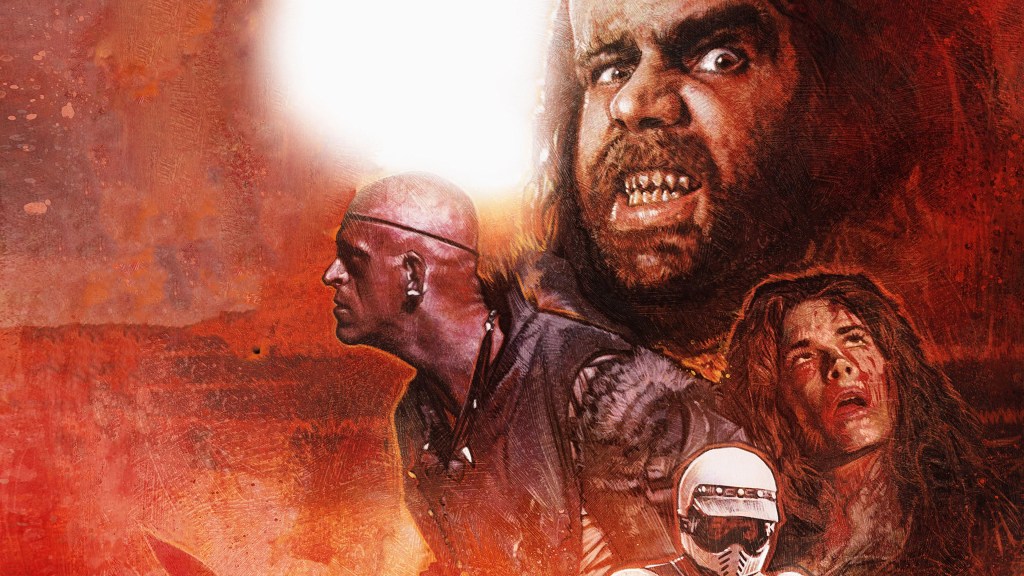

Released in 1977, the original The Hills Have Eyes—Wes Craven’s feature follow-up to his cult breakout The Last House on the Left—was his biggest commercial and critical success until A Nightmare on Elm Street in 1984. The sequel, however, was a different story. In the eyes of many it remains one of the biggest disappointments in Craven’s catalogue. And it’s not as if those sentiments were unfounded; the film hovers somewhere between god-awful and merely terrible. But there’s a little bit more to it.
Despite what some reviewers believe, The Hills Have Eyes Part II was not a poorly construed follow-up to A Nightmare on Elm Street, a movie that came to both solidify and redefine the slasher template thanks to—among others—Craven’s directorial ingenuity. In fact, The Hills Have Eyes Part II was nothing more than a gig for hire, a movie Craven signed on to direct because he probably needed money some time in 1981 or 1982, at the instigation of the film’s producers. It was most definitely a peculiar time for this filmmaker who was already far enough removed from the success of The Hills Have Eyes that he was no longer able to effectively ride on its coattails, while the money from re-releases of The Last House on the Left could only go so far. Deadly Blessing was a major disappointment and a box office failure and Craven at the time was either working on Swamp Thing or just about wrapping it up. That movie was hardly a breakout success and did little to elevate Craven’s industry standing.
Craven jumped between directing TV projects and writing for hire, and I cannot confirm nor deny if he sank low enough to return to dust off his Abe Snake alias and direct pornography for a quick buck. Therefore the opportunity to quickly squeeze out a sequel to his runaway hit from 1977—at a time when horror sequels were beginning to catch on with Halloween II, Friday the 13th Part 2, Jaws 2 and others—must have been enticing enough that Craven gave it a nod and tried his best to fit it before A Nightmare on Elm Street would go into production full steam ahead and thus consume his attention entirely.
And it shows. The Hills Have Eyes Part II was most likely written on a napkin and concocted over no more than a few evenings on the porch because very little in the movie made sense. The story didn’t really cohere and the central conceit of finding a good enough reason for a cast of characters to come back to that place in the middle of nowhere where cannibals dwelled and turned hunting unsuspecting middle-income American families with their apple pies and polo shirts into a regular pastime wasn’t perhaps given the attention it needed. Somehow, they ended up settling on pushing the story eight years into the future, gave Ruby (Janus Blythe) a new name Rachel and incorporated her into the American fabric and also made sure that Bobby (the only other survivor of the original played by Robert Houston) would only turn up for long enough to tick a box and that he wouldn’t otherwise need to be there. After all, it would be even more difficult to convince a victim of a heinous massacre to find his way to the place where his entire family was wiped out by cannibalistic mutants. What they also needed was a cast of would-be victims and some plot armour to go with it all.
So, for no other reason than because it was within the realm of what’s possible and because nobody said no to anyone when it mattered, The Hills Have Eyes Part II became a story about a former feral cannibal who became an owner of a biker team and an inventor of a new brand of racing fuel who loads her team onto a bus to go into the middle of nowhere to attend a race. And naturally they make a wrong turn somewhere, have to find a shortcut and—boom—they find themselves surrounded by cannibals, some of whom (like Pluto played by the iconic Michael Berryman) also survived the original. It doesn’t take much to surmise that not a lot of attention was paid to making sure that the story made sense. In fact, it is one of those rare movies that features a dog having a flashback, which is as funny as it is frightening to think that it was conceived as an actual idea worth inserting into the script.
And even this isn’t the end of it all. The movie ran out of money before the shooting was complete. The cast and crew had problems with Craven who seemingly didn’t care that much about making sure the movie would come together and the production wrapped with about as much material to make sure the film would run for under seventy minutes. Thus, to pad out the running time, post-production involved re-jigging some parts of the narrative and including scenes borrowed from the 1977 original. Fortunately, Craven had opted to shoot the movie in a similarly grainy guerilla style, which ended up matching surprisingly well with the archival inserts.
All in all, The Hills Have Eyes Part II was a mess from start to finish and no wonder it didn’t do well with critics and audiences alike. It wasn’t even camp enough to generate its own cult status and it has mostly survived as a tack-on companion to the original that horror fans would watch out of nothing else than inertia or completionist tendencies. But completely unwittingly—after all, it cannot be reasonably inferred that Wes Craven or anyone else responsible for this calamity aimed to inject some meta-textual commentary into this particular film—it also shamelessly denuded some of the most glaring problems with the idea of producing sequels to movies that either didn’t need a follow-up, couldn’t sustain one for story-related reasons, or shouldn’t have had one because nobody wanted to get off the couch to make an effort.
In the case of many other horror franchises, like Halloween, Friday the 13th and others, patterns would emerge slowly and over time. In fact, movies like Halloween III – The Season of the Witch tried to disentangle themselves from the template they were working with on purpose. Usually, by the time the number “4” appeared behind the title, the viewers would have developed a good enough idea as to what they were dealing with and that the people in charge of keeping the franchise alive had very little interest in making sure the series made sense and validated its own existence. The only thing that mattered was money. And the idea of outrunning the slowly compounding financial diminishing returns.
The Hills Have Eyes Part II is a movie that dispensed with any pleasantries in this regard and behaved as though it had been conceptualized as the fifth or sixth instalment in its franchise. It literally ticked all the boxes in this regard: from ridiculous motivations for characters to end up in peril to eye-rollingly terrible one-liners. Usually you don’t see gimmicks like making the lead character blind until very late in the franchise when all other ideas have been explored and the bottom of the well was being scraped against when looking for new ideas. Typically, you’d expect the direct follow-up to the original to still have some freshness to it. Some viewers even contend that many sequels outshine their progenitors when it comes to violence, inventiveness of kills etc. But this one is exactly what I think The Hills Have Eyes 7: Pluto’s Revenge ought to have looked like if the series had enough legs to sustain this many parts.
Thus, even though I found The Hills Have Eyes Part II almost completely unwatchable and a veritable nadir in Wes Craven’s catalogue—and that’s despite the fact that the opening five minutes made me think that it was going to be a return to his exploitation roots—there’s at least one reason for it to exist. And it is to be a living premonition. A dark cautionary tale for all other horror franchises that were alive and well at the time. It was a movie that showed everyone what happens to a franchise when it is allowed to run for too long without having to have one exceed its life expectancy in the first place. Because the movie completely forgot about the thematic underpinnings that made the original resonate so profoundly as a companion piece to Tobe Hooper’s The Texas Chain Saw Massacre, and because the writer-director in charge didn’t give a rat’s ass about it, the world witnessed in full view where Halloween and Friday the 13th and even A Nightmare on Elm Street were all headed eventually. And it wasn’t pretty.
 Flasz On Film
Leave a comment