
The act of separating the artist from their art has never been more difficult than it is now. In some areas, like book writing and music, it has always been nearly impossible. When it came to movies, it has long remained optional to look away from difficult subject matter because the art of making films is by definition collaborative. It takes frequently hundreds of people to force a movie into existence and the sins of one despicable human being (even allegedly so)—who might even be the one claiming authorial ownership of the project in an act of wholesale artistic subjugation—should not be used to erase the hard work and oftentimes incredibly inspired work of others associated with the film. At least in theory. In practice, though, it has always been a sticky subject and a battleground irreversibly scarred with craters left by debate artillery, a lunar landscape of fierce and emotionally-charged conflict.
With numerous tranches of strategically redacted so-called Epstein files currently flooding the marketplace of opinion and continuously unveiling new depths of depravity, corruption and evil, the moral gray area of cognitively disconnecting the painter from the brushwork is no longer viable or permissible. Even though we’ve always subconsciously suspected that some of our favourite filmmakers may have been despicable monsters, it is now simply impossible to look away. The names are in the files. Associations are crystal clear. The reckoning is on its way. It might no longer be a matter of developing sufficient skills in cognitive gymnastics or ignorance—feigned or genuine.
What do we do then? Do we consign entire filmographies to the dustbin of history? Probably. But we have alternatives at our disposal. Much like the insidiously accelerating climate change that eventually will require us to forgo the fundamental idea of raising cattle because of how energy-intensive it is and we’ll have to forget about eating beef or look for alternatives that offer similar nutritional effects without the guilt associated with participating in an increasingly frowned-upon and detrimental practice, we might be able to find suitable replacements for disgraced filmmakers whose movies we no longer feel comfortable watching.
Thus, for anyone who remembers that Woody Allen used to make fun movies and that those movies had a specific style, tone and atmosphere, you don’t have to tie yourself in knots. Just watch a Noah Baumbach movie instead. I realize he probably wouldn’t like the idea of being used in the same sentence as Woody Allen now, but my intentions are pure. He has always been accused of looking a bit like Woody Allen for rent, as his many movies dabbled in similar themes, explored emotional problems of educated intellectuals and meshed caustic comedy with searing drama in the most accessible ways. See The Squid and the Whale, Frances Ha or Mistress America for examples of just that. His work has always been inspired by Allen’s output, it’s impossible to deny it. However, on few brief occasions, Noah Baumbach succeeded in transcending this thread of inspiration and looked past Allen at the art that Allen himself looked up to—like Ingmar Bergman or Michelangelo Antonioni—and put together movies like Margot at the Wedding and Marriage Story.
Still, his filmography with each new movie added to the roster begins to look exactly like that of Woody Allen’s: varied, occasionally peppered with masterpieces, and festooned by watchable throwaways too. But without the guilt. Jay Kelly, Baumbach’s latest is therefore exactly the kind of movie anyone who used to cherish the idea of watching even the most forgettable and mediocre of Allen’s films like Magic in the Moonlight, Wonder Wheel or Scoop should be able to enjoy. Slight, visually competent, leaning heavily on its European setting and thoroughly steeped in a mixture of self-derision and self-congratulation covered in Tinseltown glitter, this is what a vegan alternative to one of the two-per-year Allen efforts we used to encounter in cinemas in the past should look like.
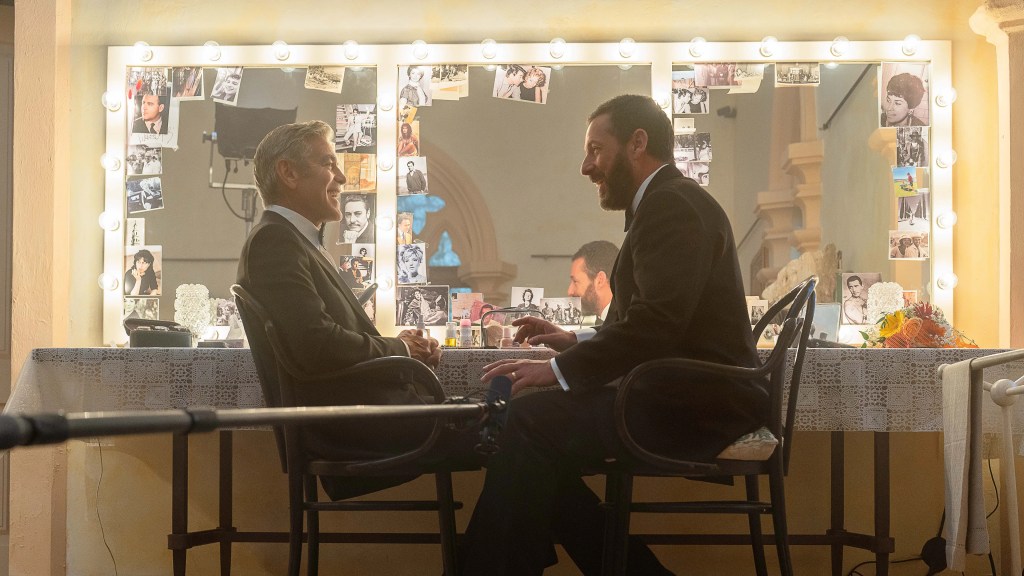
In fact, it’s probably much better than any of those lesser Allen movies and you could even perch it somewhere between The Purple Rose of Cairo and Midnight in Paris at least as far as depth of storytelling and artistic audacity are concerned. It’s one of those films that are as accessible as you want them to be and equally you can probably mine them for thematic content without much ado either. It all depends on how far you—as a viewer—you are willing to take your experience with it. On its surface, it is once again a reunification of Baumbach and one of his pet subjects—absentee fathers surveying the wreckage they left in their wake as they spent decades consumed with single-minded ego-driven pursuits of personal achievement. George Clooney essentially plays himself here, an ageing actor slowly heading towards the dusk of his career. Flanked by a small army of assistants and managers whom he has kept in an illusory limbo between friendship and employment, he travels to Italy to receive a tribute—an early herald of the end of his artistic life and a celebration of his achievements. At the same time, he is crumbling internally as his life of neglect as a father is catching up to him.
This has always been enough to get a viewer through a Baumbach or an Allen movie. A crisis of conscience, an intellectual quandary depicted through vivid deployments of magical realism and an entire heap of acerbic dialogue that cuts right into the heart of the problem with the filmmaker’s characteristic literary precision. And that’s what you will get out of Jay Kelly if you let it: a rumination on ageing in the spotlight, a guided tour through a man’s biggest regrets and a doomed attempt at mending wounds that have turned into permanent scars long ago. If you look closely and focus your attention elsewhere, you might also find that the film functions quite competently as an intellectual takedown of the Hollywood star-centered culture where actors are treated like royalty and people who enable their success are used, discarded and left by the side of the road when they become inconvenient.
That’s what you will find when you pay close attention to Clooney’s relationship with his agent played by Adam Sandler. You will also find moments—perhaps plucked out of conversations with real people or Baumbach’s own self-effacing reflections—of downright condemnation of the lifestyle imposed by the Hollywood dream. You will get to spend some time with the characters as they wrestle with their past and how a life of neglect has consequences. These kids who were chronically abandoned by the adult who should have paid attention eventually grew up and through incredible effort learned to be happy. Without their father who preferred to play a great father in a movie rather than spend time with his kids.
Again, you will get all that out of Jay Kelly if you give it a chance. If you don’t, you will get a slight comedy about a guy going to Italy and having a bunch of bittersweet conversations while the story as a whole wouldn’t amount to a whole lot. After all, this is a guilt-free Woody Allen movie of the light variety, rather than an attempt at remaking Cries and Whispers. Effective and powerful when it matters but overall slight and somehow forgettable is what this film is. Which, admittedly, is a feat of strength in its own right because it takes substantial talent and artistic restraint to balance these many seemingly conflicting proclivities. But Noah Baumbach has always been perfectly capable of probing depths of the human condition while remaining light on his feet, much like Woody Allen whom he is perfectly positioned to replace as an ethically non-problematic alternative. Hence, even his minor works, which Jay Kelly most assuredly is, are a much better show than Wonder Wheel or Café Society.

 Flasz On Film
Leave a comment