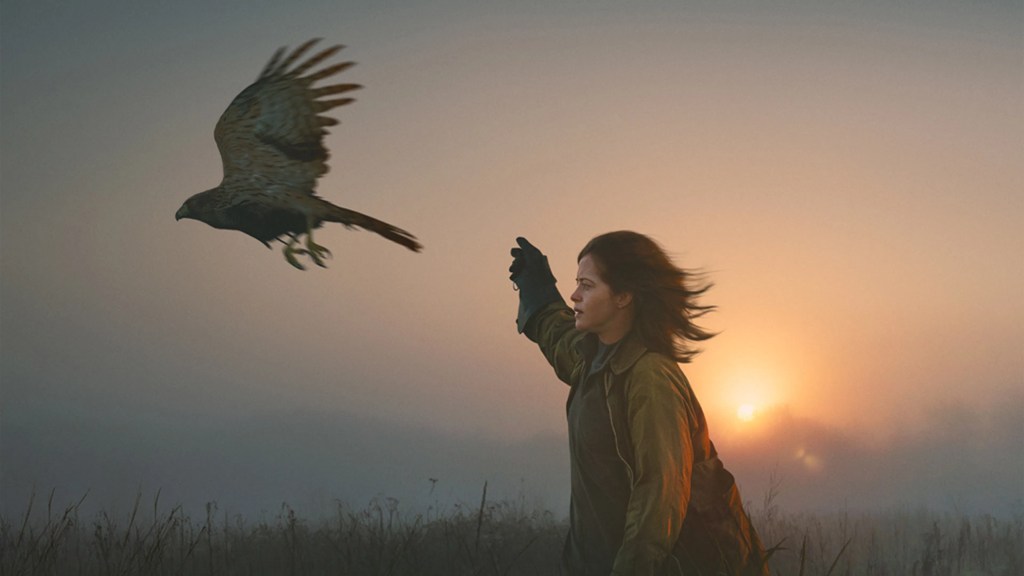

Synopsis: After the sudden death of her father, Helen Macdonald (Claire Foy) withdraws from her life and throws herself into training a fierce goshawk named Mabel, hoping the demanding, primal discipline of falconry will help her outrun her grief. As she bonds with the bird and loses herself in the stark rhythms of the natural world, she experiences both moments of transcendence and a troubling drift away from human connection.
What was that meme again? Men will [start a podcast/build a functioning lightsaber/go to war for the glory of Rome] before they go to therapy? Well, as H Is for Hawk describes, some people will adopt a majestic bird of prey before they realize they need help too. And it’s fine. I’m not here to cast aspersions on anyone’s choice of coping mechanisms that help them get through tough times. I know I have mine. But I will say a few words about the movie itself if that’s OK.
Based on Helen Macdonald’s memoir, H is for Hawk attempts to capture something profound—the utterly incomprehensible complexity of grief that follows the loss of someone who’s not only close but the closest. The one we see as the only person in the world who truly saw us. That’s exactly how Claire Foy’s character describes her father (played by Brendan Gleeson) in her soulful eulogy towards the end of the film. Losing someone this important is like losing a limb. Accidentally losing your compass during a storm in the middle of the ocean. It’s a seismic event of galactic ramifications. And the movie that follows recreates but one of the many possible scenarios stemming from such a devastating tragedy.
You could see the narrative conceit of a person adopting a bird of prey as an attempt at distraction. In fact, Helen Macdonald’s friends and family see it as such. What they observe is a person in a tailspin, gasping for air and trying their utmost to leave the grim reality of a world where the person they loved the most is no longer there. In fact, in many ways it is a useful distraction and a coping mechanism. As the movie delineates, taking care of a massive goshawk—a bird that, in the words of the man who sells this animal to the protagonist, needs to murder a lot to stay calm—is a massive undertaking; perilous and complex. Therefore, the very idea of acclimating this majestic predator to its new surroundings and earning its trust is enough to take anyone’s mind off of things. But there’s more to it.
Through its story about a relationship building between an emotionally wounded human and a seemingly feral predator, H is for Hawk attempts to weave in much more into its fabric. It is a heartfelt study on learning to let go, working up the courage to trust that—having lost someone so fundamentally important—you could let someone else fly free and see them return to the safety of your falconer’s glove. That’s what’s baked into this otherwise straightforward study of grief and coping. And it is admirable despite being handled without much artistic flair.
In fact, this movie is at its most audacious when the camera follows Mabel—Helen’s adopted goshawk—as it glides through the air, cuts between trees and hunts down little cute bunny rabbits. The nature footage included in the movie is quite astounding and could rival the most competently made nature documentaries. In a way, it is in its own right a useful distraction from that creeping realization that the story the movie tells is handled otherwise with a flair of a different flavour of a straight-to-BBC product. While BBC nature docs rank consistently among the best in the field, the same often cannot be said about their other productions. Results vary.
Unfortunately, despite its potent thematic makeup and a powerful subtextual layer that a willing viewer can engage with on an emotional level, H Is For Hawk is mostly delivered with a flair of that middle-of-the-road TV production and lacks the kind of cinematic ambition you’d expect from high-calibre filmmakers. Philippa Lowthorpe, the director at the helm, just didn’t seem able or inclined to imbue this story with the emotional scope and scale the story deserved.
Thus, the movie trots in first gear for its nearly entire duration and only puts its foot down during its “nature” sequences. Everything else—dialogue, staging and evolution of its drama—is nothing but perfectly adequate. It isn’t necessarily a detractor per se, because the movie adds up to a satisfying emotional experience with a poignant climax, but rather a realization that it could have been a bit better. Roomier. Sharper. More potent. More… artistically defined. More… courageous and hence vulnerable.
As it stands, H Is For Hawk just about peers above the average, mostly thanks to the fact that the story necessitated that the camera be trained on that majestic bird for a good chunk of the time and that the fundamental emotional tether the movie explores is eminently relatable and inherently powerful. But something’s amiss here and the more I think about it, the more convinced I am that what this movie lacks are directorial decisiveness, artistic courage, and a sense of dramatic scale, as they may be hidden behind the wall of familiarity and comfort of what the filmmaker likely found safe to work with.




 Flasz On Film
Leave a comment