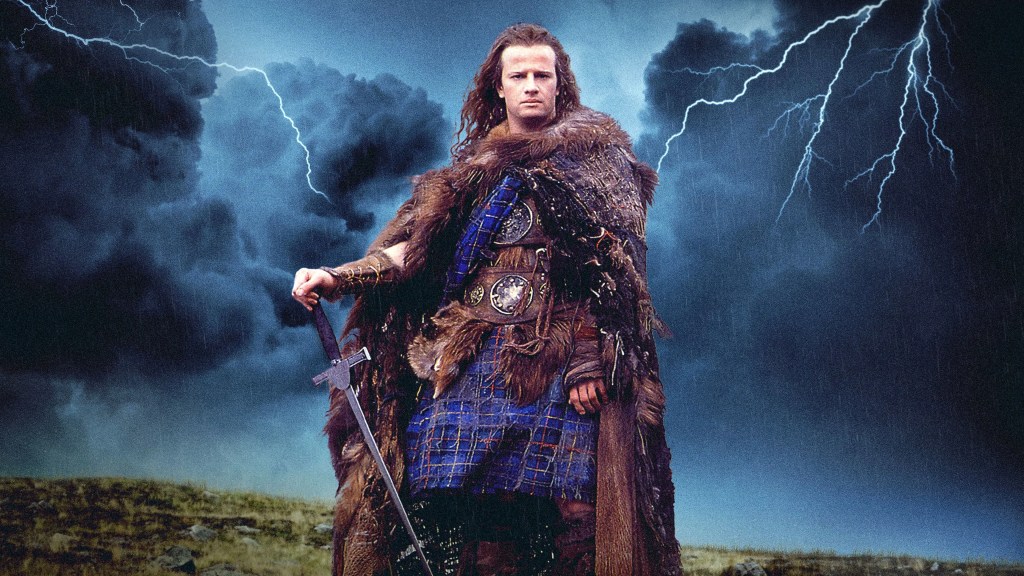
When Highlander opened in March 1986, it barely registered. It ultimately went on to scrape together just over five million dollars in domestic box office receipts, overshadowed by Pretty in Pink and The Color Purple. Soon thereafter, Highlander played only on a small number of screens in the US.
Several factors worked against the success of the film. Christopher Lambert who stared out at the public from the poster wasn’t exactly an A-list star, nor was Russell Mulcahy—who directed the film—a directorial powerhouse; after all, he had mostly directed music videos previously in addition to Razorback, a cult horror affectionately referred to by its fans as “Jaws on trotters.” Critics of the time considered Highlander a messy affair with a patchwork aesthetic borrowing from films like Blade Runner and The Terminator. Filmgoers were confused by the marketing and couldn’t tell what genre the movie was as it flip-flopped between sword fights, kilts and 80s gloom, while the only easily recognizable anchor, Sean Connery, was present in the movie for a little while and his performance only added to the preposterousness oozing from the screen.
It took a while for people to notice that Highlander was a little bit special. Much like the first fish that grew legs in place of its pectoral fins would look like a freak of nature to anyone who stumbled upon it while enjoying a peaceful walk on a primordial beach four hundred million years ago, Highlander looked like a ridiculous oddity, owing to its unfamiliar world-building, numerous little plot holes and the fact the audiences were asked to take on the chin the idea of watching an aging Scotsman play an immortal Egyptian with a Spanish name (who didn’t even attempt an accent other than his own) while a long-haired French-American pretended to be Scottish in front of him.
But there was something magical about this little-regarded piece of modern fantasy, as it endeared audiences overseas and eventually found traction on home video. Highlander became a video store hit and spawned a multimedia franchise. Mulcahy returned to direct a sequel in 1991 where all the world-building and character development were effectively binned and replaced with a haphazardly assembled mythos that made the movie look like a Roger Corman attempt at a Dune knock-off that also wanted to cash in on the recent popularity of Total Recall. To this day, Highlander 2: The Quickening is regarded as one of the worst movies ever made. This proved that even the artistic voice responsible for putting the original movie together had a very limited understanding of what made Highlander click with viewers and develop a cult following. And the fact that the franchise lived on, sired a TV show, a host of other sequels, animated spin-offs, an incoming remake and a whole host of ancillary media confirms that Highlander was not a fluke. It was culturally sticky. But the reasons why were not immediately clear either.
That freaky-looking and possibly alienating hybrid makeup bridging numerous genres and mixing aesthetics was not a genetic malformation but rather an evolutionary adaptation that people weren’t equipped to parse at the time. What critics saw as narrative indecision and messiness was a product of the fact that Highlander—incidentally or otherwise—was a well-positioned cultural linchpin that capitalized on a number of seemingly disparate cultural micro-trends of its time.
It is frankly undeniable that Highlander mostly registers as a spiritual continuator of a decade-long popularity of fantasy films sparked by the incredible success of Star Wars and Conan the Barbarian. But the key qualifier here is the word “spiritual.” After all, it would be difficult to recommend Highlander as a movie that belongs together with sword-and-sorcery works of the time, like The Beastmaster, Dragonslayer, Red Sonja or The Sword and the Sorcerer. Some sections of the film, particularly scenes taking place in the 1500’s when Connor MacLeod learns about his immortality and confronts the barbaric Kurgan (Clancy Brown) for the first time directly allude to the film’s sword-and-sorcery legacy, but that’s mostly it—they are flashbacks. At the same time, it wouldn’t be too tall an order to cut together a trailer for the film which would fraudulently imply that Highlander is a direct offshoot of Conan movies, only to discombobulate audiences with the opening sequence taking place at the Madison Square Garden during a professional wrestling event.
In fact, you could theoretically cut together a number of trailers for this film that would all suggest completely different experiences, and without much ado at that. If you look past the medieval stuff and kilts and focus squarely on the parts of the narrative taking place in present day, Highlander has a lot in common with The Terminator. The core premise of an unstoppable slasher-like villain who happens to be out of time, superhuman and dressed just like Schwarzenegger after procuring clothes from Bill Paxton and his buddies; Lambert’s trench coat get-up; frequent static electricity discharges; the mid-80’s gloom—these elements are all simpatico with James Cameron’s movie. Take out the sword-fighting and the movie immediately looks as though it wanted to capitalize on the vibe of Blade Runner and Thief. You could call it aesthetic and thematic indecision and innate messiness. I choose to see it as genetic synthesis.
Highlander is a movie that picks up these different bits of cultural DNA and splices them together to bring the fantasy genre down a few notches and ground it in the grim reality of Reagan’s America. It borrows just enough elements from many different corners of the culture to keep the primary narrative from collapsing upon its own weight while giving it an opportunity to look fresh when set against what came before. However, like that missing evolutionary link between a fully aquatic creature and the first amphibian, it’s a little bit awkward. It’s not the best swimmer and it’s not the most proficient and using its legs. But it sets the stage for what’s to come, its next evolved iteration.
To understand why Highlander felt so out of step in 1986, you have to look at what was happening to fantasy films at the time. The genre didn’t die off on the back of a singular financial catastrophe, but wore the audiences down over time. Aside from a few early successes, most big-studio fantasy films struggled theatrically, often finding appreciation only years later on home video. Hollywood’s difficulty with fantasy didn’t mean audiences rejected the genre outright, only that they responded to it selectively. The success of Ron Howard’s Willow proves it, as its reliance on discernible archetypes and pared-down world-building clearly clicked well with the masses. Audiences still wanted epic, mythic storytelling. They just didn’t want to work too hard to enter a brand-new universe. Thus, the key to immediate success at the box office was likely familiarity. Most successful fantasy movies were either adapted from existing material, like Conan the Barbarian, The NeverEnding Story and Excalibur, or like Willow harked back to George Lucas’s genius in threading the cultural needle and fell back on the most powerful and scalable archetypes. The films that faltered were often the ones that tried to invent everything at once, asking audiences to learn new rules without familiar entry points.
Out of that tension between the desire for mythic storytelling and the audience’s need for familiarity a new form began to take hold. As traditional fantasy waned, superhero films stepped in to fill the same cultural space. Superheroes offered something fantasy increasingly struggled to provide: modern settings, recognizable archetypes, and built-in lore. They delivered myth without requiring audiences to learn an entirely new world from scratch.
Meanwhile, Highlander only had two out of these three elements: it had the fantasy, it had the reality-adjacent world-building. What it didn’t have was a comic book or any other source material to draw from and which viewers could already be familiar with. As a result, it had to invent it all within the movie—hence the perceived messiness. At the same time, Mulcahy’s team could not fit a well-rounded mythology into what still needed to be an action-driven spectacle without bloating its running time and risking to turn audiences away with overwhelming new vocabulary, off-screen narration and unceremonious exposition dumps. Therefore, Highlander became a comic book movie without a lore, but one that begged to have one written in… which is a great recipe for a cult classic with a fertile ground for organic cultivation of fan fiction or franchise-building.
The real magic of Highlander that is rarely talked about—because the movie spawned its own franchise eventually and grew a fantasy universe over the course of many years, almost by inertia—is that it was that evolutionary link between sword-and-sorcery and superheroes. It was a cool movie for its target demographic of hardcore fantasy nerds who didn’t mind the legwork required to fill in the backstories or to imagine what else is going on in this world and what other characters might eventually materialize into existence if the movie is allowed to breed a series. Highlander, in that middle-ground between fantasy and a comic book movie (and without a comic book to back it up) built a world in which immortal gods roamed the planet in search of each other to wage battle for ultimate primacy. “There can be only one,” as the movie’s motto goes. Much like Superman or Batman who would square off against forces beyond the comprehension of mortal men and women, the immortals in this world would unceremoniously disregard whatever customs, traditions and laws humans imposed upon their mortal dominion. They would not however seek to rule over us, because after all, when you cannot die, your priorities would be different to ours.
This narrative design of immortals either living in permanent withdrawal from society and only engaging with other immortals, thus effectively ignoring everything else, might be (and perhaps was) misconstrued as a flaw because the movie didn’t offer typical stakes. Highlander isn’t suggesting the world would end if only one immortal was left, or if an evil one would survive as the victor. The Prize was not hegemony over the planet. The prize was release from the immortal curse: a blessing to grow old and die. In a way, what Highlander ended up proposing as a topic for a thematic conversation with the viewer surpassed the depth of typical superhero or fantasy fare of its time. Awkward as it is, the film is a meditation on mortality, on how personal values shift away from human connection when you get to outlive everyone close to you and how an inability to die is ultimately a curse.
At the same time, bolstered by the visual language lifted from other 80’s dystopias, this narrative construct of setting up a fantasy universe within modern-day reality and suggesting the two co-exist with minimal interfacing was also a reflection of societal malaise permeating the western civilization. Indirectly, the movie made a comment on the lack of agency regular people must have felt as macro-economic forces beyond their control dictated if they had jobs or not, while the world leaders waged political wars without so much as consulting those who elected them into power. In a way, Highlander is an elevated and stylized comic book-adjacent dystopic allegory about the representatives of the ruling class propped by their inherited generational wealth engage in squabbles while the world clearly crumbles into dust.
Today, forty years after its release, Highlander remains just as important because the same immortal rulers continue their skirmishes while the planet heats up and nations gear up for war. Just like its central characters, this movie remains timeless. Not because it flopped in 1986. Not because Queen gave it an immortal soundtrack. But because it helped reshape how fantasy could exist on screen. A comic book movie before Hollywood learned how to make comic book movies, Highlander was a transitional species: awkward, unlikely, and essential. A cinematic proto-amphibian.

 Flasz On Film
Leave a comment