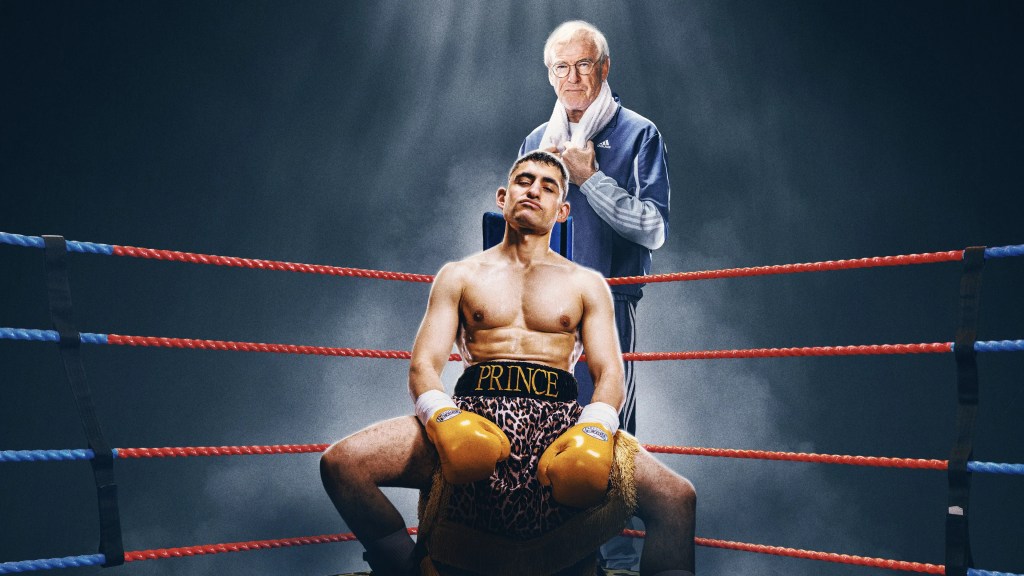

Synopsis: Naseem Hamed rises from a troubled childhood in 1980s Sheffield to become an international boxing sensation, propelled by swagger, talent, and a refusal to conform. Under the guidance of his lifelong coach Brendan Ingle, whose unorthodox methods shape both his fighting style and sense of self, Naseem reaches the pinnacle of the sport, only to find that the scale of his success begins to fracture the relationships that carried him there.
The poster to Giant, currently playing in UK cinemas, proudly announces the film as “the UK’s answer to Rocky.” I am no stranger to hyperbole and I understand why some people write lines like these—exactly because they’d like to see them pulled out and slapped across the poster—but I must take exception to this particular case and call it out as false advertising.
You would think walking in to see Giant, which recounts the story behind the rise of Prince Naseem Hamed (played here by Amir El-Masry) to the top of the featherweight boxing division under the guidance of Brendan Ingle (Pierce Brosnan who got to reconnect with his native Irish accent), that the movie—based on the combination of marketing supporting its release and your own general knowledge of the boxing movie genre—would amount to an emotionally-charged underdog story. You’d go on to imagine a young kid from a neglected background and a tough neighborhood overcoming racism and prejudice to climb to the top of the world and prove wrong everyone who refused to believe in his abilities and drive. And you’d only be partially right because—yes—Giant retraces these elements of Hamed’s life but it somehow lacks the energy of that underdog movie.
In fact, in many ways it is difficult to get behind Hamed’s character, who is arrogant and cocky, and who seems to make his ascent to greatness without breaking a sweat. We see him get into the ring, taunt his opponents, wind up a right hook and put them to sleep. And you know what? That’s fine because as far as I can tell, this is more or less what Hamed’s real-life trajectory looked like. The guy clocked thirty-six victories and only one loss throughout his professional career and thirty-one of those wins was delivered by knockout. He was unstoppable… and he was kind of obnoxious about it, too. Which makes it difficult to root for him but it also happens to be true to life.
And I’m not exactly sure that the movie was edited together in a way that was conducive to letting us in on what the story was truly about, which is the tragic life of his coach Brendan Ingle. We are led down an emotional cul-de-sac as we try to get invested in Hamed’s journey while fighting our own innate early-warning systems flagging the character as unworthy of support, whereas the real drama was in Hamed’s corner. What’s even sadder is the fact that way more artistic attention was paid to building these archetypal boxing movie micro-narratives or staging certain sequences to evoke the likes of Raging Bull or Creed, leaving only leftovers for the other potential emotional heavyweight of the movie.
In truth, a movie like Giant must have been a challenging beast to tame because it truly looks as though it wanted to capitalize on those Rocky beats, montages and some easy wins courtesy of its coming-of-age first act. Yet, it would have been a bold move to make a film based upon a story of Prince Naseem Hamed and zoom right past Hamed to focus on his coach and the depth of human drama that characterized his life’s story. That’s what the movie needed to include to give the film its heart. Unfortunately, Giant just doesn’t seem interested enough in Ingle’s story, which shows predominantly in how workaday and cliché-laden these potentially powerful scenes ended up being. It is almost painful to sit through.
Therefore, here I am telling you not to trust a word of what you might think Giant is going to deliver based on your own assumptions of the genre and the glowing praise staring at you from its ubiquitous marketing materials. This could have potentially been an intriguing biopic of Brendan Ingle—a man who devoted his entire life to straightening out young lads, focusing their energy and pushing them to find success in life, and rarely seeing his efforts appreciated, let alone rewarded. In fact, Pierce Brosnan was already there with his well-crafted performance, only to be smothered by schmaltzy violins and—in a bout of irony—overpowered by the glitzy treatment of the Hamed side of the narrative.
In so many words, Giant has very little to do with Rocky as it’s an emotionally awkward and an overall manipulative experience that clearly doesn’t realize where its dramatic core is until it’s too late to care. It would be less incorrect if Rocky had been a movie about Balboa’s trainer Mickey and his lifelong struggle to coach someone to the pinnacle of the sport. Instead, it is more of a hybrid of narrative elements found in Rocky III and Rocky V, but I agree that seeing “the UK’s answer to Rocky III and Rocky V, kind of” on a poster wouldn’t make the right impression. But then again, neither does Giant make the right impression, because it promises a lot and delivers little.
Maybe not every boxer’s life makes a good movie. Perhaps it is as simple as that. Or maybe not every boxing movie needs to follow one of the small handful of tried-and-true templates and Rowan Athale, who wrote and directed Giant, didn’t have a good enough idea to flesh this story out to make the movie rewarding or even worth watching.
 Flasz On Film
Leave a comment