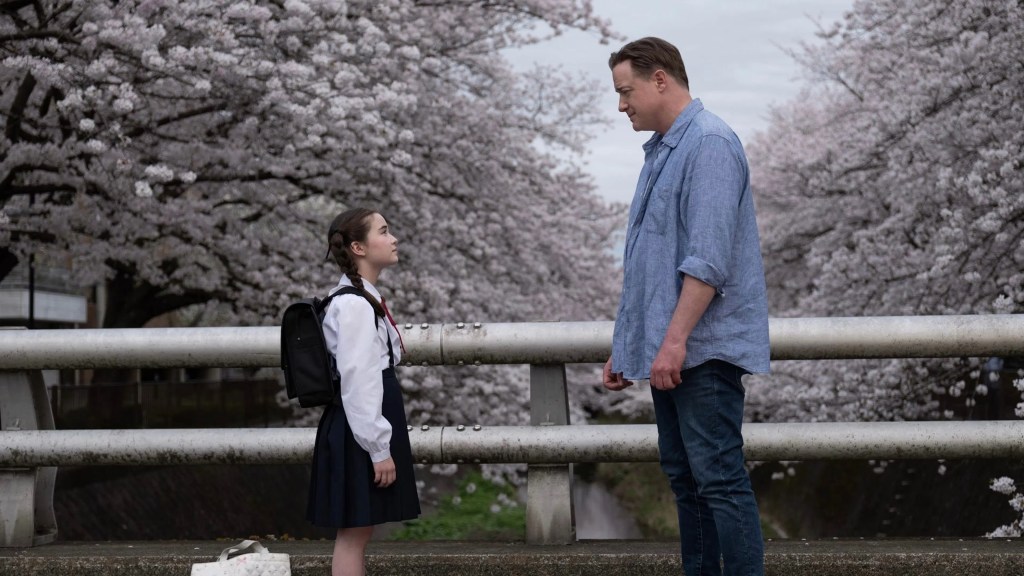

Phillip (Brendan Fraser) is a stranger in a strange land. A fish out of water. We are never explicitly told why he lives in Japan, but we are fed enough in throwaway lines of dialogue to piece together his backstory. He is an actor struggling to find his big break, wrestling with the fact that he is all alone in this world.
When he is asked to perform as a “sad American” on short notice, Phillip thinks he’s getting a quick gig as an extra in a show, or something of that persuasion. This sounds like the kinds of roles he’s been looking at for a long time, so it takes him aback when instead of an audition or a movie set, he joins what looks like a real funeral. Only it’s fake: organized by a specialist agency where you can hire actors to perform roles in your otherwise very real life. A fake boyfriend to introduce to your conservative parents. A fake mistress to show your wife if you don’t have the guts to leave the relationship. A friend to come over and play video games with you.
After all, acting is acting. Or is it? Phillip needs work and he signs up… to become a fake dad to a little girl Mia (Shannon Mahina Gorman), whose mum needs his help to get Mia accepted into a prestigious school. And sooner than he realizes, the line between what’s real and what’s acting begins to blur.
In so many words, Rental Family transcends the seemingly formulaic parameters of its setup as a dramedy leaning heavily on stark cultural differences between life in Japan and in Western societies. We rapidly dispense with requisite comedic beats, which never really rely on watching Fraser’s character navigate a culture that he doesn’t understand. He gets a lot of it. He speaks half-decent Japanese. Though, as his Rental Family boss (Takehiro Hira) says on one occasion, you can live in Japan a hundred years and still feel alienated by some of its customs.
Therefore, what you won’t find is the kind of comedy you might have witnessed in Lost in Translation by Sofia Coppola where Bill Murray struggled to fit in the shower or understand the melody of the Japanese language while being directed on a set. Rental Family is a different kind of experience. It’s not Coming to America or Les Visiteurs. However, much like Lost in Translation—which quickly revealed its true mission as a study on loneliness at the fringes of celebrity—this movie, directed and co-written by Hikari in her sophomore feature effort, utilizes its setup that Western audiences will find exotic and weird as a springboard from which to launch a truly heartfelt story teeming with humanity and… a subtle conversation about the mission of an actor.
After all, what is an acting performance supposed to achieve? A performer should evoke their character to the best of their ability, advance the story and establish a connection between the audience and the narrative. Acting is what humanizes written text, as it becomes spoken and as written descriptions or stage notes become movement and expression. A lot has been said about the concept of method acting, which is often synonymous with wholesale embodiment of the character by an actor, learning as much as possible about what life would be like in their skin and frequently remaining in character for extended periods of time, in an effort to bring more realism and authenticity of the performance. But what’s always a little bit suspicious about the idea of method acting—and some actors are better at it than others, while some choose to apply different techniques in their acting craft—is that it is often used by actors tasked to play despicable characters or engage in deeply internalized suffering. It is almost as though it was an excuse to gain permission to explore some dark facets of the human condition and/or indulge in terrible behavior under the guise of character work. Think of Daniel Day-Lewis playing Daniel Plainview in There Will Be Blood, or his work in My Left Foot; Robert De Niro in Taxi Driver and Raging Bull; Marlon Brando in A Streetcar Named Desire or Apocalypse Now!; Christian Bale in The Machinist.
What Rental Family allows us to experience is the alternative and perhaps helps us understand why we rarely hear about method acting in contexts other than crafting characters consumed by darkness or internal anguish. Phillip’s work essentially entails crafting completely enveloping method performances whose goal is to never allow the people in front of whom he is acting to see through the character. His mask must not slip because the ramifications might be profound. He might break the heart of a little girl whose trust he has gained and who might end up permanently scarred if she were to learn that he is not her real dad. He might completely discombobulate an aging actor (Akira Emoto) with whom he has built a delicate friendship. And most importantly, Phillip might form such lasting and strong connections through his method acting work that he might completely lose the sense of who he really is outside of his performance and even choose to disappear into one of his characters permanently.
This could be a potential danger of method character work and a little-explored reason why you often see actors use this technique to pursue crafting characters that are questionable, or consumed by darkness. It is unlikely that Robert De Niro would have consciously chosen to remain Travis Bickle after the production wrapped because embodying this man must have taken a mental toll on him. Characters like Kurtz in Apocalypse Now! or Louis Bloom in Nightcrawler require actors to expend considerable energy in the aftermath of the shooting to “shed” them, and I can only assume that actors simply cannot wait to leave behind the anguish, suffering and despair required to embody these characters. It’s hard enough already when the actor wants to go back to their real self, so I can only imagine how emotionally taxing it must be for an actor to leave a character that they loved playing and through whose eyes they might have preferred to see the world permanently if they had been allowed to.
We see this conflict explored in great detail in Hikari’s Rental Family as Phillip’s entire arc rests on the friction between being his lonely self who lacks purpose and desires most of all to belong, and becoming somebody else in order to feel loved, wanted and useful. Therefore, the movie becomes a complex mosaic that explores the blurry interface between base reality, our secret wants and desires and the consequences of decisions driven by emotional longing where the concept of acting and performing plays a central roles. Following Phillip’s path of self-discovery and healing from traumas that led him to live as a stranger in a foreign land as he learns profoundly from the characters he must inhabit—a father trying to rekindle a relationship with a child, a friend to a lonely man on a mission to reconnect with his long-forgotten past—becomes a platform for a potent catharsis and an instructive case to understand the power of acting that’s rarely talked about.
Rental Family carries many stories within and subtly weaves complicated emotional ideas into a largely cohesive narrative with a distinctly humanist core, but it most profoundly focuses on the fundamental idea of crafting an acting performance capable of touching and influencing lives and growing internally as a result of new emotional planes we might discover while in character. Thus, the line between reality and performance might blur to such an extent that we might end up becoming who we play, not because it’s impossible to “shed” the character but because the qualities we develop change who we are underneath the mask.
All this is somehow encapsulated in a thoroughly feel-good cinematic experience, which only goes to show that Rental Family is one of those inconspicuous gems that hides in plain sight as it offers laughs and emotional exhilaration that is well-crafted and assembled with requisite prestige sheen. In fact, it is perfectly possible and largely acceptable to view this film as a subtle and accessible story about belonging, the immigrant experience and loneliness stuffed into a culturally-exotic predicament. But what I found within this movie transfixed me and led me to understand quite a bit more about the nuances of character creation and performance. Not every movie can do so many things with such ease and operate on so many levels of thematic interpretation without looking muddled, misguided or indulgent. But Hikari pulled it off, in no small part helped by Brendan Fraser for whom this performance as Phillip takes his comeback energy up a notch from The Whale.

 Flasz On Film
Leave a comment