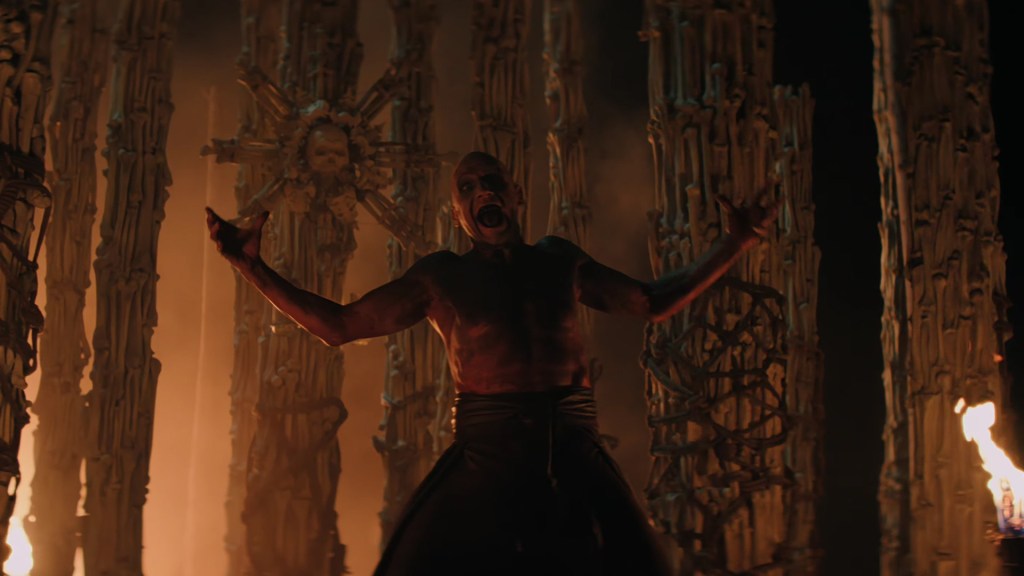

When I was walking into the screening of 28 Years Later: The Bone Temple, I was doing so having made a pinky promise to myself that I would do my level best to give this movie a chance. This meant that I would try to make sure that my opinion on the previous instalment in this franchise that should not have been would not influence my thinking.
After all, what’s done is done and Nia DaCosta (Candyman, The Marvels), who ended up directing this middle chapter in what Alex Garland and Danny Boyle have envisioned as a self-contained trilogy set in this zombie-ridden universe, had an opportunity here to make a few calls and perhaps gently push the movie away from what I saw as glaring problems. However, having said that I must be realistic about what could and couldn’t possibly be done to influence the progression of the big picture narrative of this series and that whatever wiggle room this movie had in terms of course correction was most likely quite limited.
Therefore, I won’t be re-litigating my outstanding woes with the 28 [Blank] Later series, nor will I be holding Nia DaCosta to account for decisions she was not responsible for making in the first place. You will have to refer to my article on the previous movie to read more about it.
In fact, what I ended up doing as I was watching 28 Years Later: The Bone Temple—and this definitely lowers the ceiling of maximum enjoyment I could have possibly derived from watching this film because it constitutes work I should not have to be forced to do—was to frequently send myself a mental reminder that none of the previous movies existed. That as far as I was concerned, this movie’s title didn’t need a colon and it was simply titled The Bone Temple.
So, let us forget that the narrative picks up immediately after the previous movie closed, with Spike (Alfie Williams) joining a gang led by Jimmy Crystal (Jack O’Connell), provocatively stylized to look like the disgraced BBC presenter and pedophile Jimmy Savile. Let’s just imagine that we don’t know anything about Spike, other than he is a young boy who’s all alone in a world that was ravaged by an undisclosed apocalypse a long while ago; and who finds himself between a rock and a hard place because he must choose if he’s safer fending for himself in a world full of terrifying threats (and let us also imagine that we don’t know anything about the provenance of those sprinting naked zombies either), or if he’s better off sticking with a merry bunch of sociopaths—led by a guy who believes he has a direct mental line to Satan himself—who roam the land looking for survivors to terrorize and skin alive.
For the most part the movie lets us forget frequently enough that there are supposed to be zombies out there because it finds different facets of the world-building much more intriguing. Hence, through sheer commitment and strong will I succeeded in temporarily displacing my knowledge about the series beyond and let Nia DaCosta’s film exist on its own terms where the main thrust of the story lies in the fundamental conflict between innocence and corruption and the idea of base morality still smoldering in a world reduced to rubble so long ago that even those survivors who are old enough to remember it—like Dr Kelson (Ralph Fiennes) who has built the titular bone temple as a monument to the dead and walks around covered in iodine like a 90s rave enthusiast who couldn’t afford to get a tan and opted for a cheaper alternative—have only vague recollections of what life was like before the civilization came to an end.
This temporary unmooring from the franchise is mostly a product of subtle directorial decision-making and gentle visual cues, as Nia DaCosta doesn’t necessarily throw the narrative out of the window, but rather chooses to force the viewer into a position where they have to concentrate on what’s right in front of them. To put it bluntly, The Bone Temple thrives on its relentless and aggressive depiction of violence, which is present all throughout the entire movie, either directly or as a constant looming threat of what’s to come.
We start with Spike having to “earn” his place among the gang of Jimmys by engaging in a brutal knife fight that ends in fountains of arterial spurts raining upon the screen. We continue with sequences of incredible tension owing to the fact that we know what Jack O’Connell’s Jimmy Crystal and his minions (referred to as “fingers”) are capable of. We get a front row seat to a ritual of “charity” that involves brutal flaying of helpless people whose only transgression was that they were in the wrong place and at a wrong time. The list goes on. DaCosta must have understood that the way to make viewers focus on what the movie was about as a standalone endeavor was essentially to minimize the threat from rabid zombies (who should have starved to death long ago thus extinguishing the virus) and remind them, much like The Walking Dead or The Road and even the original 28 Days Later have done in the past, that in a post-apocalyptic environment the real threat is always a fellow human being. Homo Homini Lupus.
What I found particularly intriguing in all this—all the while trying to keep the zombie-laden world in my blind spot, don’t you forget—was that The Bone Temple with its central story about a young kid essentially trying to evade a satanic cult and how an iodine-covered hermit comes to his aid to protect his innocence, could transcend its franchise limitations and temporarily develop thematic colors the previous movies in the series obscured with their fraught logic and haphazard world-building. Suddenly, because we have been acclimated to the idea of staying in the moment and wrestling with the unsettling violence on display, we could see this entire movie as a temporary mirror of the world we live in currently. The constant threat looming in the background, the many false prophets dealing snake oil and the cultish devotion they somehow evoke in others through a combination of intimidation and charm masking sociopathic degradation… It doesn’t take much to connect some dots in here and see The Bone Temple as a mirage, a funhouse mirror of where we are currently headed as a civilization and that our final destination ain’t pretty.
However, while we are able to extract a meaningful commentary out of this veritable orgy of violence culminating with an absolutely mesmerizing ritual reliant on a supposition that in this post-apocalyptic universe you could convince gullible cultists that you’re Satan by taking inspiration from Ozzy Osbourne’s stage moves and make-up and by using Iron Maiden’s The Number of the Beast as atmosphere-setting background music, The Bone Temple still had—much to my chagrin—a job to do. It must set up the next movie in the series, for which Danny Boyle is likely coming back to the helm. To achieve that, DaCosta’s camera simply had to spend time pointing at naked bodybuilder zombies and remind us that after all, this whole universe made very little logical sense. Though, because the movie did succeed in untethering itself briefly from the series at large, I was able to incorporate intellectually those elements into this standalone reading and chose to see these alpha zombies with nefariously flapping genitalia as metaphorically warped stand-ins for unwitting henchmen of political death cults that continue to lead us towards a self-imposed Armageddon. Consequently, I was able to recontextualize Dr Kelson’s mission to understand the alpha zombie (Chi Lewis-Parry), as well as the way he dealt with Jimmy Crystal’s sway over his minions, as a piece of messaging reminding us that even in a world crumbling to pieces, the true key to survival are compassion and a well-calibrated moral compass.
But, boy, did it take a lot of mental gymnastics and intellectual labor on my behalf to keep all these ideas and elements in focus while pretending that the franchise of 28 [Blank] Later did not exist at all. I spent nearly two hours burning calories and brainwashing myself into believing that The Bone Temple was its own little thing and a completely self-sustaining story set in a post-apocalyptic universe reliant on tangential world-building only to be reminded that in the end the intention was for Garland and Boyle to loop the big picture story back to its very origins. And although the fans of the series will cheer the way The Bone Temple concludes, this was the moment the bubble popped for me and I could no longer lie to myself.
Therefore, I shall leave you with the following summary. The Bone Temple accomplished an objectively incredible feat and let me forget just how much I despised the previous movie in the series. Furthermore, thanks to the way it evoked a sense of immediacy that Nia DaCosta had previously done in Candyman—mostly through her unflinching approach to gore and violence—I found it possible to engage with a movie that counts as the fourth sequel in a series that’s bound together using superglue and good intentions in ways I never thought I’d be able to.
And even though this whole experiment in self-mandated selective blindness had to eventually fall apart because there’s only so much one can do to keep this many things out of focus, I emerged satisfied. Tired. Bruised. Exhausted mentally from all this never-ending blind spot management. But satisfied nonetheless. I can only imagine just how elated I could have been if I hadn’t had so many problems with this entire series and especially the one movie that directly preceded this. So, if you are among those who loved it, The Bone Temple will register as phenomenal. If you’re like me, better come prepared to do some work. Get a protein bar ahead of time and hydrate because this movie will be a mental workout.
 Flasz On Film
Leave a comment