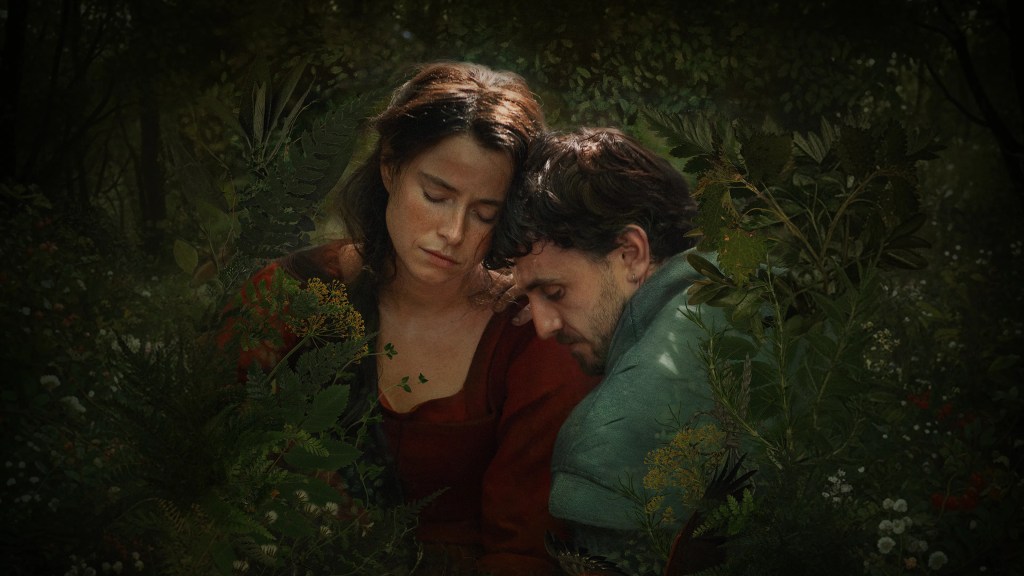

Synopsis: A young William Shakespeare (Paul Mescal) is drawn into a passionate, fated marriage with Agnes (Jessie Buckley), a woman rumored to possess uncanny insight, as love, ambition, and folk magic entwine their lives in Stratford. When Shakespeare leaves for London to pursue the theatre, success comes at a devastating cost: the death of their son Hamnet fractures the family and leaves both parents lost in grief.
That Hamnet is adapted from a 2020 award-winning novel by Maggie O’Farrell is a fact. That the book and in turn the film directed and co-written for the screen by the Oscar-winning Chloé Zhao (Nomadland) are somehow rooted in fact and can be therefore experienced as a William Shakespeare biopic is not necessarily the case.
Very little is known about the family life of the Bard and although certain facts can be established based on available source documents—like that he did in fact have three children, one of whom was named Hamnet, and who died very young—the story of Shakespeare’s family life is mostly a work of artistic confection. In fact, Shakespeare’s name is uttered only once in the entire film, as though to distance the story somewhat from the iconic persona of one of the foremost pioneers of theatre and a prolific wordsmith.
And it does not matter on jot because Hamnet from its very opening frames merely flirts with facts about its legendary protagonist and only occasionally sends the viewer on an impromptu Easter egg hunt, as the script is delicately peppered with lines you ought to remember from Shakespeare’s most iconic plays, sometimes inserted into the mouths of the characters in the movie; enclosed you might also find certain ideas and tropes, like Bard’s recurring interest in supernatural phenomena and pagan wizardry. But they are not here to tickle your brain either or to suggest at the possible provenance of some of the most recognizable elements of Shakespeare’s plays.
Hamnet is by far and away an attempt at wrestling with the nature of art and it uses a fictionalized account of William Shakespeare’s partial biography as a rhetorical device. After all, we do not know too much about the genesis of Hamlet, one of Shakespeare’s legendary tragedies. But we can dream and imagine. We can look at the puzzle pieces that have not been ground down by the sands of time and wonder. What is more, we can also safely assume that life wasn’t much different back when Shakespeare was alive from what it is like today, especially when it comes to the genesis of art. Artistic expression has always spawned to imitate life as we know it and coalesced from seemingly disparate elements of inspiration that a creator would then pour into their work.
Therefore, Zhao’s film is less about Shakespeare, as its narrative is a mostly a product of largely inaccurate fiction, than it is about the idea of making art as a means to cope with the pain of living and how this art then becomes a catalyst for catharsis for those able to see their own life reflected within it. And this is not easily achieved.
Thankfully, Zhao was perfectly aware of the mission at hand and with the use of pensive direction and intimate camera work could turn this would-be-biopic into an exhilarating character study of both the artist and his wife Agnes. In fact, the film manages to divert the focus sufficiently from the Bard to build a story that revolves just as much around her and how the loss of her only son punched a hole in her soul, as it is about Shakespeare and his attempt to mend this wound through his work. Both Jessie Buckley and Paul Mescal reach deep into their fundamental humanity to find what is necessary to evoke the complexity of the story that Hamnet was intended to weave and they both deserve all the accolades that the future may hold for them.
What the film amounts to is a complicated experiment that sketches out the interface between life and art and moves between the two universes with remarkable ease and the confidence of a creator who instinctively knew where the heart of this story laid hidden. Void of pretension and suffused with earnest authenticity, Hamnet becomes a multidimensional portrayal of the kind of tragedy that might have inspired—although we will never know for sure—one of the most renowned works ever written in the English language where we might be able to peek into the mind of a tortured creator and see how life seeps into art. Superficially, we might gain a new understanding of where the iconic monologue about the futility of life might have originated, but more importantly we might understand that great ideas sometimes fly down from heavens, as if in an attempt made by higher powers to turn the artist away from the brink of self-destruction.
Finally, Hamnet will allow us to experience a communal catharsis together with Agnes who comes to understand what her husband’s work was meant to achieve and that he grieved the loss of his son through composing the greatest play in history driven by a desire to rescue his beloved wife from the darkness that had enveloped her. He went into the underworld like Orpheus to rescue his beloved Eurydice, hoping that through his work she’d be able to cleanse her soul come back to the world of the living.
In doing so, Zhao’s film allows us—the viewers—to participate in this truly cathartic experience vicariously. Together with the audience gathered at The Globe we get to extend our hands and touch the ghost of a boy taken from this mortal coil prematurely and thus prove that life begets art, often out of necessity, and then the art comes back to repay its dues by enriching the lives of those who choose to interact with it. Therefore, Hamnet transcends its superficial classification as a largely confabulated biopic of the Bard and triumphs as an evocative and ultimately exhilarating study on the genesis of art itself, the power it wields over our lives and love as the ultimate driving force propelling humans to create beauty out of most profoundly dark emotions. It is a victory of human expression that shows unequivocally how art—born out of untold anguish and despair—may become the key to our salvation.


 Flasz On Film
Leave a comment