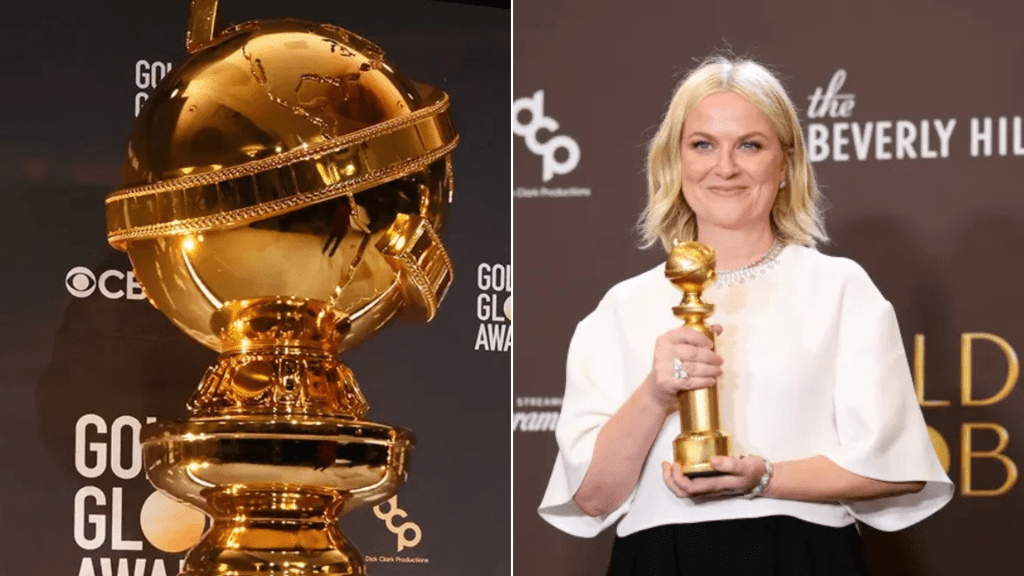
Last night the 83rd Golden Globes were awarded. Nikki Glaser came back to host the gig with her signature snarky roast vibe that flew just a few inches above the level we had experienced with Ricky Gervais at the wheel: punchy and combative yet somehow wholesome and prestige-appropriate. Stars turned up aptly tuxedoed and wrapped in designer gowns, and grinned nervously whenever Glaser mentioned their name. Which is about what you’d expect from an awards show.
I flicked through the winners list this morning just to see what’s what. Not that it matters. Even as far as the Oscar race goes, the Globes are a statistically insignificant predictor. The reason why I decided to sit down and type a few words tonight is because (1) the ceremony didn’t matter to me in the first place and the simple fact that it didn’t was enough to get me thinking, and (2) because the Globes remain one of those awards shows—maybe even the only one—that looks a little bit desperate to an outside observer with its struggle to remain relevant.
Their organizers keep trying to add and change things here and there, most likely in pursuit of better ratings and engagement from viewers. For years now, they’ve been tweaking the formula, much more than the Oscars and other industry stalwarts. Even the idea of splitting the Best Picture award into two categories in the early 1950s—which effectively doubled the pool of films viewers might want to see do well— or incorporation of TV awards in the late 1950s, or even the recent addition of awards for stand-up specials, all made Golden Globes into a cultural broad church. But there’s a limit to it. You can only add and evolve so much before you hit a wall. What then?
This is where things begin to look a little bit desperate. For instance, the recently introduced award for Best Box Office Achievement, which I wrote a little about recently because they decided to nominate a movie that wasn’t even released yet, assuming it would do well. Or more likely, they assumed that the inclusion of Avatar: Fire and Ash would give more viewers a reason to watch the show.
Funnily enough, despite having raced to the third place at the global box office, Fire and Ash did not walk away with this award. You’d think that in this one category that seems theoretically underpinned by actual data the numbers would actually mean something. Well, you’d be wrong. In fact, the list of nominees alone did not look as though it was dictated by box office numbers (even when disregarding the fact that Avatar had zero dollars to its name at the time of nomination). So, I suppose the HFPA just voted on the winner and democratically decided that the biggest cinematic achievement of the year was Sinners. Vox populi, vox dei. Why? I don’t know. Maybe because it stayed in the cultural consciousness for a few weeks longer than everyone assumed it would. Much like Weapons, which didn’t even come close to making serious money at the box office but in the dying weeks of the summer it generated some considerable buzz among filmgoers.
And then, there’s the award for the Best Podcast which is the first attempt of this voting body to extend that cultural broad church further and include a new modality of entertainment in addition to film and TV. Good Hang with Amy Poehler became the first Golden Globe-winning podcast in history, beating Armchair Expert, Call Her Daddy, SmartLess, Up First and The Mel Robbins Podcast. Which is where I felt like channeling my inner Michael Jordan in that meme scene from The Last Dance. Because I took it personally.
As someone who has been an indie podcaster for the last five years and someone who has been an avid podcast listener for the last twenty years, I think I might be somewhat qualified to tell you that the so-called “best” podcasts, as narrowed down by the HFPA, say way more about the demographics the Golden Globes would like to access and the HFPA consists of than it does about their ability to determine what the best podcasts actually might be. In fact, even the shortlist of twenty-five entries looked as though it missed out on a handful of massively influential podcasts, such as Modern Wisdom, The Rest is Politics, or Hardcore History. The shows that ended up with nods are the kinds of shows a random bystander would think of if a pollster on the street asked them to name a podcast they listened to in the last year. No. Even that’s incorrect. The pollster in question would have to be actively canvassing shopping centers in well-to-do areas of Los Angeles to come up with this list.
What this award ended up highlighting is the kind of podcasts that divert attention from thousands of much better shows run by phenomenal people who actually have stuff to talk about. They are run by celebrities, amplified by platform endorsements and adorned with professional production quality and supported by salaried staff, all despite having very little meat on the bone. But I understand—this is a new award and you have to start somewhere. Maybe by 2027 some better quality research will precede the shortlisting process to include podcasts that actually have accomplished something of note or offered added value on top of simply having access to high-flying celebrities with absolute jack to say. Where’s recognition for Dan Carlin for decades of extensive history research that went into his gargantuan series? Where’s the nod for Chris Williamson for pulling out all the stops in terms of production value and intellectual quality of conversations he hosts? Alas… maybe next year.
Nevertheless, the most important take-home message from this year’s Golden Globes, and specifically that podcasting award, should be the realization—perhaps overdue—that movies and TV are no longer the focal point of our culture. Movies have long ago scootched to make space for TV shows, miniseries and limited series in the spotlight and now they are all simply being replaced by other modes of entertainment that young people care about much more. And the question remains if awards shows should pursue relevance outside of their primary domain. The selection of podcasts highlighted at the Golden Globes suggests that they perhaps should remain in their lane because these basic choices look as though they were inspired by what upper class moms listen to on their way to and from yoga classes. And what’s next? Best memes? Best TikTok videos? Best YouTube content creator? Will we ever see the Pulitzer Prize for Best Social Media Posts?
This is where the culture has shifted over the last decade and if the Golden Globes as a cultural broad church wants to remain relevant, this is where they should move next. But it would be a terrible choice because they wouldn’t have the first idea how and what to award to look relevant instead of looking desperate, dated and divorced from the cultural mainstream. Therefore, maybe it is best for them to remain firmly entrenched in film and TV and to leave podcasting, memes and other new entertainment modalities to new and emerging bodies formed by people who actually know what’s worthy of recognition in their respective domains. Meanwhile, maybe next year the Best Podcast category should be renamed—if not pulled altogether—to read as Best Podcast That Celebrities Listen To While On School Runs, In The Sauna And During Cold Plunges. I know it’s a mouthful but I think it would actually reflect what the category is going to award.



 Flasz On Film
Leave a comment