
Synopsis: Set in 1970s Massachusetts, an out-of-work carpenter masterminds the theft of four Arthur Dove paintings, only to watch his carefully rationalized scheme unravel as accomplices are arrested, criminals close in, and the authorities turn their gaze on his family. On the run and stripped of illusions about both art and rebellion, he drifts through a country in turmoil, his private failures collapsing into the broader social unrest of the era.
Kelly Reichardt, one of the most prominent contemporary indie auteurs, went back to the millstone in 2025 to write and direct The Mastermind. This is her first film since Certain Women to both depart Oregon as a setting—Certain Women was set and filmed in Montana while The Mastermind is set in Massachusetts—and which she wrote without her lifelong screenwriting collaborator Jon Raymond. It is also one of those rare movies of hers, like First Cow and Night Moves, that could be theoretically classified as a genre film. However, it is still an experience rooted in this director’s singular interest in observational storytelling, as opposed to anything else.
Therefore, the idea of recommending The Mastermind to anyone who enjoys heist movies is sinister because anyone seeking superficial exhilaration, complex plotting and emphasis on procedurality will be sorely disappointed. This isn’t Ocean’s Eleven. In fact, this is the very antithesis of such filmmaking, even though I remain fairly confident that Kelly Reichardt would never embark on a mission to make a movie with explicitly iconoclastic intentions. This is not a New Wave movie that tries to deconstruct or undermine the genre tropes it plays with, like Breathless or Le Petite Soldat, but rather a film that looks past the genre and through the tropes to focus on the lives of characters that happen to live inside such a movie.
This is where the bleeding heart of this story is—that otherwise might look slow and barren to someone who decided to watch it on a whim—as it reconnects the filmmaker with her longstanding artistic interest in portraying lives of people who normally wouldn’t make it into the frame of a movie: regular-looking humans struggling to stay afloat and fighting desperately not to slip further into societal fringes. What is more, using the guise of a heist film inspired to an extent by French classics like Rififi and the works of Jean-Pierre Melville and under a thick cover of a competently visualized period setting, The Mastermind adds intriguing nuance and color to the ongoing conversation about the plight of men living lives of quiet desperation. We follow someone who doesn’t ever express his inner emotional anguish, but who nonetheless feels trapped, overwhelmed, unappreciated and emasculated. J.B. (Josh O’Connor) is unemployed and feels completely powerless and useless as a father of two boys and a husband to a woman (Alana Haim) who also looks as though she was on the verge of complete burnout; after all, she is the one carrying the team.
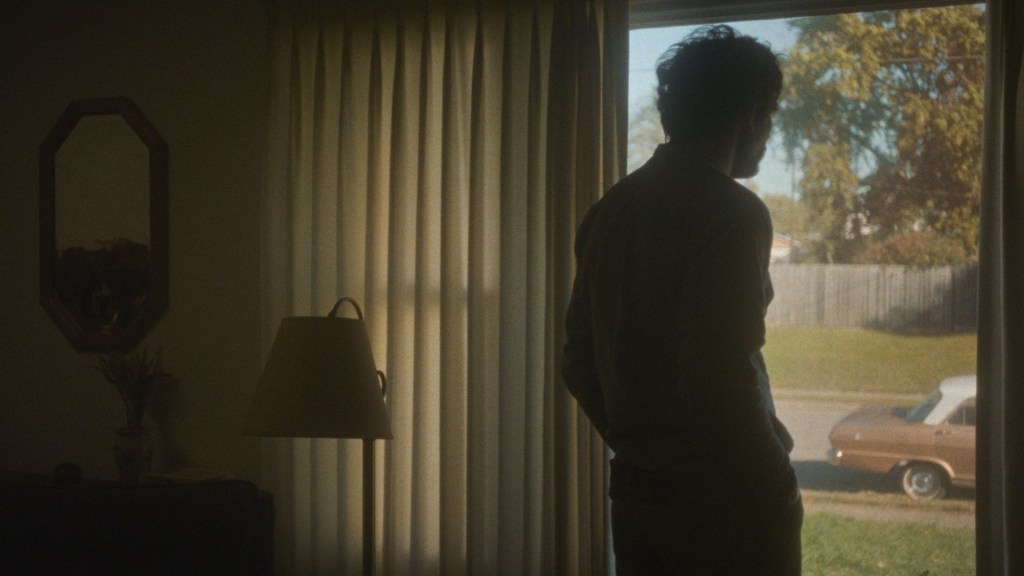
Reichardt’s idea to observe from the sidelines—from an angle rarely assumed by genre filmmakers—as J.B. puts together a plan to snatch a few paintings from a suburban museum allows us to peek into J.B.’s headspace, especially because the film isn’t very interested in the plot itself. It is almost as though the heist movie was being filmed elsewhere and Reichardt decided to give us the family life of the titular mastermind and examine the complex web of motivations that could push someone towards such an extreme position that he would put the integrity of his family and his entire life at risk. And because this is not your typical Hollywood spectacle, J.B. doesn’t get a Hollywood ending, nor does he experience a spectacle. Reichardt methodically films him—in a way that marries the kind of intimacy you’d find in movies of John Cassavetes and austere formality derived from Yasujiro Ozu—to give us a sense of futility that might accompany the process of being slowly crushed by a giant boa constrictor. Slow, relentless and inevitable.
Thus, as we follow J.B. as his carefully-hatched plan is foiled in every possible way according to the non-negotiable laws of what would happen in real life and as his tenuous existence crumbles apart, we might recognize some of those character flavors the filmmaker identifies and elevates. Even though The Mastermind is technically a period piece set at the height of the Vietnam War, it is another distinct movie in direct conversation with the current moment (like Eddington, One Battle After Another and Bugonia). Much like a contemporary man, J.B. feels lost, insignificant and drowned out by the high-volume cacophony of never-ending crises reported in the media and a sense of the world coming to an end outside his window. In fact, he is in many ways a Millennial avatar in an anachronistic 1970’s garb: tired, burned out and disappointed with the life he ended up living.
Reichardt captures this conversation in a delicate yet powerful way, which is characteristically hers. Because she leaves the characters enough room to exist in the moment and breathe—which comes at the expense of plotting that simply does not belong in her movies at all—the viewer is afforded an opportunity to engage with the film on this level in the moment as well, which only deepens the experience and removes the artifice of the medium. In the tradition of great humanist filmmakers, Kelly Reichardt successfully converts the screen into a window into another person’s life, that also might serve as a mirror reflecting our own reality back at us.
The Mastermind, a great companion to Night Moves which reassembled a thriller about ecoterrorism into a treaty on the psychological futility of a Davidian struggle against overwhelming forces, thus becomes an important piece of a growing cultural mosaic that comments on our own perilous existence and reminds us that somewhere underneath these seemingly never-ending macro-scale sensations, wars reported to us live in the media and out-of-control cultural divisions there are millions of people like J.B. with families just like his. Their quiet desperation is invisible because it hides in crowds. Like Wendy in Wendy and Lucy and Lizzy in Showing Up, their pent-up anguish crashes against a wall of resilience and fortitude cultivated as an evolutionary adaptation to chronic exposure to adversity. And Kelly Reichardt is here to remind us that these people exist: hopeless, overwhelmed and unseen. So, even though some viewers might end up feeling bamboozled because there isn’t enough exhilaration in this heist film to feed a hamster with, I’m here to tell you that The Mastermind belongs alongside such great films as Leave No Trace, Winter’s Bone and Reichardt’s own Wendy and Lucy. A modern contemplative masterpiece.




 Flasz On Film
Leave a comment