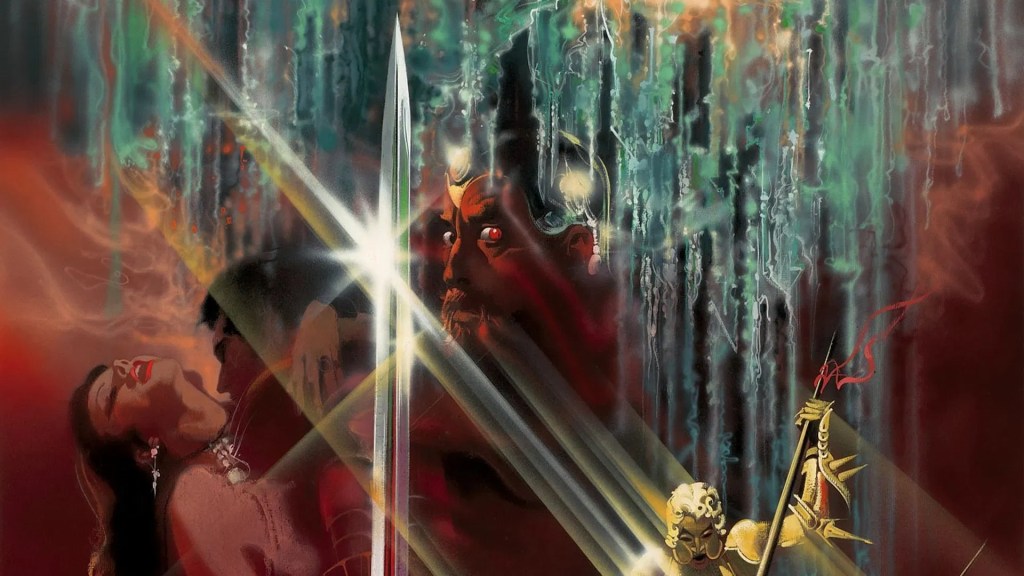
Upon its original release, the John Boorman-directed Excalibur registered as a box office hit, and although it split the critical opinion, it was a much-needed comeback for the director whose career had been on the rocks since helming a duet of consecutive flops: Zardoz in 1974 and Exorcist 2: The Heretic in 1978. However, despite being praised for its lush visuals and a decidedly mature tone, the slowly swelling tide of fantasy movies eventually overshadowed this unique take on the archetypal Arthurian mythos. And I’m here to tell you that it might be more important and culturally relevant than you imagine.
To this day, Excalibur is rarely given sufficient attention and instead it is mostly banded together with other fantasy works of the time, like Conan the Barbarian, or the Ralph Bakshi’s cult animated version of The Lord of the Rings. It might also get a mention here and there in low-rent listicles and video essays adorned with such clickbait titles as “X Fantasy Movies You’ve Never Heard of,” “John Boorman Movies Ranked” or “Y Movies that Zack Snyder Considers Great.” In fact, the latter is true—Zack Snyder does hold Excalibur as his all-time favourite film. What remains largely overlooked is that this movie that Boorman successfully unleashed upon the world at the precipice of the 1980’s is an incredibly important hinge film and one of the last vestiges of the kind of filmmaking that used to be prominent in the 1970’s, but would end up almost completely sidelined in the forthcoming years.
It is widely reported that Excalibur originated as an adaptation of J.R.R. Tolkien’s The Lord of the Rings and went into early development in the mid-70’s. However, Boorman had always wanted to make a movie about the Arthurian mythology and carried this idea under his heart since late 1960’s. Unfortunately, nobody ever wanted to commit any serious money to adapting this vast and sprawling collection of myths and legends. And the money would have to be substantial because Boorman’s vision of what later became Excalibur was going to be epic both in scale and scope.
United Artists—a well-renowned sanctuary for risk-taking auteurs—refused to finance Boorman’s movie about King Arthur when he pitched it to them, but instead they told him he could adapt The Lord of the Rings to which they held the rights. One of the biggest challenges involved in this project was related to the fact that the studio wanted him to condense three thick tomes of high fantasy into a single movie. Undeterred, Boorman began work on the film while shopping his Arthurian movie around. Locations were scouted, sets built. But the project eventually collapsed, partly due to studio politics and internal instability that led to a number of high-ranking executives leaving United Artists.
New management gave The Lord of the Rings to Ralph Bakshi in addition to committing vast sums of money towards projects like Heaven’s Gate that eventually led to their bankruptcy. Meanwhile, a bunch of ex-UA producers went on to set up Orion Pictures where Boorman ended up finding a home for his long-gestating passion project. A number of sets built for the purposes of bringing Tolkien’s Middle-Earth to life were re-engineered. For instance, the set of the trial by combat scene in which young Perceval steps in to defend Queen Guinevere’s honour before Lancelot’s return was originally built to film the council of Elrond sequence.
After more than a decade of trying, convincing, begging and hoping, John Boorman was allowed to make his dream come true. He got to make Excalibur. And probably if it hadn’t been for a confluence of coincidences—such as the civil war at United Artists that led to Orion Pictures being born and the release of Star Wars that renewed interest in space opera and fantasy among studio moguls—this movie would not have been produced at all. It was nothing short of miraculous that Excalibur was allowed to come together the way it did. And that’s because, as critics of the time themselves pointed out, it was the darkest, most brooding and violent piece of fantasy one could find; which directly contradicted the post-Star Wars zeitgeist.
The arrival of Jaws, Star Wars and Superman and their unparalleled success at the box office was a clear sign that audiences had had enough of malaise, violence and grit. They wanted movies to become an escape hatch from the post-Nixon and post-Vietnam reality and studios obliged and course-corrected. Meanwhile, massively lavish, ambitious and frequently indulgent productions helmed by New Hollywood giants tanked one by one: Sorcerer, Apocalypse Now, Raging Bull, Heaven’s Gate. The landscape of studio-produced entertainment shifted irreversibly and new blockbuster movies would frequently appeal to all four quadrants. Raiders of the Lost Ark, Empire Strikes Back and E.T. – The Extra-Terrestrial would dominate the box office exactly because they appealed to everyone: young, old, male and female.
Excalibur on the other hand was a single-quadrant movie, made to appeal to mature audiences most likely of the male persuasion. If it had originated in the wake of the success of Star Wars, it would have looked completely different and would have likely resembled the 1988 Willow more than anything else. In fact, it would have become a branded product and a vehicle for all sorts of merchandising opportunities. But it didn’t because Excalibur came together as a result of a singular vision and drive coming from a filmmaker who didn’t want to sell toys or tinker with special effects and was coincidentally supercharged by the effect of Star Wars on Hollywood spending sentiments. Boorman’s movie was in many ways a trailblazing effort that set early foundations for other brave visionaries to take note and draw inspiration. It was still limited by what was considered humanly feasible at the time. In 1981 nobody would ever allow Boorman to turn his Arthurian dream into a trilogy because trilogies were simply unheard of. Even The Lord of the Rings, as I mentioned already, was supposed to be turned into a single movie at a time when the institution of a sequel was still largely novel.
Therefore, Excalibur is easy to pick apart by viewers interested in straightforward plot-driven storytelling and explicit world-building. It’s impossible to fit it all into a single film and as such Excalibur comes across as episodic and perhaps disjointed. But it looks like nothing else released at the time. In fact, the closest blood brother to the kind of fantasy this movie builds is the 1982 Conan the Barbarian, which also happens to be a product of a long-gestating vision slowly built by a group of passionate visionaries, not a multimedia franchise in the making.
Excalibur was a bold take on dark fantasy that stood apart, but it nonetheless left a mark. You will definitely find its DNA in Zack Snyder’s work like 300 or even Rebel Moon and you might find that Peter Jackson’s take on The Lord of the Rings tips its hat to Boorman on numerous occasions too: from resplendent production design and costuming to concrete scenes. Arthur’s showdown against Mordred most certainly inspired a certain moment when Uruk-hai impales himself on a spear in the heat of battle. It is a work imbued with the kind of artistic vision that had no other choice but to give other directors reasons to make movies.
Nevertheless, tucked between set piece-laden escapist spectacles Excalibur is sadly a vestige of an era that had collapsed under its own weight right at the time of its release. Although it premiered in 1981, Boorman’s work is decidedly a New Hollywood movie of the kind you’d have found in cinemas in the early and mid-70’s, had anyone had enough wherewithal and fundamental courage to bankroll it then. It was a movie made out of pure ambition and drive that enveloped with its epic scale and indulged in the kind of pathos that had gone out of style by the time the movie saw its release. Boorman’s intention wasn’t so much to entertain masses as it was to give these archetypal legends a truly epic treatment. And despite the fact that it must have been impossible to squeeze these tales into a single narrative, he succeeded in crafting a piece that resonates and reverberates with those viewers who approach Excalibur with requisite earnestness.
Even though it has its problems and now, forty-five years later, some of its visual aspects have dated considerably, Excalibur remains a visually arresting experience, resplendent in vibrant colour, awash in violence and unapologetically epic. It is in many ways one of the last movies of the New Hollywood era, a hinge piece that remembers the philosophy of the 1970’s when anything went and when movies were allowed to be cool, and one that anticipates the imminent blossoming of high fantasy as a genre. Also on the level of its narrative, Boorman’s rendition of the Arthurian legend is in itself an exploration of the same pursuit of greatness that filmmaking used to be at the time when directors like William Friedkin, Francis Ford Coppola, Martin Scorsese and others were given the opportunity to express themselves and probe the boundaries of what’s possible by arrogantly crossing them. Friedkin crashed cars at full speed, built refrigerated sets and sent trucks through shoddy bridges. Coppola went on to recreate the horror of Vietnam on the scale nobody had ever seen. And John Boorman took fantasy with apt seriousness and went on to look for his own Holy Grail hoping he was pure of heart and thus worthy of it.
Thus, when you watch Excalibur now, it might be instructive to look past the obvious interpretation carried forward from the legends themselves and see it as a swan song for New Hollywood; a treaty on making great art for the right reasons; on indulging in beautiful and resplendent aesthetics for no other reason than because it feels right; on joining a valiant quest that was doomed to fail after clashing against forces of materialistic and power-hungry evil because it was the right thing to do. You might in fact notice that the Knights of the Round Table as rendered in Boorman’s vision were driven by similar principles to those New Hollywood mavericks. And that they shared similar fate. They either perished under the blade of ruthless progress or conformed and lost their souls.
King Arthur’s mission in the film ends in ambiguous collapse, with Perceval looking toward the uncertain future while bidding farewell to Arthur as he ships off to Avalon, his resting place. The titular Excalibur is returned to the Lady of the Lake who will wait for another knight worthy of wielding it, while a period of darkness would descend on the world. New Hollywood guys like Boorman and others were given the chance to wield that sword, an opportunity they ended up squandering because Hollywood forces were much stronger than their combined artistic willpower. Their egos got the best of them and New Hollywood fell apart just like that Arthurian dream.
And it is all captured in the film, thus making Excalibur a potent reminder that the greatest era in Hollywood’s long history did not end with the failure of Heaven’s Gate but with the release of one of the most potent pieces of dark fantasy of its time. Filmgoers at the time could not realize that what they were watching was a poignant and self-aware love letter to the kind of filmmaking they would have to wait another twenty years to see once more.



 Flasz On Film
Leave a comment