In the early 1990’s Mike Nichols’s filmmaking career was at a precarious juncture. He had just turned sixty in 1991, in the year that also saw his movie Regarding Henry flung into the weeds by critics and audiences disappointed with the schmaltzy drama he put together, and shortly thereafter he ended up abandoning the prospect of directing the adaptation of Kazuo Ishiguro’s The Remains of the Day. And even though he had had a few successes in the preceding decade—the most prominent of which was the 1998 Working Girl, Nichols was clearly running out of breath while trying to keep apace with the pack of A-list Hollywood directors.
In fact, he was beginning to feel like a has-been, a man who despite directing only thirteen films was already being considered for various lifetime achievement awards. Sure, we must remember that throughout his entire adult life Mike Nichols kept two careers going simultaneously—one in movies and one on Broadway—which effectively split his time and attention, but he wasn’t ready to retire and move over just yet. He felt he had things to say and movies to make, yet life was most assuredly catching up to him, inch by inch. He needed a hit. A movie that would give his many detractors pause. After all, the main accusation volleyed at his movies was almost always that Nichols had lost his touch. That his caustic wit was watered down and neutralized and his coarse edge got sanded down over time.
Nichols had helped to blaze the trail for the arrival of New Hollywood with his eponymous adaptation of Who’s Afraid of Virginia Woolf in 1966 and The Graduate in 1967 and then ended up overwhelmed by the swelling tsunami of auteur cinema that overtook Tinseltown. His massively underrated Catch-22 could not compete with the rougher and more audacious M*A*S*H* from Robert Altman, and although Carnal Knowledge that he directed the same year was a smash hit, it still had to compete against other acerbic dramas of the time, like Five Easy Pieces and The Last Picture Show. And from that point onwards—from 1970, that is—Nichols would always end up criticized for failing to live up to the high bar his early movies set for him. While other greats of the New Hollywood movements went on to make the biggest movies of all time, Nichols continued to struggle for the majority of the next two decades while also realizing that the crowd of A-list filmmakers that he wanted to be a part of was getting younger, and younger, and younger still. By the time he was directing Working Girl and Biloxi Blues, many performers and collaborators he’d surround himself with would be half his age.
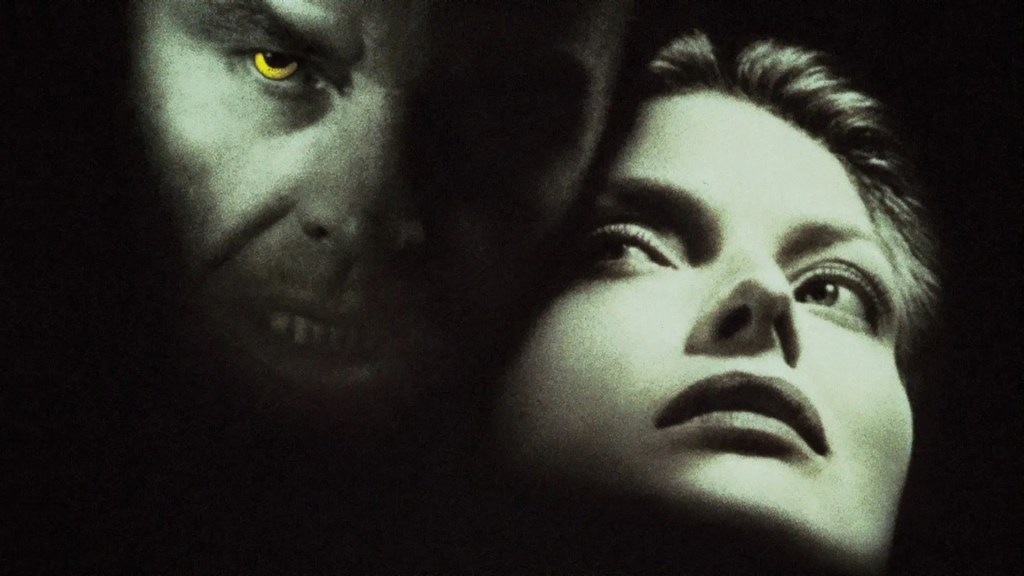
Therefore, the idea to direct Wolf, a movie concocted by his old pal Jack Nicholson and Jim Harrison about a man who wants to reclaim his masculine energy and becomes a werewolf, offered an opportunity to craft a hit that Mike Nichols desired to remain relevant. The problem was that the script wasn’t any good, even after Wesley Strick, who had written Cape Fear for Martin Scorsese, was recruited to rewrite it. Only when his old bestie Elaine May, a well-renowned script doctor whose own directorial career had been euthanized by the failure of her severely underrated Ishtar, took a blade to the script, Wolf became a movie worth making.
What May called a rather short film because it was originally “about a guy who wanted to became a wolf, which he did” was turned into a genre-adjacent psychological thriller about an aging book editor forced out of his career in the wake of a business takeover, who finds new energy to fight for what he wants only after being accidentally bitten by a wolf, and over time he begins to transform into a wild animal. On paper, Wolf looked as though it was going to be one of the biggest hits of the summer of 1994. It followed a short streak of largely successful forays into genre made by prestige directors, like Bram Stoker’s Dracula, The Silence of the Lambs, and Mary Shelley’s Frankenstein and it also starred two bankable stars that promised audience engagement: Jack Nicholson and Michelle Pfeiffer.
Wolf became a minor summer hit as it earned in excess of 130 million dollars worldwide alongside such juggernauts as The Lion King and Forrest Gump. Interestingly, this objectively “small” financial success relative to the enormity of the 1994 box office was also the highest-grossing movie of Nichols’s entire career, placing above Working Girl and The Graduate; though, when adjusted for inflation, the latter would have likely still come out on top. In the context of everything around it, it was a small win. It earned just about as much as James Cameron’s True Lies cost to make. Still, Wolf received some praise specifically for Nicholson’s performance and Rick Baker’s great makeup special effects. Critics commented on the film’s attempt to critique predatory practices in the workplace and scratched their heads at the frequent use of slow-motion during film’s werewolf sequences, so the verdict stayed mixed-to-positive with the emphasis on “mixed.”
Thus, the 1994 Wolf came and went and became a little bit of an oddity because there clearly were more exciting movies for critics and audiences to focus on. And although some commentators picked up on the film’s metaphorical plane by calling it a midlife crisis horror and a veiled treaty on masculinity in crisis, the idea to tether the theme to Mike Nichols was largely missed. In fact, the filmmaker himself saw Wolf as a movie about the AIDS epidemic and even the premiere of the film was accompanied by a handful of fundraisers for AIDS-related charities. But it doesn’t take much to connect these dots now, especially from a safe distance of over three decades since the film’s original release.
In all honesty, even the central thematic thesis of the film alone that persisted in the screenplay since its early drafts—a wish fulfillment fantasy for closet outdoorsmen, eventually expanded upon and infused with crucial nuance in subsequent revisions—is a more potent topic of discussion now than it was thirty years ago. The current conversation about modes of masculinity, enlightened and emotionally empowered stoicism clashing against subservience to toxic traits and the need to shift the focus away from “men being the problem” to “men having a problem” would undoubtedly benefit from the thematic breadcrumbs left behind in Wolf.
What specifically speaks to this fundamental societal issue in the movie is hidden in the dynamic between Will Randall, Jack Nicholson’s character, and Stewart played by James Spader, a young up-and-comer who pushes Will out of his position using sneaky dishonest tactics while performatively humbling himself in front of him in faux deference. It might be easy to overlook this detail but it is nonetheless important that both Will and Stewart end up on the same trajectory of metamorphosis—slowly transforming into wild animals. Will is bitten by an animal he hit with his car and Stewart is bitten by… Will who snaps at him in a momentary lapse of control having found out that not only did Stewart take his job but also slept with his wife.
Even this micro-nuance speaks to the same conversation about perceptions of masculinity, as it is overtly stated that Will’s wife immediately loses interest in him when he loses his job and social status. She turns around to pursue the new “alpha” in the pack. And when Will uses his new-found strength as a reawakened man to get his job back and also literally mark his territory by peeing all over Stewart’s shoes at the urinal—a rather discombobulating on-the-nose piece of comedy I can only imagine Elaine May could have introduced—his wife comes crawling back… only to be rejected because by that time, Will has also understood something more about his predicament. Which we all thought was related to his turning into an animal, while in reality it had more to do with his growing understanding of himself as a man.
Wolf uses familiar archetypal tropes of Will’s senses sharpening and a progressive physical transformation both in service of telling a story about werewolves and as a stand-in for something more subtle—Will’s masculine liberation. Having initially struggled to control his urges and animalistic desires—he does fall prey to violent tendencies and on one occasion gropes Michelle Pfeiffer’s character Laura—Will finds a way to harness them instead of being piloted by them. His confidence grows exponentially, which projects respect of his peers and superiors. That’s what gets him the job back. However, his greatest newly-acquired superpower is not his ruthlessness or awareness of his physical superiority over others. It isn’t his perfect hearing, eyesight or the sense of smell either. It’s his macho indifference.
It is as though Will understood that he no longer wanted or needed to climb the greasy pole of career progression any more. He could mouth off to his new boss and threaten him with radical action exactly because he did not care one jot about the rather likely possibility that he’d get fired on the spot for doing so. It is as though he was a proto-Neo and the wolf that bit him was a furry Morpheus giving him the red pill. He saw through the code. He understood that he lived in the Matrix and hence he was no longer bound by its rules. You can’t win the game against someone who refuses to play it. In fact, this is how the movie concludes—with Will presumably completing his transformation and going off to live in a forest, or Central Park, together with his new partner. As wolves they don’t need jobs, careers or social status. While Stewart became a victim of his carnal desires and turned into an out-and-out villain that needed to be put down like a rabid dog, Will and Laura got to live their lives as they pleased without the need to seek monetary gratification and external validation. Lives of true freedom afforded by their outright refusal to play the rigged game of real-life Monopoly any longer.
Which is exactly what I think Mike Nichols needed to hear at the time when he was making the movie. While he thought he was making a movie about AIDS, which he had his reasons for as well, the movie he ended up making was an equivalent of an intervention. It doesn’t take much to see Will as symmetrical to Nichols, a sixty-something guy who’s stuck in his ways and afraid of losing whatever status he has held onto to young sharks circling his boat and waiting for the first drop of blood to fall into the water to initiate a feeding frenzy. He had spent nearly twenty years hearing a growing chorus of critics telling him that had lost his touch. He was being replaced by younger directors with bright ideas and incredible vision. Movies like Jurassic Park ruled the roost and stuff by Robert Zemeckis was running laps around Nichols. In fact, just a few short years before, in 1989, young Steven Soderbergh opened the floodgates for a new revolution with Sex, Lies and Videotape, a movie that is in many ways a spiritual descendant of Carnal Knowledge, Nichols’s last truly iconic film, thus tacitly suggesting that Nichols was no longer a player in the directing game but an inspiration for young auteurs.
Is it possible that Mike Nichols was the last one to notice that he was trying to succeed at a young man’s game as a sixty-year-old? I want to live in a world where the “masculine intervention for Mike Nichols” interpretation of Wolf was consciously installed in the movie by his lifelong friend and partner in crime, Elaine May. She’d have been perfectly positioned to do so as an incredibly talented writer with a knack for subtext and someone who had a singular connection to Nichols. She most likely watched his struggles from the sidelines, as he volunteered himself to direct George C. Scott talking to a dolphin and agreed to make a movie out of Neil Simon’s WWII stories that could have been titled Diet Metal Jacket or I Can’t Believe It’s Not Full Metal Jacket. If you know, you know. She saw him rise and she saw him fall. And then she saw him fall further and go into a tailspin.
Somehow, Wolf became more than a WB attempt at capitalizing on the renewed interest in classical horror archetypes and a general conversation about men’s issues, which remains one of the main points of interest in the movie to this day, by the way. It is most importantly a pivotal experience for Nichols who reunited with Elaine May while developing it and reignited a professional collaboration that had started his entertainment career more than thirty years earlier.
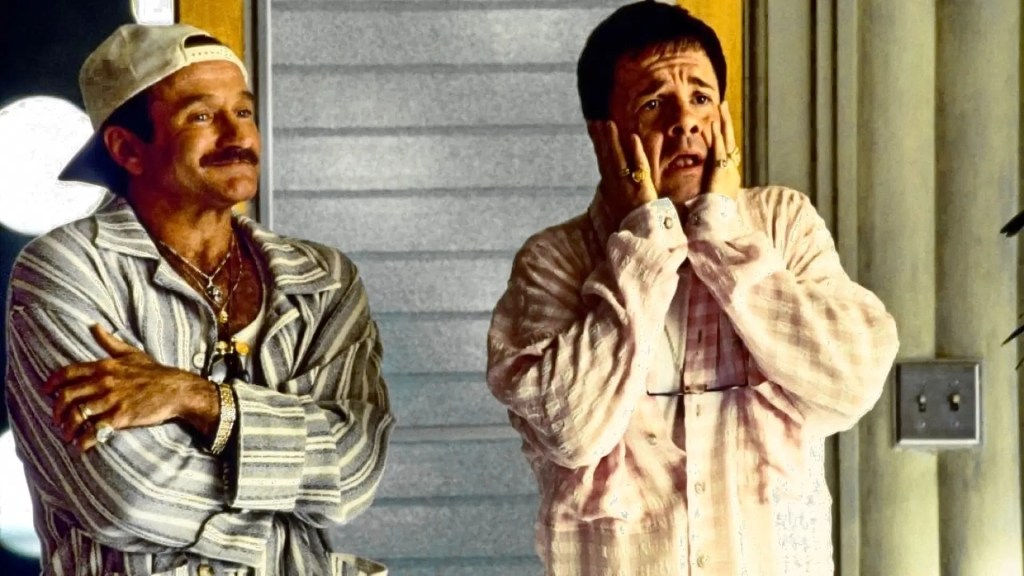
You could say that Nichols needed May to rediscover his true calling and emerge safely from a decade-long tailspin. In fact, Nichols had always been particularly fond of honest collaborations and he succeeded when his screenwriting partners and performers resonated on his frequencies naturally. But Elaine May was always the one who’d keep him in his tracks and maybe when she was hired to rejig Wolf, she turned the movie into a mirror in which Nichols could see himself. I don’t know if she did it on purpose, but it is clear as day that the movie looks as though this could have been the case. More importantly, the fact that Nichols went on to direct The Birdcage shortly thereafter—a movie that became both a smash hit and a confirmation that Nichols still had what it takes to make a great movie that critics could get behind—and he did it both by working with his best friend and by making a movie of the kind he always loved making, is all the proof you need.
Mike Nichols, like Will Randall, got bitten by a wolf. Swallowed that red pill. Saw through the code. And understood that it was futile to play the game and that his desire to be seen as relevant was simply puerile and pathetically desperate. Wolf is the movie that liberated Mike Nichols. Will Randall went on to live in the forest as an animal and Nichols found inner peace and the courage to make movies for no other reason than because they were worth making.



 Flasz On Film
Leave a comment