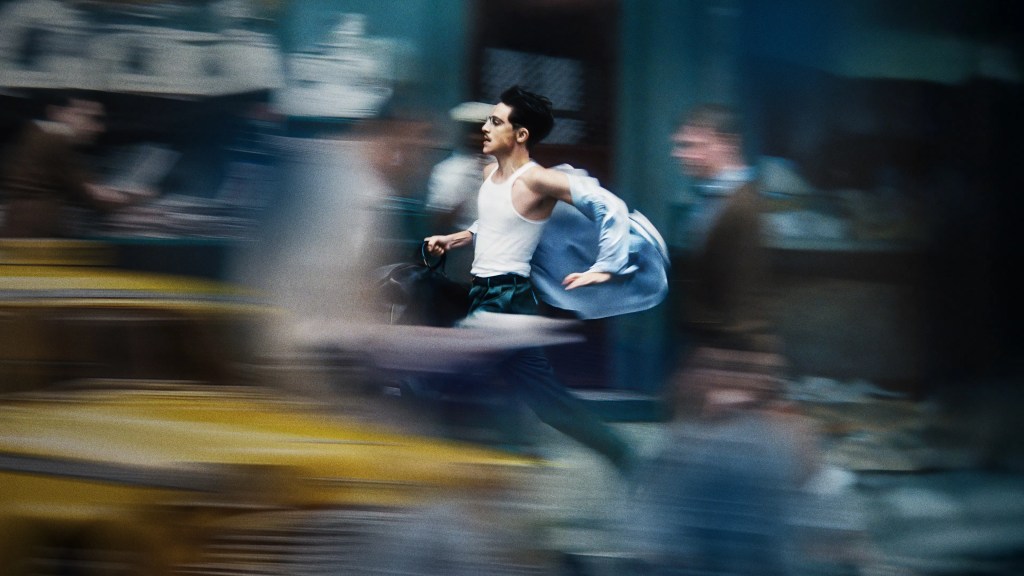

Much like the Coen Brother Separation Experiment, which produced some meaningful initial results recently, The Safdie Iteration of the Brother Separation Experiment is now officially available for an early readout as well. Having access to Benny Safdie’s The Smashing Machine and Josh Safdie’s recent Marty Supreme, we can gently infer—after all, we will require more data points to draw sound conclusions—as to where exactly an artistic aesthetic derives from in a collaborative effort, where the themes come from, who does what, how and why.
The experience of watching Marty Supreme is therefore utterly indispensable and most instructive to any self-diagnosed movie nerd curious enough to ask these oftentimes unanswerable questions pertaining to division of artistic ownership in a directorial partnership. And it doesn’t take long to reach some preliminary conclusions. Just the first thirty-to-forty minutes is more than enough to confidently state that Marty Supreme looks and feels and smells and runs exactly like a Safdie Brothers movie would.
But that doesn’t tell you much, does it? How exactly does a Safdie Brothers movie look and feel and smell and run?
There is a magical balance between naturalistic immediacy of the storytelling and its frenetic pacing, a special kind of intimacy afforded by frequent shaky close-ups and a particular penchant for working with non-actors, using constricted settings and filming everything to look down-to-earth, gritty and rogue that all add up to what I would call a Safdie aesthetic. Their movies—from Daddy Longlegs to Good Time and Uncut Gems—have all shared the same visual and narrative toolbox that positioned their work somewhere in the twilight zone between the movies of John Cassavetes, Abel Ferrara, young Martin Scorsese and Jim Jarmusch. They are all incredibly personal, intimate, soulful and yet they run on high-octane gasoline doped with pure adrenaline, such that the viewer has no other recourse but to persist in a paradoxical state of suspended animation, torn between bleeding from their hearts for the protagonists’ doomed pursuits and tearing their hair out by the handful and driven to madness by their astonishingly abysmal decision-making abilities.
Think about Lenny from Daddy Longlegs, a down-on-his-luck divorced projectionist trying to take care of his two sons during a short time when he gets to see them unsupervised, and how he proceeds to make terrible choices one after another, which leads to endangering his sons’ lives. Think about Howard from Uncut Gems and how his untreated gambling addiction leads him to make increasingly ridiculous decisions in pursuit of “winning it all,” without even contemplating the indescribably perilous position he’s putting himself into with each passing minute. This is a Safdie pattern: introduce a likeable scrapper, set him into motion, watch him navigate the fringes of society and begin spiraling towards the black hole of total mental breakdown; and film everything with that Cassavetes-meets-Ferrara-meets-Jarmusch combo.
The same exact pattern emerges in Marty Supreme, a movie based very loosely on the life story of Marty Reisman, where we follow the exploits of a young and cocky table tennis prodigy Marty Mauser (Timothée Chalamet) as he loudmouths, weasels and swindles his way between the gutter and the New York high society while chasing the dream of becoming a national icon. That’s the best I can do to summarize the movie without venturing into the many minutiae of its sprawling plot, which sports a myriad branches, outgrowths and tangents, all adding color to Marty’s pursuit, increasing the temperature of the entire experience and perhaps occasionally veering into unwarranted narrative complexity. It’s all about a young guy’s journey chasing immortality complicated by the fact that his girlfriend (Odessa A’zion) is pregnant, he lost a dog that belonged to a local wise guy (Abel Ferrara), he entangles himself in an affair with a faded Hollywood star (Gwyneth Paltrow) and he tries to use her cuckold husband (Kevin O’Leary) as a financial springboard to get him to Japan to win the championship. It’s a bit of a rollercoaster.
It honestly does not matter at this point. But it does create the mosaic of the viewing experience and lays the foundation to create the same kind of emotional stranglehold you ought to remember from the time you watched Uncut Gems or Daddy Longlegs… which is exactly what you need to determine that Marty Supreme, a movie directed by Josh Safdie without his brother Benny participating in the process, is formally, aesthetically and experientially indistinguishable from a movie technically made by the Safdie Brothers. Meanwhile, The Smashing Machine bears only vestigial resemblance of it. Josh is clearly the “dominant” Safdie.
Perhaps this ought not to come as a surprise to anyone who has traced the Safdie trajectory to its origins and watched The Pleasure of Being Robbed, a movie technically solo-directed by Josh Safdie; which also bears the same qualities and explores the same narrative ideas you will find in spades in Marty Supreme. If anything, Marty Supreme functions mostly as an evolution of the craft in that its production was far less rogue and haphazard and more deliberately prestige-adjacent, while its engine—a Safdiecharged V8—remained essentially untouched. Some would say that this movie might be an outright ploy to generate awards appeal and act as an Oscar buzz incubator of sorts, especially after last year’s win by Sean Baker’s Anora, a similarly energetic and emotionally frazzled experience rooted deeply in the indie tradition. And they might as well be right. Who knows? But it is also highly likely that Safdie’s movie reaches through Baker to reconnect with the archetypal underdog movie with a sports element, the most well-recognized example of which is undoubtedly the John G. Avildsen-directed masterpiece Rocky.
In fact, Marty Supreme essentially works as a reimagining of the same ideas that Rocky explored almost exactly fifty years ago. Stallone’s Balboa was just as scrappy and loudmouthed as Marty Mauser and his journey culminating in the iconic bout against Apollo Creed similarly functioned as a test of the protagonist’s mettle and it equally served as a way for him to realize what his true priorities in life actually were. While Chalamet just doesn’t have the same presence as Stallone had for obvious reasons—he is a thoroughly Gen-Z sex symbol with his skinny and non-intimidating demeanor—his story as told in Marty Supreme hides the Rocky framework within that quintessential Safdie bedlam and distracts the viewer with frequent sharp turns and completely unexpected twists while additionally discombobulating with anachronistic music choices.
You wouldn’t accuse Stallone and Avildsen of concocting a scene in which Rocky Balboa would fall through the floor while taking a shower and break an arm of a gangster while he was giving his dog a bath. Equally, you’d not find a scene in which Stallone gets his backside paddled by a local business mogul in public. But both scenes are present in Marty Supreme, which contributes to the chaos required to keep you in a rear naked choke and actually gives you a chance to miss the obvious realization that what you are watching is essentially Rocky. With extra steps. And a cherry on top. And a whole lot of scenes that involve people getting angry and faces getting blown apart by shotguns… all the while the stage is being set for an epic showdown and Marty Mauser’s equivalent of shouting “Adrian!!!” while the credits rolled, which amounts to weeping in unbridled catharsis while seeing his newborn baby.
I suppose what I am trying to articulate is that what Marty Supreme is after you strip the critical buzzwords away is a thoroughly familiar experience that capitalizes on the energy of previous Safdie movies—which we now can surmise is derived mostly from Josh Safdie’s artistic drive—while also building on a tried-and-true capital of Rocky, the seminal underdog piece that also happened to be filmed under the spiritual patronage of John Cassavetes. However, the meme of Uncut Gems meeting Rocky does not seem to directly self-amplify. Two phenomenal movies do not furnish an even greater film when launched at each other at high speeds.
This high-energy hybrid is, objectively speaking, incredibly watchable, profoundly entertaining and dischargers emotional electricity at every opportunity, but it somehow fails to eclipse either of these two movies that it most clearly looks up to. It sands down the Safdie roughness that Daddy Longlegs, Uncut Gems and Good Time thrived on while also complicating the fundamentally relatable arc of a Rocky-like underdog with numerous ancillary subplots and tangents which mostly serves to obfuscate the emotional exhilaration due at the climax. While it definitely remains a strong contender for the upcoming Oscar race and undeniably furnishes its audiences with a good time at the movies, Marty Supreme somehow succeeds best at reminding the viewers that they haven’t watched Uncut Gems and Rocky in a while. And these two movies are just better: simpler, less meandering, more energetic and precise.



 Flasz On Film
Leave a comment