I sat down the other night and barricaded myself in the living room. Surrounded by rolls of wrapping paper, strings, bows and stickers and with a stack of assorted merchandise I was almost ready to begin the annual ritual of wrapping presents only to see them unwrapped in under forty-eight hours. The only ingredient missing was a movie to put on in the background and set the mood for the event.
For as long as I can remember, I have been wrapping gifts to the accompaniment of National Lampoon’s Christmas Vacation, which happens to be my favourite Christmas classic. Somehow, the idea of sitting on the floor and carefully wrapping Lego sets and the like with Clark Griswold slowly losing his marbles in the periphery of my vision qualified as blissful and perfumed this otherwise mundane task with the essential holiday spirit.
This year, however, I decided to change things up a little bit. Variety is the spice of life, as the adage goes. I thought it would be a good idea to put on Gremlins as background viewing to infuse the gift-wrapping process with a different brand of oomph. After all, I have always enjoyed this Joe Dante movie, both as a piece of nostalgia-driven entertainment that carried me right back to my salad days when I watched it frequently on my own thirteen-inch tube TV, and as a Christmas-suitable genre movie with some spice to it.
To be honest, I’ve seen Gremlins enough times in my life to feel qualified to say that I know it like the back of my own hand. Between Gizmo’s cheery tunes, kitchen bloodbaths, Ms Deagle being launched into the stratosphere in her stair lift, all the Gremlin rules and that final confrontation with Spike complete with a truly unforgettable special effect of the final Gremlin boss dissolving into nothingness, this movie is nothing but a timeless classic full of immediately familiar scenes, memorable moments and flourishes of chuckle-worthy levity. Just a piece of harmless 80’s entertainment leaning heavily on its outstanding puppetry and a Spielbergian edge that just about passes the test of a four-quadrant blockbuster while also riding close to the edge of intensity that younger viewers would find acceptable or palatable.
But this time something was different. As I was ensconced in wrapping gifts with my signature mix of second-rate dexterity and first-rate zeal, the images registering through peripheral vision made me stop and watch the movie a bit more closely. “Wait a minute,” I muttered to myself. “Hold on a second,” I followed while putting the scissors down.
Has this… always been this way? Am I seeing things? Is Gremlins secretly… right-coded?
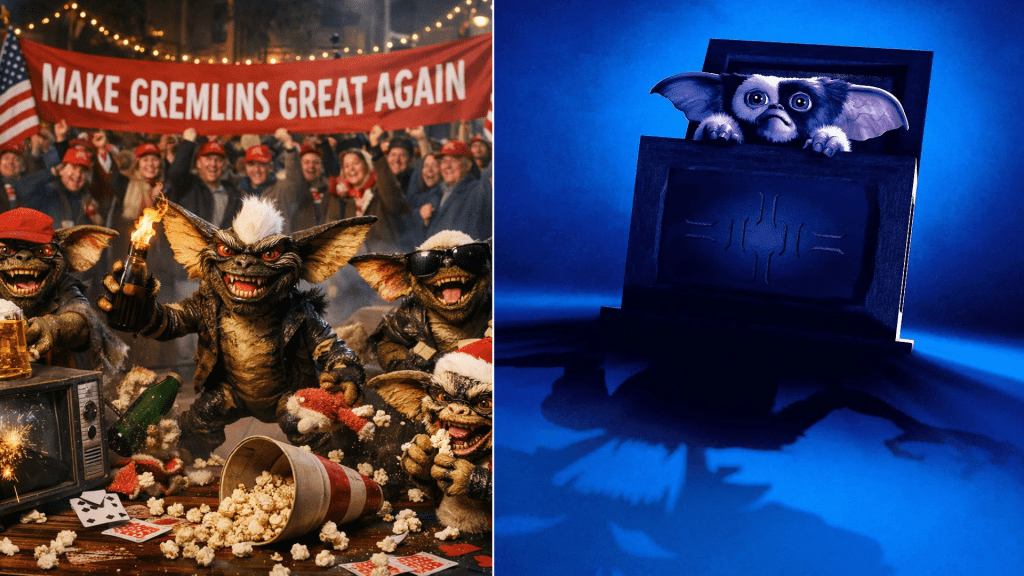
The more I watched, the more convinced I became that this 1984 movie somehow reverberates the kinds of MAGA-coloured talking points I have heard shouted at me from all corners of the online experience all throughout 2025. Somehow, this seemingly innocuous movie about a bunch of fantastical creatures ruining Christmas and wreaking havoc in an otherwise sleepy American town appeared to be carrying isolationist messaging rooted in xenophobic fear-mongering.
When you think a little bit about what Gremlins is about, you might see that this Christmasy-looking flick seemingly harbours an overt “America First” reading that is ready to be weaponized by politically-inclined forces if they chose to do so. Where does the old man Peltzer get Gizmo from? Chinatown. Gremlins are essentially foreigners smuggled to America. They represent the fear of the other. They come over with their weird rules and customs and it is childishly assumed that they will assimilate and embrace the American way. When the old man Peltzer learns that Gizmo reproduces when sprinkled with water—a rule that makes little sense if you give it a second—he immediately thinks about capitalizing on this. He’d be OK with selling a mogwai to every American family if it made him a fortune in the process. He wouldn’t care less about the potential dangers of other families reproducing the mogwai exponentially and flooding the country with them, let alone remembering not to feed them after midnight—another rule that canonically never held any water.
It’s really out there in the open. In the text. Gremlins are an invasive immigrant force that has very little regard for the American way and when mismanaged—which happens almost immediately—drives the country towards ruin. It’s almost an overtly Trumpian dog-whistle when you read out loud what the movie is saying. They’re even… eating the pets.
I sat there with my mouth agape at what Gremlins was seemingly—and outwardly, it looked like—attempting to communicate. The dots were all there for me to connect. In that scene where Billy Peltzer unsuccessfully tries to fire up his car, what make is the car? A Volkswagen Beetle. A foreign car. Mister Futterman even rolls along to make that connection for you as he bemoans that foreign-made cars are terrible quality. Meanwhile his made-in-USA Kentucky Harvester is seemingly indestructible. It is as though the movie was supporting the idea of re-shoring goods manufacturing because imported products were inferior to those made in the Land of the Free.
In fact, this conversation doesn’t stop there. It cuts even deeper when we take a closer look at the Peltzer family, or specifically the man of the house who is a failed inventor-stroke-entrepreneur incapable of inventing a product that would be both innovative and useful. This is a great source of comedy in the movie—like that smokeless ashtray that nearly suffocates a guy, a lethal juicer or a multi-padded flyswatter—but it is also a tacit suggestion that the American entrepreneurial spirit might have gone awry. That America no longer produces goods useful to consumers, who feel forced to import them from abroad. While American inventors are busy entertaining their own whims at corny-looking conventions full of genre winks and callbacks to Forbidden Planet and The Time Machine, the markets are flooded with inferior imported goods… filled with those pesky Gremlins. It’s only one logical step away from openly calling for tariffs on imported products as the only sure-fire way to “protect American interests” from havoc-seeking Gremlins.
Once I saw it, I could no longer unsee it. All of a sudden, Joe Dante’s Gremlins ticked all the boxes to be implicitly read as a MAGA-compatible text that speaks against supporting foreign companies and their inferior products while also equating foreigners to an invasive force capable of uncontrollable multiplication carrying absolutely no tolerance or respect to American customs and traditions. We see a Gremlin exhibitionist, a violent thug, a bunch of vandals, a group of carolers butchering a Christmas classic. It’s all in jest but the subtext was there when I saw it. It was a festival of xenophobic generalizations and I didn’t know what to do to force my brain to forget that I ever noticed it in the first place. It somehow didn’t register with me that it was all supposed to be intended as deeply satirical.
This simply must be the case as it is recorded knowledge that Joe Dante would likely have counted himself as a staunch opponent of right-coded politics. His movies like Innerspace and The Burbs carefully critiqued the fallacy of the American Dream and carnivorous capitalism innate to the American experience. And Gremlins also fits this mold because all these talking points I mentioned above are elements of satire lampooning this worldview. But satire only works as long as the viewer realizes it is so. Especially now, in times of dire uncertainty, weaponized fakery and reappropriating facts to suit political talking points it is possible that a movie like Gremlins could be read not as a takedown of Reaganite “americafirstism” but as its endorsement. Satire reproduces fear while mocking it. These dots are right there, waiting for you to connect and if you stop short of asking if this is supposed to be taken seriously or not, you might as well adopt this movie as a confirmation of your own preexisting political leanings, even though it was supposed to challenge them.
It is actually quite well documented that despite the fact that depiction does not equate endorsement, many movies end up watched “the wrong way.” Films like Taxi Driver or Fight Club openly critique, satirize and comment on dark avenues of masculinity and dangers of echo chamber thinking, yet you will still find people who see them as instruction manuals instead. Equally, I bet that some finance bros gather periodically to watch The Wolf of Wall Street while fist-pumping and howling at the debauchery and excess that Martin Scorsese’s movie depicts for the purposes of critique.
In the end, I think I can still enjoy Gremlins the way I used to; the way I think it was intended to be enjoyed. It is still a fun 80’s movie I can throw on with a deeply embedded satirical angle lampooning right-wing thinking and materialistic consumerism. But now I have a sneaking suspicion that it might also be a film that MAGA cultists could watch completely differently, cheering at different beats, wincing in disgust at what I used to think was harmless comedy. Does Donald Trump watch Gremlins like this? Does he watch Star Wars and cheer for Darth Vader? Does he root for Travis Bickle’s ambition to take care of who he calls scum?
At the end of the day, I think it was a bad idea to break with tradition this year. Had I put on Christmas Vacation like I was supposed to, I would have wrapped all my gifts within the ninety minutes this movie affords and the matter would have been resolved. Having watched Gremlins instead, not only have I come close to ruining a childhood classic for myself, but I also failed in the primary mission of getting all my gifts wrapped in time for Christmas and had to stay up well into the wee hours of the morning instead. And losing sleep around Christmas, with numerous chores and tight kitchen-related deadlines is ill-advised.




 Flasz On Film
Leave a comment