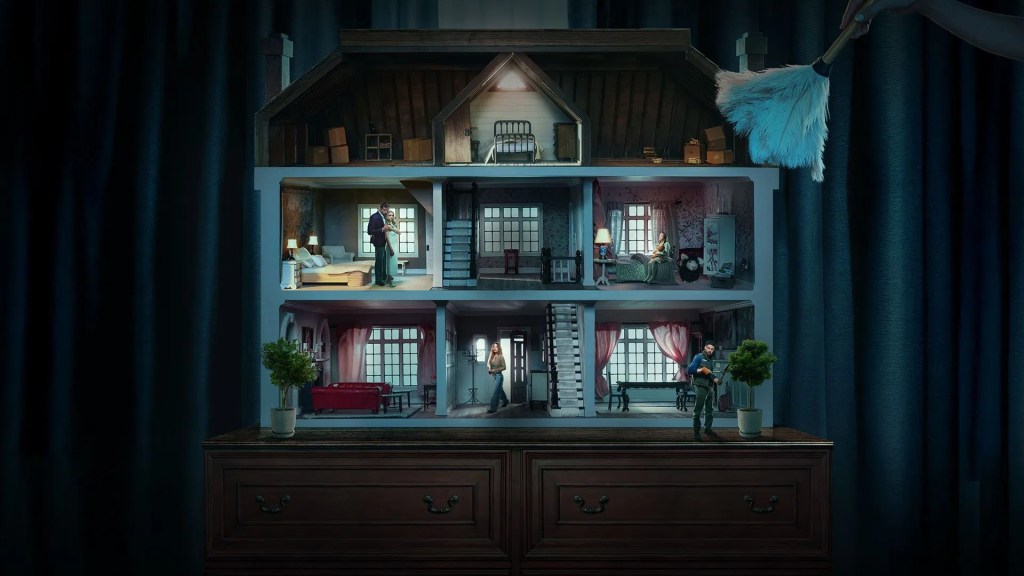

Synopsis: Fresh out of prison, Millie Calloway (Sydney Sweeney) takes a live-in maid job with a wealthy Long Island family, only to find herself drawn into a household defined by paranoia, locked doors, and an unsettlingly unstable marriage.
Adapted by Rebecca Sonnenshine from Freida McFadden’s bestselling novel, The Housemaid is a movie that cements Paul Feig’s departure from his directorial comfort zone of edgy comedies like Bridesmaids and The Heat. Having previously directed A Simple Favor and its sequel Another Simple Favor, the idea of now coming back with another movie in the space of highly polished psychological thriller with conceptual twists and gender-coded thematics traceable to authors like Gillian Flynn is just about enough for audiences to stop seeing these movies as curiosities but as a genuine direction of travel for this filmmaker.
For what it’s worth, I welcome this development because from what I have seen, Feig seems perfectly at home in this space and manages to craft experiences that are perfectly entertaining despite lacking in fundamental originality. In fact, The Housemaid almost plays on expectations set by the filmmaking style—which is rather plain and visually evocative of off-the-shelf romances you’d expect to find on streaming services or in cinemas around Valentine’s Day—and curates a suggestive tone of superficial familiarity.
But it is all a ruse. A trap set up by the storytellers who want to manipulate our own preconceived notions and set up a twisty thriller that actually goes places you wouldn’t expect a movie that looks like this to go in the first place. It’s one of those experiences that looks perfectly timid, familiar and easy to decode. The characterizations of its main leads played by Sydney Sweeney, Amanda Seyfried and Brandon Sklenar are written in all capitals and they slot into their prefabricated roles with ease as we navigate a story that looks perfectly innocent and cute with its attempts at building psychological dread, explorations of gaslighting and describing a world that seemingly exists only in novels found at airport book stands. Feig manages the perceived clash of energies between Sweeney and Seyfried as he builds expectations upon which he is able to capitalize when the rug is eventually pulled and the story makes a turn.
This is perhaps where The Housemaid somewhat stumbles because what the narrative sets up and how it is all executed fundamentally works but not without resorting to protracted explanations. It is as though the viewer could not be trusted to connect a few dots themselves. Nevertheless, the movie sticks this landing, even if with a noticeable wobble. It is nowhere near as intriguing or thematically engaged as Gone Girl, not to mention the fact that Feig is a far cry from David Fincher when it comes to directorial control and sharpness of visual execution, but The Housemaid adds up to a satisfying experience and earns its long running time.
Without going into too much detail—after all, this is a movie you might want to go and see completely cold to give yourself the best chance to enjoy it—it’s a date movie with a little bit of zest to it. A romance that preys on gender preconceptions in an overt way and then punts itself into a squirm-adjacent territory inspired by thrillers whose titles I shan’t disclose to make sure I wouldn’t divulge too much and accidentally ruin the surprise the movie sets up. However, even knowing that there is a surprise to be had is enough to ruin things here. I went to see The Housemaid blind and so should you. So, if you’re six hundred words deep into reading this text and you haven’t seen the movie, you have now done yourself a massive disservice.
After all, this isn’t a timeless masterpiece. The Housemaid is a perfectly disposable genre piece that’s skillful and playful in its treatment of tropes and character expectations with an effective twist in the middle and a bout of exposition that probably could have been trimmed down. But it is entertaining and effective nonetheless. Sydney Sweeney and Amanda Seyfried clearly understood the assignment and, under Feig’s straightforward direction rooted in genre staples, made sure that The Housemaid could be seen as a perfectly serviceable piece of entertainment. You are most likely to watch it only once in your life so you might as well make a go of it. The Housemaid is not going to change anyone’s life. It’s too conventional and plain to do so. But it works.





 Flasz On Film
Leave a comment