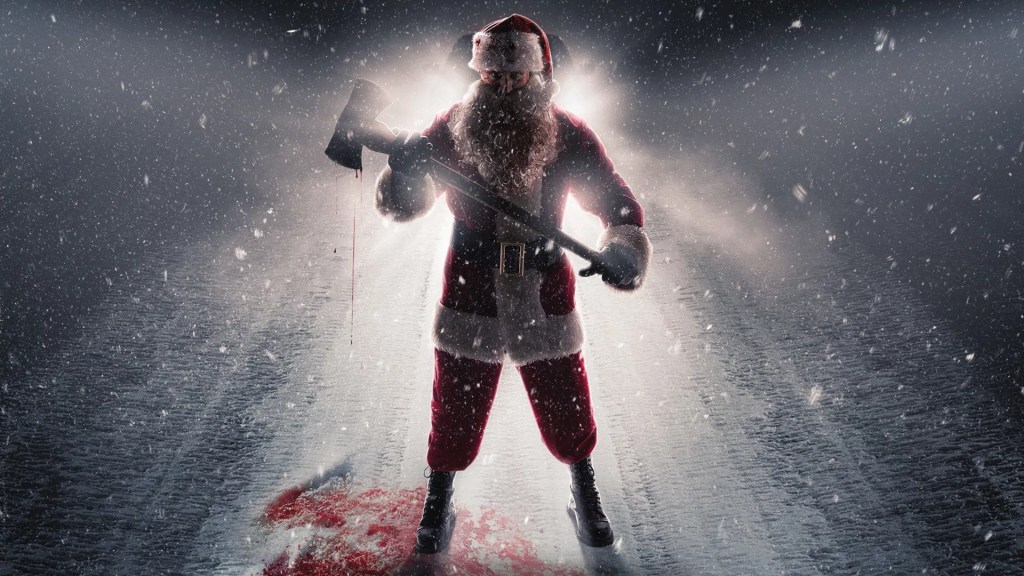

On its surface, the 1984-released Silent Night, Deadly Night presented itself as an attempt at cashing in on the slasher trend, as it essentially added a Christmas gimmick to what looked like a canonical execution of the Halloween template. And perhaps if it hadn’t been for the outrage coming from various conservative groups reinforced by the panning and shaming executed by high-profile critics, the movie would have likely come and gone.
Instead, after it was pulled from cinemas shortly after its release and having gained some additional notoriety thanks to some countries refusing to rate it for release, Silent Night, Deadly Night became a bit of a cult item in no time. After all, there is an element of base curiosity driving viewers to see exactly why many self-avowed evangelical bible-thumpers believed that a movie about a deranged guy dressed as Father Christmas going on a violent killing spree with an axe was likely to deprave children (who had no business going to the cinema to watch it in the first place) and would ruin the spirit of Christmas. You can call it a proto-Streisand effect if you want. The outrage caused people to take interest in the movie that so many people wanted everyone to look away from and hence it was only a matter of time before a franchise would sprout.
The movie was reduced to its basic ingredients and a number of sequels where an archetypal slasher villain would chase people around with a murder weapon while wearing Santa garb shortly saw the light of day. A grand total of four sequels were produced between 1987 and 1991, two of which had absolutely nothing in common with the 1984 original. In 2012 a remake titled Silent Night was also produced and today, forty-one years after the original ill-fated release of Silent Night, Deadly Night, a new take on this story was presented to us, almost in time for Christmas itself.
What I find particularly interesting about the new-and-improved 2025 edition of Silent Night, Deadly Night is twofold: it is clearly a movie made by people who seemed to understand that the original carried some depth underneath the superficial idea of letting Michael Myers don a Santa suit and go nuts; it is also a movie that interrogates the cultural shift that took place over the last forty years, which the viewer might notice having compared the two movies a bit closer and understood that essentially the same story can illuminate different nuances, try a few new things and fall into a handful of brand-new traps as well.
This new movie directed by Mike P. Nelson (who directed the seventh movie in the Wrong Turn franchise and a segment in the V/H/S/85 anthology) identifies and recreates the core of the original story where a young boy named Billy witnesses the brutal murder of his parents by a man in a Santa outfit, which scars his psyche permanently. However, in contrast to the 1984 original where young Billy was then subjected to abuse at the hands of nuns running the orphanage he lived in and then, later on, his long-suppressed trauma forced him to snap after donning a Santa costume at work thus beginning his spree, the adult Billy in here (played by Rohan Campbell who previously portrayed Corey Cunningham in David Gordon Green’s Halloween Ends and Ricky in The Monkey) is already a serial killer when we meet him. He doesn’t need a trigger. He drifts from place to place, kills seemingly random strangers, and marks each kill in his creepy-looking advent calendar. Also in a departure from the canon, Billy is not alone in his quest as he is accompanied by Charlie (Mark Acheson), a voice in his head that tells him who to kill and why and also supplies extra-sensory information Billy would have no business knowing on his own. He’s essentially got his own personal Venom-esque mental passenger who makes him violently murder people with an axe every so often. And, as it turns out later in the movie, Billy and his inner voice follow a highly specific code, which makes Billy look a bit like Dexter Morgan in a Santa outfit.
As the movie unfolds its narrative, which retraces somewhat the familiar beats of the original while also nodding to its iconic kills (like the antler scene, the bow and arrow moment as well as the snowmobile decapitation sequence), the filmmakers both improve over the original and detract from its own allure to a significant extent. The 1984 Silent Night, Deadly Night was paced to resemble the acceleration curve of an 80’s turbo-diesel Volvo with a four-speed automatic gearbox attempting to overtake a car. Depressing the gas pedal would initially result in a good handful of seconds where nothing happens because the transmission needs to downshift, then the turbo gracefully spools up and after three-to-five business days you will notice that all the ponies hiding under the bonnet have been awoken and engaged. It took nearly fifty minutes for the original to get going, but when it eventually did, stuff just happened, the axe got busy and fake blood was everywhere.
This movie does not have a lull like that. Instead, violence and gore are dished out in regular intervals as we familiarize ourselves with Billy and decide whether we are supposed to pity him as a victim of untreated trauma or simply engage in voyeurism as he goes about his business of surgically embedding his axe in people’s skulls. In fact, the filmmakers seem to have understood that the original already contained this conversation within, albeit rudimentary and nearly completely under-explored. Billy has always been an ambiguous character that transcended the template of an irredeemable slasher victim bent on killing everyone who stood in his way. He was not evil incarnate but a victim of crime and abuse who was left behind by his community and turned into a ticking time bomb, waiting to snap at any moment. In fact, maybe the reason why conservative groups wanted the movie destroyed at the time of its original theatrical release was not because it was a threat to Christian tradition of Christmas which is supposed to be cheerful and jolly, but rather a subversive takedown of Christian institutions where abuse runs unchecked, like that orphanage managed by a convent of nuns.
The 2025 Silent Night, Deadly Night carefully dispenses with this solemn critique and instead introduces a supernatural element which suggests that Charlie’s voice is some kind of a transferrable killing force or a magical intellectual parasite, perhaps partially inspired by the mostly forgotten The Hidden from 1987. While the “original” Billy was a product of his conservative society with unregulated access to firearms and a penchant for wholesale sexual repression who lashed out indiscriminately against people he deemed “naughty” based on their perceived promiscuity, the new-and-improved Billy is essentially an anti-superhero. Like I said—Venom in a Santa outfit with Dexter Morgan’s code of ethics. His choices as to who’s naughty and who’s not follow political demarcations too. He goes after an innocent-looking older man who is found to have brutally murdered his own wife in an act of misogynistic fury. He dispatches a ring of boy-snatching pedophiles. He stages a brutal massacre at a party of blatant Nazi-sympathizers who hoped that America would embrace a different kind of “white” Christmas—a White Power Christmas.
The 1984 Billy slotted perfectly into the milieu of its time where slasher villains represented repressed sexual anxieties and symbolized the dangers of sexual revolution creeping into suburban backyards. Even though he was a bit more subversive than many other slasher killers of the time, it wouldn’t have been out of place to see him as the same expression of conservative fears as Leatherface, Freddy Krueger and Michael Myers. This one, however, is an emotionally-repressed agent of the political left who kills rogue law enforcement officers, far-right scumbags and toxic men.
And this is exactly what makes the new Silent Night, Deadly Night an interesting specimen. The only problem is that I think the movie wants to do too much too quickly and rushes towards establishing a franchise instead of leaving some more room for the movie to thrive on its intriguing thematics. The gimmick of supernatural transference of Billy’s mental passenger is already an indication that the movie can go on organically and become a series by virtue of having us jump into a different character next time round but this is also where the filmmakers choose to complicate matters further. They don’t want us to figure out all by ourselves whether we’d want to see Billy as a Michael Myers-type killer, a Venom-like superhero or a Travis Bickle-type lone wolf who lives too much in his own head. They tell us which way to swing and effectively dismantle the film’s slasher constitution while setting up an ending that would both kick off a franchise and completely redeem Billy in our eyes as a misunderstood, neurodivergent victim of untreated PTSD.
I think this would have all been fine with extra ten minutes of storytelling where we could coexist with Billy—and Pam (Ruby Modine), his girlfriend prone to violent outbursts and displays of acute emotional dysregulation—for just about long enough to comprehend his inner turmoil well enough to remain confident that by hanging onto his shoulder we’re not tacitly approving of acts of mean-spirited sadism akin to Terrifier. Instead, Silent Night, Deadly Night sets up the foundation for a potent discussion and then flubs it all because it’s markedly easier to default to convention and familiarity instead of trusting that the viewer would get the message. Alas, we can’t have everything, can we?
If anything, I’m glad that Silent Night, Deadly Night spawned a remake that seemingly grasped with ideas that were embedded in the franchise lore four decades ago. It remains an entertaining thematic counterpoint to the original that perhaps tries to stuff a bit too much into the narrative while also hoping to secure its own longevity. It’s a mess, I’ll grant you that. It’s ridiculous, overwritten and underdirected. And occasionally completely consumed by its own stylizations. But as far as messes go, it’s a fun one. More to talk about than to watch, but fun nonetheless.
 Flasz On Film
Leave a comment