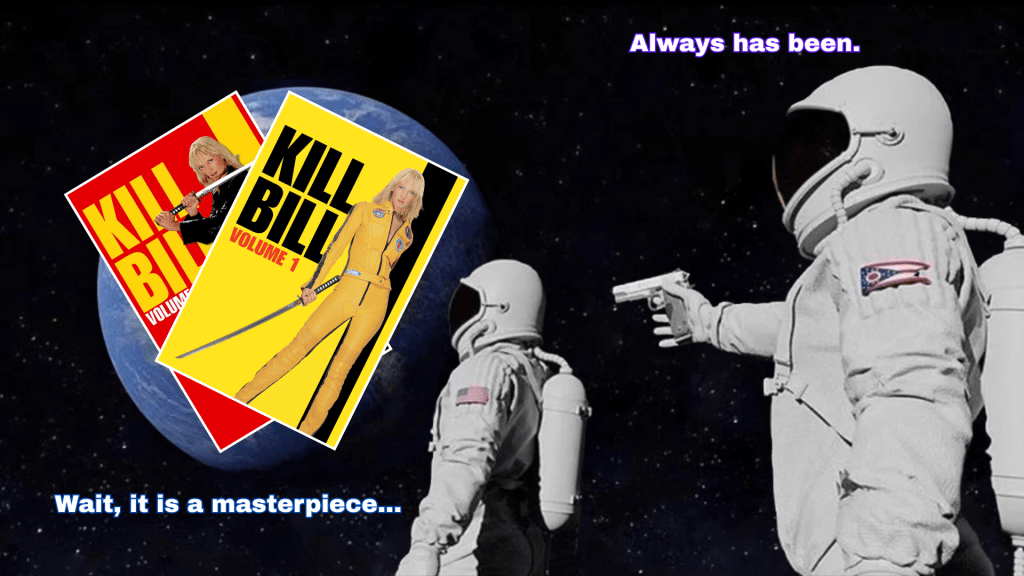
It is a well-established fact that Quentin Tarantino’s Kill Bill was supposed to be one movie. In fact, the man has always referred to it as such, especially when threatening fans and the world at large that he’d retire having directed just ten films. According to Tarantino’s calculations, he still has one bullet left in the mag; if we were to count Kill Bill as two separate entries, Once Upon a Time in Hollywood would have counted as his final picture, which means curtains.
What is known as Kill Bill: The Whole Bloody Affair, a reunified cut Tarantino screened out of competition at the 2006 Cannes Film Festival, could thus far only be seen by select few: those lucky enough to have gone to Cannes in 2006 and those who could watch it at one of its limited screenings at Tarantino’s own Beverly New Cinema and also the Vista Theater. Until now, that is. The Whole Bloody Affair is now available worldwide, mostly in limited theatrical engagements and I strongly suggest you put your shoes on and leave the house to watch it. And when it inevitably lands on store shelves in physical form, I equally suggest you pick it up, if for nothing more than the love of the physical media game.
And why should you spend north of four hours immobilized in a cinema chair, which I hope to Jesus that it reclines at least slightly? Because Kill Bill is an amazing movie and any opportunity to see it theatrically is an opportunity worth pouncing on. Alternatively, you can read some reviews and pieces of SEO-first clickbait which will tell you that we’ve been waiting for twenty years for this movie to be shown the way it was intended. That this reunified cut is the masterpiece we have been patiently waiting for. That much like the title card at the end of this awe-inspiring blood-soaked revenge saga suggests that “the lioness has reunited with her cub and all is right in the jungle,” the two volumes separated at birth are now reunited once more. And that all is well in the entertainment jungle too.
Which is where my eyebrows raise and my lips twist into a smug grin because the critical reception of Kill Bill: The Whole Bloody Affair suggests it is just incomparably better than what we have had access to before, i.e. Kill Bill Vol. 1 and Kill Bill Vol. 2, by a country mile. Are you guys sure about that?
Well, first of all, how do we know that Kill Bill: The Whole Bloody Affair and what Tarantino and Sally Menke presented to Harvey Weinstein when post-production was completed are the same thing? Has it always been a movie split right down the middle into two distinct halves? I guess we’ll never know. Maybe it always has. Or maybe the movie as envisioned by the filmmaker was completely different and what we have now in cinemas is the best we can obtain based on the fact that the original cut was deconvoluted, spliced, re-edited and rejigged to make sure as little footage as possible was lost upon release. But that’s just a hypothetical and it really doesn’t mean much in the grand scheme of things.
What I do find slightly amusing, however, is the narrative built around the reunified cut of Kill Bill that has grown its own cult following over the last fifteen years or so, mostly fueled by elitism intrinsic to the idea of having seen something that only truly small numbers of people were ever privy to. It is as though the wide release of The Whole Bloody Affair was akin to a seismic shift that somehow closed a tectonic rift and we no longer have to take a long detour around it and from now on, this would be the only acceptable way to view Kill Bill. This also implies that the four-hour cut is vastly superior, clicks better and fixes all inadequacies that had stopped viewers and critics from appreciating this movie before. But does it?
So, I want you to lean in for a second because I’m going to tell you something in secret: It’s the same movie. Not kidding. I have seen both volumes enough times to know. And before you scroll all the way down to leave a well-actually comment—I am aware. I know the anime sequence has an additional scene in it. I know the cliffhanger closing the first volume was removed and that The Bride and the audience now learn her daughter is alive together. I know the fight sequence at the House of Blue Leaves previously desaturated to appease the MPAA (with a clever framing of “blinking” the colour away) was restored and that all the little frames of gore and arterial spurts have been reinstated from where they had been amputated originally. I know that Uma Thurman’s black-and-white recap was only a product of necessity and thus it was not needed in a reunified movie. But these are merely cosmetic changes. Just like it was Weinstein’s commercial drive to sell twice as many tickets that likely resulted in the original split.
But Kill Bill: The Whole Bloody Affair is still the same Kill Bill I have lovingly indulged in watching as a duology of two volumes. In fact, I have frequently watched both volumes on the same day with a small bio-break in between volumes… just like Tarantino intended, it seems. And I am here telling you that the movie I went to the cinema to watch last night produced the exact same euphoria. Which leads me to make what might be construed as a provocative statement.
Maybe—just maybe—it is possible that people have originally misunderstood Kill Bill and now, with the benefit of hindsight and with enough water under the bridge they would like to acknowledge that Kill Bill is and always has in fact been a masterpiece. You have to remember that in 2003 the reception to Kill Bill Vol. 1 was favourable but mixed. It wasn’t a rave. Sure, guys like Ebert and others knew greatness when they saw it, but a good chunk of general viewership didn’t know what to do with this movie. And that’s because it was a massive departure in terms of style, aesthetic and tone from the kind of movies Tarantino had made previously. It was nothing like Reservoir Dogs, Pulp Fiction or Jackie Brown. Kill Bill Vol. 1 was a completely different beast. Drenched in blood, saturated with overt nods to highly stylized movies and deliberately fake in the way films Tarantino chose to pay homage to were, like Lady Snowblood, samurai epics, or a whole host of Yakuza movies and Kinji Fukasaku’s oeuvre. Not to mention Bruce Lee and Brian De Palma.
It was a clear and confident stylistic pivot that required viewers to adjust their scopes in order to appreciate what Tarantino was trying to achieve. Kill Bill Vol. 1 was tonally jarring yet incredibly precise. It was funny, self-aware and wince-inducing in a way Tarantino’s previous movies simply weren’t. By the time the second volume rolled out, things were different though and Kill Bill Vol. 2 received much more support from critics and general audiences who had had the chance to acclimate to this shift. Still, many bemoaned what they saw as protracted pacing and indulgent screenwriting, as though they had not noticed that once again the filmmaker performed a pivot and refocused around hyper-stylized homage to kung fu classics and spaghetti westerns of Sergio Leone and Sergio Corbucci, with a few winks here and there at Tarantino’s own favourites like Rolling Thunder in blink-and-you-miss-it references.
But it was all by design. The indulgence. The tonal shifts. The fake-looking violence. The aesthetic jaunts. The oftentimes glacial pacing and deliciously stylized line deliveries. Kill Bill was an unannounced handbrake turn performed at speed that took many viewers by such surprise that they ended up ejected from the car by centripetal forces and thus they were unable to enjoy the ride. Instead, they tumbled like sacks of potatoes.
Meanwhile, I wore a seatbelt and fell in love with Kill Bill as it was released originally, in two volumes. Not because I’m blind or that I’m happy to excuse its shortcomings. No, no. These movies were amazing twenty years ago even when sliced asunder and released months apart. Even with changes made to get the movie its R-rating. And what we have been given now is only a slightly touched up version of the same masterpiece that no longer requires me to get off the sofa and change discs. Scorsese could re-release Taxi Driver tomorrow with the final shootout in full colour and with the porn theater scene uncensored and it will still be the same elegant and foreboding masterclass that it always has been.
Kill Bill: The Whole Bloody Affair doesn’t really fix anything. It doesn’t “click” any better. It doesn’t need to click. It has no business fixing itself. It just gave time and space to those who for some reason could not recognize greatness when it stood before them and who were discombobulated by the abrupt shift in the direction of travel of Tarantino’s directorial vision that Kill Bill signaled at the time. The only thing it affords me now is a choice. I can now rewatch this movie in one sitting by committing to The Whole Bloody Affair or split it across two evenings if I’m short for time. But the point I am making is that objectively speaking, this isn’t any better than what we have had access to already because what we have had access to was already remarkable and great. If anything, this is a micro-tonal adjustment of preexisting perfection that is too minuscule to detect. But I’m happy to see that others are now ready to join the cult without backpedaling into a humiliating Damascene conversion.
Happy to see the newcomers. Snacks to the left. The sign-in sheet to the right. But never forget that some of us have been here from day one and we’ve loved Kill Bill ever since its original release.


 Flasz On Film
Leave a reply to How Quentin Tarantino Broke the Hollywood Omerta by Putting a Foot in His Mouth – Flasz On Film Cancel reply