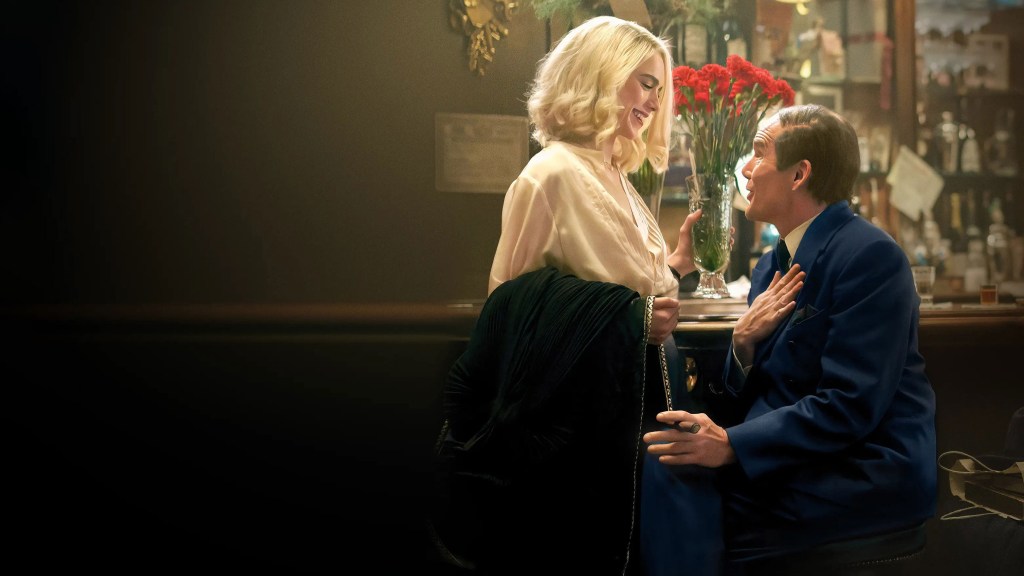

The last time Richard Linklater unleashed two films in the same year upon the unsuspecting public was nineteen years ago. In 2006 A Scanner Darkly, a rotoscope adaptation of Philip K. Dick, and Fast Food Nation, a genre cross-cutting dramatization of a non-fiction book, all saw the light of day. In 2025, Linklater lavishes us with Nouvelle Vague, a New Wave movie about the French New Wave, and also with Blue Moon, which admittedly looks perfectly conventional and formally unassuming in comparison.
Inspired by a collection of letters exchanged by Lorenz Hart (played here by Ethan Hawke) and Elizabeth Weiland (portrayed by Margaret Qualley), this movie may look taut and formulaic, but nothing could be further from the truth. It is perhaps even more subversive a project than Nouvelle Vague with its distinct and recognizable aesthetic cues and overt nods to Godard, Truffaut and others, as it hides its riches within the text and therefore asks more of the viewer. Hence, it might require multiple watches or auxiliary reading to unearth just how nuanced and layered this seemingly inconsequential little single-room experiment is in reality.
What it is first and foremost is a subversion of a canonical biopic. Instead of the more expected prestige look at how the iconic partnership between Hart and Richard Rodgers (played here by Andrew Scott in a brief yet substantial appearance) disintegrated after Rodgers partnered with Oscar Hammerstein to produce the smash hit Oklahoma!, the screenwriter Robert Kaplow, who had previously worked with Linklater on Me and Orson Welles, encapsulates what could have been a full-on biopic in a single set populated with just a handful of characters. As events unfold in the immediate aftermath of the premiere of Oklahoma!, the movie never leaves the smoky interiors of a restaurant in which Hart bemoans the direction in which his art form is headed, muses on his unrequited love for a much younger woman and wrestles with his own legacy and impending obsolescence.
Driven by a powerhouse performance reliant on unrestrained verbosity, the movie sidelines the familiarity found in overblown size, scope and requisite Tinseltown schmaltziness that is part and parcel of the biopic genre. Without a single flashback, dramatic set piece or re-enactment—with wit and banter alone—Blue Moon outlines exactly what we need to learn about Rodgers and Hart: the friction in their professional partnership, the jealousy built into their misaligned trajectories, the likely reasons for their lives drifting apart and tonnes more. Just by listening to Ethan Hawke as he effortlessly commands the screen and captivates with his frequent perorations and lewd jokes we get to learn so much more about the tragic story of Lorenz Hart than any Wikipedia-to-screen biopic could enable.
However, Blue Moon is not here to expose its audience to events in Hart’s life or the detail of how his partnership with Rodgers went south, but rather to let us experience what it was like to be with Hart at a time when his vices, proclivities and idiosyncrasies caught up with him and precipitated his downfall. With a bit of an inspired twist. In fact, Linklater and Kaplow drape Hart’s story over top of dramatic beats extracted from Casablanca, which would have been a recent hit at the time the story is set, and where Hart’s hopelessly romantic existence functions as a surreptitiously anchored evocation of Humphrey Bogart’s Rick, a man doomed to love a woman who might never be equipped to love him back the same way. In fact, Hawke’s Hart borrows a handful of lines from Curtiz’s movie, as if—in an expression of longing self-awareness—to underscore his own self-diagnosed tragedy. Thus, Blue Moon gains its own New Wave dimension that challenges its genre affiliation by dint of intellectual elevation.
As we skim across these perfect micro-performances, imbued with great energy, and maybe notice a wink here and there—like a sneaky suggestion that the lyricist with the gift of gab and a knack for an impromptu rhyme was in fact responsible for the naming of E.B. White’s Stuart Little—we might just be able to notice that this densely packed with dialogue chamber anti-biopic is here to also serve as an opportunity for artistic self-reflection. By looking at Hart, a man on his way to obsolescence and obscurity while his former partner embraces new-found success, we might be inclined to spend a moment thinking about how Blue Moon comments on the vagaries of artistic pursuits. Although most likely far from factual, the movie asks us to think about how history tends to rhyme and repeat patterns of success and failure. How in times of strife and uncertainty bare-naked escapism triumphs over nuanced satire or intellectually-demanding experimentation with the form and how those unwilling to evolve are left behind. We see how Hart is clearly and tragically out of step with the changing times. Fettered to his vices and driven by a creative process that infuriates his business-savvy partner to the point of departure, Hart wants to make art just because it’s what his heart tells him he should do. He scoffs at the people-pleasing escapism of Oklahoma! and refuses to move on. Yet, he looks entrapped by the swirling chaos of his own making.
In all likelihood, this might be the filmmaker living vicariously through Hart. It is entirely possible that Linklater and Kaplow enmeshed something truly profound within a movie that looks as though it could have been directed by Woody Allen and debated internally about the place of inspired art in the world where money talks and bullshit walks. After all, there is a good chance that a hopelessly romantic artist devoted wholeheartedly to doing art for its own sake, subverting the form and challenging the audience instead of pursuing material success might see a little bit of themselves in Lorenz Hart here. This almost certainly completely manufactured approximation of what it could have been like to spend the night drinking shots alongside one of the godfathers of musical theatre and witness firsthand how effortlessly he associated inspired ideas and how greatness poured out of his mouth without necessarily asking permission is therefore best seen as an earnest love letter and a monument to the very idea of artistic expression.
In a way, this purportedly small-scale piece of actor-driven storytelling is a great companion to Linklater’s Nouvelle Vague. The two movies somehow cohabit the same orbit as they circle the ideas of creating art, reasons to challenge the form and expressing yourself not because it’s a job that pays but because it is something you cannot imagine yourself not doing. Even if it leads you to fall from grace, end up in the gutter and die of pneumonia like Hart, whose soul was torn by unreciprocated love of a young woman and the loneliness of an artist who refused to compromise his values to remain employable. But these two movies released mere weeks apart do so from two distinct angles. They are complementary yet totally and incontrovertibly orthogonal.
Perhaps this is why Blue Moon might be the more intriguing of the two films Richard Linklater directed this year. It is definitely more accessible than a formally strict New Wave film made with French actors and where even specific frames had stories to tell, but it is the one that hides more depth beyond the epidermis of its tragicomic bent. It is a single-location hybrid of quantum states extracted from Casablanca and A Star is Born that looks as though it wanted to tell us something about a wonderfully resplendent character whose persona outmatched his physical stature, but it hides a wealth of ancillary conversations that are truly intriguing to investigate.
Consequently, Blue Moon is one of those movies that will lure you with the veneer of familiarity afforded by its localized format and then it will hook you with the verbal opulence of its writing and the bravado of its extravagant performances. But then, it will allow you to tug and pull at its narrative and rifle through its pockets in search of spare change, which is where you will find that sometimes the most unassuming movies spark the most illuminating and timeless debates and force us to re-examine the romantic tragedy innate to purely artistic pursuits better than a formally flashy and attention-grabbing experiment. It just so happens that Richard Linklater gave us both this year to compare, contrast and admire. And this one, if only by a tiny margin, is the one to watch more closely.


 Flasz On Film
Leave a reply to 2025 in Review: 10 Best Films I Watched – Flasz On Film Cancel reply