
Chapter 1: The Setup
I wondered for a hot second about how to best convey my thoughts about Sisu: Road to Revenge and I surmised that the best course of action would be to deploy the good old technique called reductio ad absurdum combined with a more immersive but equally tattered mechanic called show, don’t tell. This way, I hope I’d be able to get my point across and achieve something closely matched to what the movie itself left me with.
Chapter 2: The Synopsis
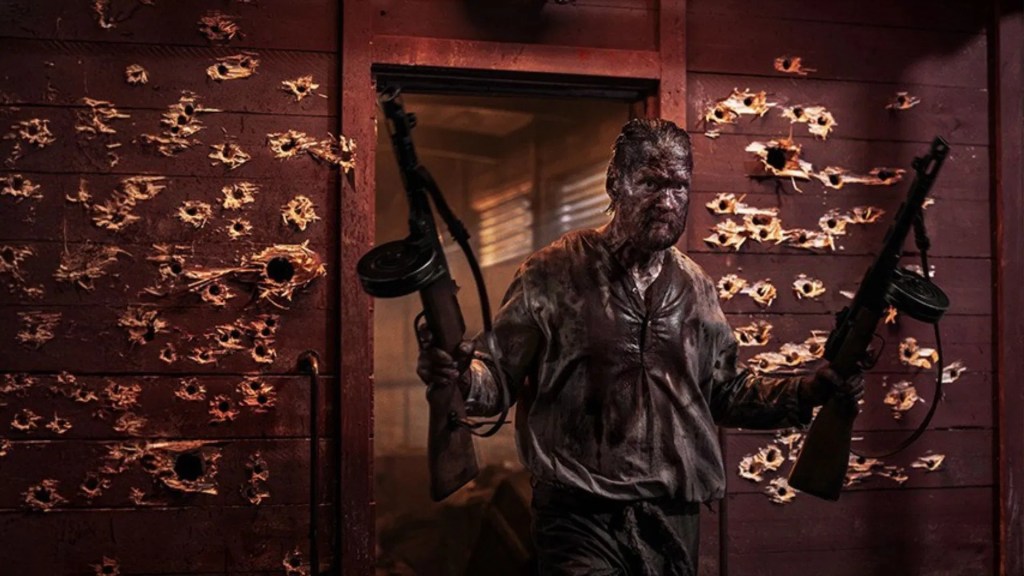
In this chapter of my review-adjacent lecture on why Sisu: Road To Revenge is more annoying than it honestly should be, I will spend precious few words describing what it’s about. If you ever saw Sisu from 2022, you will know exactly what the sequel is going on about too. Which is more of the same. It is still a John Wick-adjacent revenge fantasy about a silent Finnish guy who seems to be immortal or at least fiendishly resistant to mutilation. However, this time we are not watching him go medieval on a bunch of Nazis who took his gold, but rather on a bunch of Soviets who wouldn’t allow him to move his house—that he personally dismantled and put on a truck—across the border, from where Finland used to be to where it ended up being in the post-WWII arrangement. And we also find out that someone who killed Finn Wick’s family with a shovel is going to be immediately released from a gulag to hunt him down. Because why not.
Chapter 3: The Structure
This is where I discuss the decision by the filmmakers to divide what essentially is less than 80 minutes of narrative bookended by stylized credit sequences into a number of chapters, most of which are no longer than five minutes each. In fact, this is a stylistic carryover from the previous movie which suffered from the same ailment of a story that wants to be a novel but sadly has the girth of a Reform UK pamphlet that doesn’t even need to fit into your letterbox because it is thin enough to be slid into your house under the door. It’s honestly kind of redundant, unnecessarily indulgent and supreficially inspired by the works of Quentin Tarantino and Robert Rodriguez who have frequently deployed similar techniques in the past. A this point I hope you have realized what I meant in the opening paragraph (sorry—chapter) of whatever this is.
Chapter 4: Backseat Gaming
Again, similarly to what the 2022 Sisu attempted, the sequel is nothing more than a loosely threaded narrative blanket covering the filmmakers’ desire to indulge in heightened and openly ridiculous on-screen violence. And there’s nothing wrong with that. I love a good revenge movie as much as the next guy, especially one filled with braindead levels of blood and guts. But the prerequisite for success is that the onslaught of action and exhilaration must be at least as dynamic as it is stylized. And this is where the problem is because this movie (again, like its predecessor) suffers from a John Wick problem in that it looks and feels like a video game I wasn’t allowed to play and was instead forced to observe impotently as somebody else had fun with it. There’s a difference between feeling included in the experience and watching it through a window and Sisu: Road to Revenge unfortunately missed that day in storytelling university when it was being taught.
Chapter 5: Grindhouse in Slow Motion
Consequently, the entire viewing experience feels artificially dilated. In fact—once again, just like its predecessor—Sisu: Road to Revenge is a comparable experiment to what I imagine it would be like to watch Mad Max: Fury Road while high on that Slo-Mo drug from Dredd. Pretty, stylized and infuriatingly, pointlessly never-ending. The logic of action transpiring on the screen rivals Bollywood movies in ridiculousness, the heightened feel combined with strategically placed music cues evokes DC movies directed by Zack Snyder (every time the protagonists shows up on the screen, you can hear throat singing in the distance) and it all somehow looks as though the movie was projected at 0.75x speed. It moves like an Olympic swimmer through a tar pit.
Chapter 6: Who Is This For?
Much like Predator: Badlands or any of the John Wick sequels and offshoots, Sisu: Road to Revenge is clearly a movie made to resonate with specific demographics. Its hyper-stylized aesthetic toolbox combined with a narrative structure inspired by what you might expect from a video game progression and the attempted coolness courtesy of tanks doing backflips, rockets jamming in people’s faces and extended sequences of violent hand-to-hand combat undercut by Buster Keaton-esque ridiculousness are here to endear the same viewers who whooped and hollered at the dragon’s breath sequence in John Wick: Chapter 4.
The problem is that it all looks uncanny and levitating just an inch above the epidermis of reality. Just like you can always tell a good video game from a bad one by how in some games the character you pilot feels tactile and connected to the environment while in others it runs above ground without ever touching it, Sisu: Road to Revenge suffers from the same malady I have termed acute johnwickianitis. It’s a truly debilitating disease that renders the entire viewing experience completely void of sensory engagement and one needs to be inoculated against it through years of video game exposure to come away unscathed. All other viewers must wear N95 masks and full body hazmat suits to stand a chance of survival.
Epilogue: The Lesson
By now I hope you have learned what my gripes with Sisu: Road to Revenge are. It’s an unnecessarily fragmented piece of heightened video game-adjacent revenge fantasizing that looks up to the likes of Kill Bill and Mad Max but it doesn’t have what it takes to extend its elevator pitch of a silent and indestructible Finn Wick doing crazy stuff for long enough to earn the right to ride a literal missile right into Stephen Lang’s kisser into a movie that has both legs firmly affected by the gravity of its environment. And hence it feels long and dilated, which is an achievement for movie that wraps under 90 minutes. And if you take out all of its credit sequences, chapter subdivisions and speed ramping, I bet this could already count as a rather expensive short movie.
Afterword: Why Short Stories Don’t Need Chapters
In case you missed it, I’m going to lay this all out in plain King’s English. The idea to punctuate a movie this short with this many chapter title cards is quite frankly stupendously disruptive (almost as braindead as dividing a thousand-word article into eight titled subdivisions) and instead of elevating what could have been a piece of heroic revenge fantasy of a grindhouse variety, it serves to undermine it and further distance the viewer from the experience. Which is exactly what Sisu did a few years back. But doing something once is a gimmick and a curio. Do it twice over and it’s premeditated incompetence disguised as style and I’m not having it.


 Flasz On Film
Leave a comment