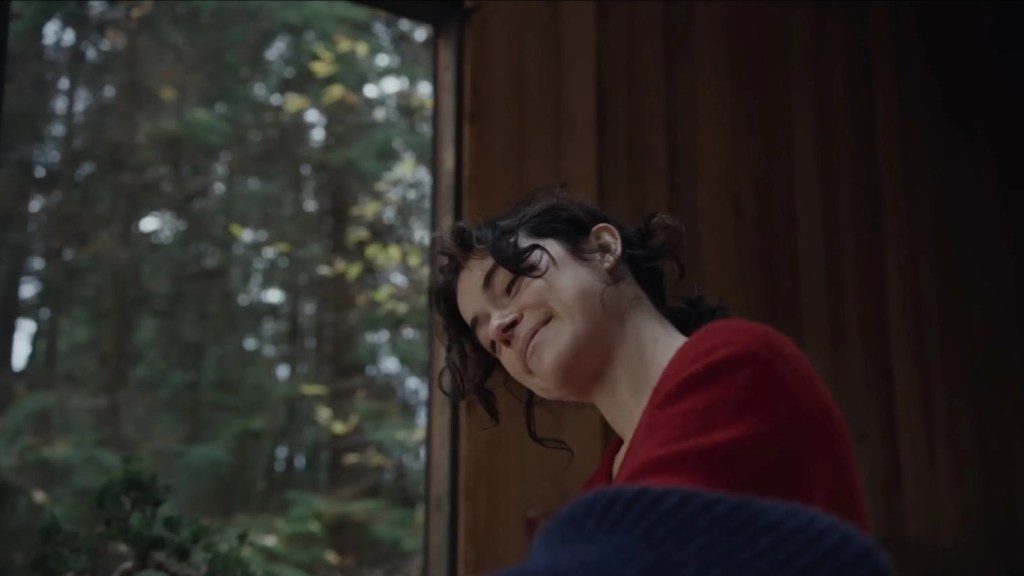

Synopsis: A romantic anniversary trip to a secluded cabin spirals into terror when Liz begins seeing violent visions and is stalked by strange, otherworldly entities. As her fear and paranoia escalate, she struggles to understand whether the evil surrounding her is supernatural — or much closer to home.
Whichever way you’d like to look at it, Osgood Perkins seems to be on a productivity roll these days as his newest directorial creation, Keeper, has recently hit cinemas, with a gap separating it and his other release of the year, The Monkey, that is just about wide enough to accommodate a standard human pregnancy. And if we were to look at his career more holistically, Perkins directed the same number of movies in the last two years (which also includes Longlegs) as he had done in the preceding five years.
However, it’s highly unlikely for anyone to deliver numerous movies of sustainably high quality in such a short space of time, therefore it is perhaps expected for some of those efforts to feel a bit slighter than others. One can argue that The Monkey, which I personally liked a whole lot for a host of reasons, was already a piece we’d come to refer as a “minor Perkins” in the future, but Keeper most definitely counts as one as well. Still, coming from a voice as strong and deliberate as Osgood Perkins, even a “minor” effort like Keeper is a worthwhile affair despite the fact it also clearly looks as though it was assembled in a hurry. It is also only second film in his entire career as both a screenwriter and director, after Hansel & Gretel, that is not officially written by him as well.
This doesn’t change the simple calculation that on balance what Keeper has to offer is an effective exercise in building sustained dread and suspense using mostly tried-and-true camera techniques. Deployment of negative space, usage of shadows, music and juxtaposition of imagery all work in pursuit of emotionally discombobulating the viewer who might not have a good idea as to what the movie is about. In fact, this seemingly simple premise—a woman trapped in a secluded forest with a boyfriend she barely knows, experiencing seemingly supernatural phenomena and slowly losing her mind in the process—is delivered for the most part in a way that blatantly locks out any attempts at deploying logic and understanding of what’s happening. It is mostly a string of sequences that effectively compound tonal dread and keep both the protagonist and the viewer in a state of elevated suspension, which is something I think Perkins is particularly adept at achieving. Thus, Keeper manages to retain viewer attention by curating a familiar folk horror mood and allows the viewer to vicariously experience the progressively tightening noose of isolation around the lead character who begins to distrust not only her partner but also her own senses.
In a way, Keeper manages to successfully spend nearly three quarters of its entire duration engineering an experience akin to the one found in Ti West’s The House of the Devil or even, to an extent, in Roman Polanski’s Rosemary’s Baby. Perkins quickly acclimates the viewer to his deliberate pacing, oppressive use of silence and creepy house acoustics and even angular camera placement that requires a few seconds to accommodate to its gauche positioning. There’s something deliciously eerie about the way the film indulges in sequences whose only aim is to bolster the mood and perhaps additionally complicate the process of untangling the plot of the story. We can infer a thing or two based on the knowledge of folk horror we might carry into the movie ourselves, but Keeper—whether purposefully or incidentally—keeps the viewer at arm’s length and insists on taking in the tone… until it decides to lay everything on the table in one fell swoop.
Having spent enough time indulging and basking in the filmmaker’s effortlessness in playing with our emotions using little more than tone, pacing and camera tricks, the movie spills the beans unceremoniously, sits us down for a micro-lecture and explains what all those seemingly inspired images truly meant. It is as though the filmmakers realized themselves that the way the movie was coming together there was absolutely no chance that anyone would understand what’s happening (and they clearly didn’t want to go full-on David Lynch and just leave everything open to viewer’s interpretation). And unavoidably, the movie falls off the chair in the last act having spent most of its running time mesmerizing the viewers with its skill of balancing its weight on the chair’s two hind legs.
To some viewers this will undeniably be a deal-breaker. They shall emerge from the cinema furious and disappointed because Keeper spoon-feeds the audience with “this means this and that means that” kind of exposition-heavy climax; though it still proceeds to end on a slightly bizarre note that includes a jar of honey or tree sap and a set of creepy contact lenses. I, however, choose to remember that before dropping the ball, Perkins’s movie did its job quite respectably and built an intriguing and mysterious narrative drench in folk mystique and upsetting ambiguity. I think it would have been a real shame to overlook Tatiana Maslany’s compelling lead performance or Rossif Sutherland’s competently aloof and terrifyingly ambiguous character work, not to mention the simple inescapable fact that Osgood Perkins has a great knack for effortlessly keeping the viewer in a vise as he oppresses with tone, mood and deliberate pacing.
Therefore, I choose to see Keeper as a movie that is great until it’s not and even though it eventually surrenders to obvious logic delivered without a lubricant, I’d like to think that on average it counts as a victory. A minor one, or maybe even Pyrrhic, but a victory nonetheless.


 Flasz On Film
Leave a comment