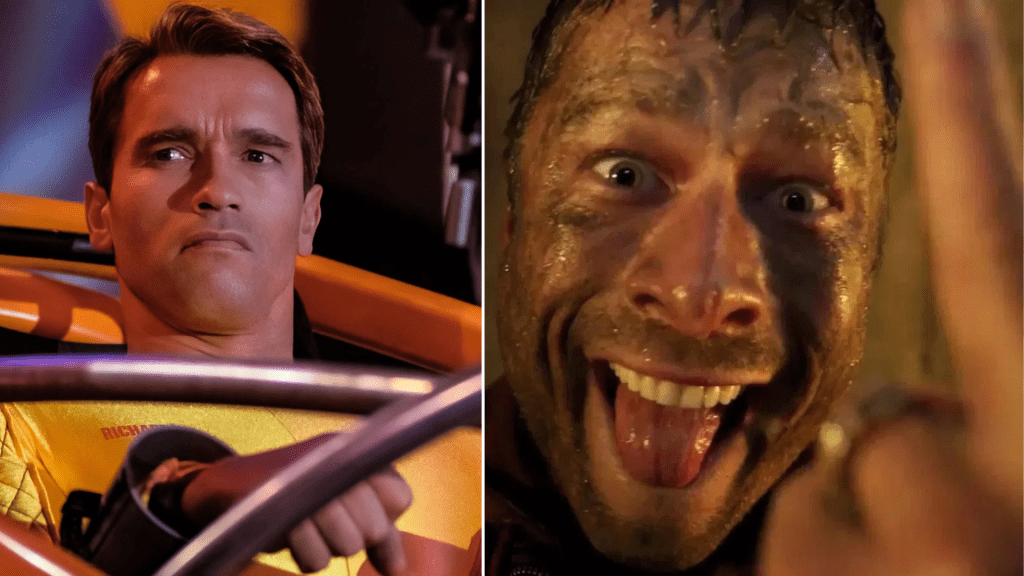
The Running Man is the fourth of the original “Bachman Books” that Stephen King published during what I call the short-lived “Bachman spree” between 1977 and 1982. Like the previous three efforts (Rage, The Long Walk and Roadwork), the author often admits it was a part of an experiment in seeing if King’s work could stand on its own without the King brand elevating sales.
However, the circumstances of its publication remain somewhat opaque, as I can’t be 100% sure if this is also a book that King wrote when he was young and stuffed it in his drawer, or one he pounded out alongside Cujo and Firestarter. All I can surmise is that it is possible that it was originally written in 1972, submitted for publication and summarily rejected. It is also possible that The Running Man was rejected for the second time in the early 1980’s, but I don’t have enough hard evidence to support it, short of messaging the man myself and crossing my fingers that he’d reply. There is too much ambiguity surrounding King’s comments, most of which revolve around the anecdote stating that his publishers rejected it because there was “no appetite for negative utopias” at the time. It’s likely that these comments were made in 1980’s, but something tells me it might have been a part of a rejection note King received in 1972. Hard to tell.
What isn’t hard to tell, on the other hand, is that The Running Man remains a fascinating specimen to examine King’s organic style, his influence on the popular culture and his own inspirations as well. This is by far one of his angriest and edgiest works that dispenses with literary artifice altogether and pours its author’s socio-political anxieties directly into the text. This simple and immediate narrative written start-to-finish over the course of one month—a rapid turnaround even for King who typically delivers a manuscript in three months or thereabouts—clearly reflected the same Nixon-stroke-Vietnam anxieties as his other early works. The idea of telling a story about a downtrodden member of the permanent underclass in a dystopic America who agrees to partake in a deadly game show where he must survive for thirty days while being hunted by professional assassins most definitely walked hand-in-hand with The Long Walk. It spurred from the same place of complete disillusionment with an oppressive government willing and able to lie to the public, carelessly send its citizens to certain death on foreign soil and distract the country from its misgivings with bread and games.
However, The Running Man might not have been conceptually original, as its central framework of a TV show in which a contestant is chased by trained killers, appeared previously in a short story written by Robert Sheckley, titled The Prize of Peril. In fact, the two share striking similarities. I believe King was once asked about drawing inspiration from Sheckley and could not remember if he had read this short story at all. It’s possible that he didn’t despite being a self-avowed voracious reader, simply because it is fundamentally possible for two people to channel similar anxieties in a mirror-like fashion. Though, while Sheckley was mostly anxious about the rise of TV as the new mainstream medium taking control in the attention economy of the late 1950’s, King’s frustrations and fears extended well beyond that.
What I have always found fascinating was that King could have drawn inspiration from Sheckley without even realizing it. Being very fond of movies, he might have wandered into an art house cinema in the late 1960’s and watched Elio Petri’s The Tenth Victim starring Marcello Mastroianni. The central conceit of the movie mimics closely that of The Prize of Peril and The Running Man as it takes place in a futuristic dystopian world in which a televised game show called The Big Hunt is the talk of the town. In it, some people are victims and some are hunters and they chase one another around the globe. I don’t think it’s outside of the realm of possibility to suggest that King could have watched the movie. Maybe by 1972 it was already available on TV where he lived. I have no way of checking. But then again, The Tenth Victim once more circles back to Robert Sheckley, as it is based on another short story of his, The Seventh Victim, which—ironically and conveniently enough—is not formally connected to The Prize of Peril. It just seems that the rise of TV and its potential for nurturing dystopian vibes was one of Sheckley’s recurring pet obsessions. Therefore, whichever way I look at it, the constellation of inspirations setting The Running Man in the wider culture inadvertently comes back to Robert Sheckley, whether I like it or not.
Nevertheless, the point stands that in contrast to The Prize of Peril and The Seventh Victim, King’s take on dystopian America and its spiral towards an Orwellian surveillance state with a population medicated with dopaminergic game shows full of real violence and death remained original enough to stand out. The combination of gripping page-turning action with a compelling and edgy character of Ben Richards most assuredly had something to do with it. In fact, for a book written at a machine gun pace, and most likely still according to King’s established ritual of letting the character dictate where the story would go while the author simply observed, commented and did all the typing, it was remarkably complex. Over the course of its entire narrative, we got to observe Ben Richards transform from a grey man brought to such a cliff edge that he’d embark on a suicide mission to give his family a shot at a better life (after all, he never planned on winning the game show but rather tried to survive for long enough to ensure his family could afford to leave the slums they lived in) into an unlikely symbol of a quietly brewing revolution against the tyrannical state. From there, his sacrifice would grow in scale because by the time the final pages come around and he flies a plane into the network building, he fully embraces his destiny as a martyr to a political cause and a catalyst for an uprising that we don’t get to witness because the book ends with Richards’s dying breath.
This was the core of the book that both set itself well apart from Sheckley’s more superficial anti-TV cautionary tales and cut much closer to the bone. The Running Man had sufficient political edge to make potent comments while wearing a genre trench coat and hence it smuggled its frustration and anxiety while depriving the reader of breath with its relentless suspense. It was a compelling and fundamentally competent piece of fiction that simply happened to materialize, allegedly, ahead of its time.
Still, the themes King tackled in the book remain fundamentally timeless. In fact, just as I outlined above, they might be so timeless and universal that it’s possible for a story like this to look like a piece of plagiarism because many other artists would also choose to channel similar frustrations in similar ways. Which also means that despite the fact the book encountered resistance before its publication and didn’t become a stunning success—especially since it lacked King’s branding while it stared at passersby from airport book stands stuck between a multitude of disposable paperbacks, it would lend itself towards cinematic adaptations with ease.
Hollywood’s interest to do so translated into action in mid-1980’s, three years after the original publication. And by the time the film was out, in 1987, the cat was already out of the bag as the whole world had learned that Stephen King and Richard Bachman were the same person. Nevertheless, the rise of reality TV and reigning prominence of television in general most likely contributed to The Running Man being adapted at the time, initially with George P. Cosmatos as director and Christopher Reeve in the lead role, with the project creatively driven by a first-time producer George Linden who loved the book and optioned it for adaptation. From what I understand, the original idea was to remain faithful to the novel, but with increasing numbers of cooks in the kitchen, the story changed massively before the finished movie could hit theaters.
In the meantime, after many tussles over creative differences and presumably because Arnold Schwarzenegger—one of the biggest action stars of the time—expressed interest to star in the movie, Reeve was out. Ben Richards had to morph from an everyman (though to what extent the literal incarnation of Superman could portray an everyman is anyone’s guess) to an action hero. Cosmatos left the project and ended up replaced by Andrew Davis, who also didn’t last long in the driver seat. Steven de Souza was brought on to rework the script, which he did upwards of fifteen times and Paul Michael Glaser, best known for playing Starsky on Starsky & Hutch was hired to direct… again, presumably to allow Arnold to control the operation and turn The Running Man into a vehicle he’d find suitable for his star stature.
Consequently, The Running Man we got in 1987 cannot be counted as an adaptation of King’s work even when the most charitable reading of the definition of “dramatic licence” is applied. On the spectrum of fidelity to source material ranging from The Lawnmower Man, which de facto adapted only the title of King’s short story, to any adaptation directed by Mick Garris on the other end, The Schwarzenegger-starring The Running Man finds itself just slightly to the right of The Lawnmower Man. It dispensed with the plot of the book almost completely, turned Richards from a downtrodden everyman to a wrongfully convicted helicopter pilot, morphed the nationwide manhunt into a localized game show taking place in a curated slum and converted the largely faceless and unseen Hunters into Stalkers, most assuredly inspired by the widely popular American Gladiators.
What the filmmakers left more or less untouched, or perhaps only mildly perturbed, was the dystopian setting, which included placing thematic comments on the role of mainstream media in distracting the public from the oppressive surveillance of the state and the raging inequality between the haves who lived like kings, and havenots who warmed themselves every night by the fire of burning bins. At the same time, they completely dispensed with the book’s authentic edginess and instead chose to heighten the experience considerably, almost to the point of preposterousness. This way, the movie was allowed to walk the tightrope of self-parody with its goofy gladiators and their workout videos and Arnold’s lines almost exclusively comprising of puns, one-liners and winks at the fanbase. In fact, in one scene Schwarzenegger is seen carrying a log, like in the opening shots of Commando and then he casually wears a World Gym t-shirt in a handful of scenes and tells the game show host Killian “I’ll be back” in a clear attempt at self-awareness.
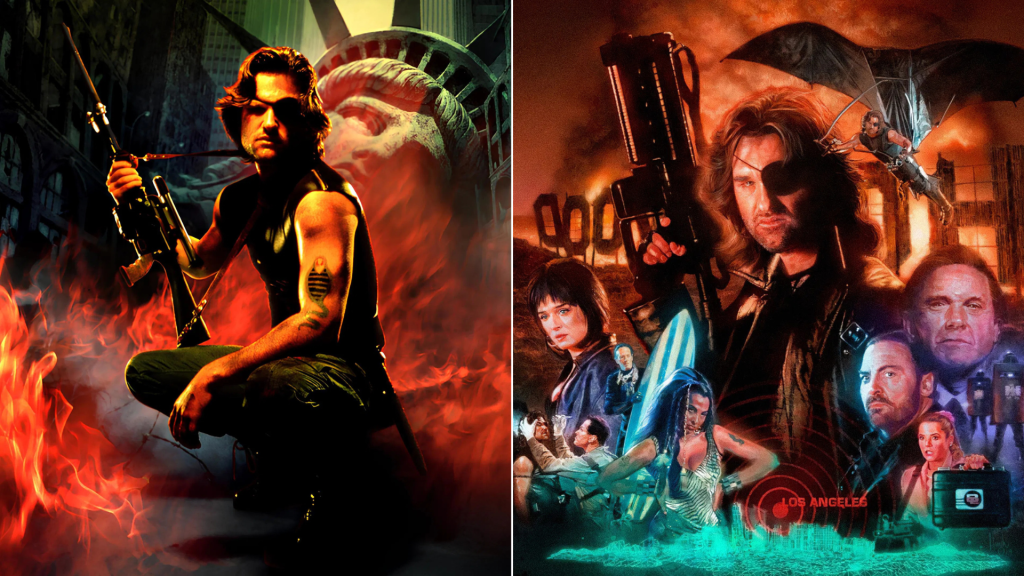
Thus, it is best not to conflate the book and the 1987 movie too much and perhaps see it as more of an Arnold movie than a King adaptation. What I find intriguing in just how far apart these two works are is that despite King’s rock star stature in the 1980’s, Hollywood filmmakers felt they had permission to meddle with his work so profoundly that it ended up so completely detached from its source material that it became the subject of a lawsuit accusing The Running Man movie of plagiarizing the French adaptation of The Prize of Peril. I couldn’t find any corroborating evidence suggesting that King was also named in the lawsuit. From what I gather, it was limited to the studio, the screenwriter and the star. But if the movie found itself on the business end of a plagiarism claim, it perhaps suggests that the original feature in King’s novel was that specific dystopian arc of an everyman-turned-symbol-turned-martyr that the movie reduced to a best-of B-roll aesthetically inspired by They Live and Escape from New York brimming with references to Schwarzenegger’s biggest hits. Owing in large part to the many trials and tribulation involved in bringing this film to cinemas, it is perhaps the best course of action to view the 1987 The Running Man as an exercise in 1980’s camp excess, a rogue mess stacked with seemingly disparate cultural touchstones and quite simply a bad movie that is impossible to dislike, and a cult icon on its own terms. But a King adaptation it is not.
Interestingly, because the process of taking the 1982 novel and converting it to a movie was such a belabored and complicated process, the idea of a do-over has remained only a distant pipe dream for many years. It is known that Edgar Wright had attempted to procure the rights to the source material for at least fifteen years, which for undisclosed reasons remained elusive only until very recently. Stars finally aligned and The Running Man starring Glen Powell as Ben Richards and directed by Edgar Wright finally saw the light of day in the early days of November 2025, the year in which the original novel was set.
Wright’s take on this material is more clearly positioned as an adaptation of the novel, rather than a remake of the 1987 cult classic as it finally commits to the format of the game show described in the book and characterizes Richards much more closely as a disaffected misfit on a mission to sacrifice himself to give his family a chance at a better life. Well, the movie still winks in a few places at the 1987 film, especially with the production design of the show, gaggles of dancers moving as though choreographed by Paula Abdul and Arnold’s unmistakable gab adorning the $100 bill. What matters though is that Wright’s movie correctly isolates the core narrative framework and attempts a story in which Ben Richards would hopefully convert from a family man kamikaze to a bona fide catalyst for a nationwide revolution against the dystopian police state that keeps people poor and misinformed.
And being completely frank here, Edgar Wright’s The Running Man had all the opportunity to come sufficiently close to succeeding as a compelling and faithful adaptation of King’s novel, which it squandered wholeheartedly because they clearly didn’t have the gumption to commit to the book’s earnest anger and edge. This movie is too tonally dissonant to function correctly, specifically because Glen Powell’s Richards, characterized clearly to evoke the angst found in the novel, grinds against the film’s overt tone of self-diagnosed parody. It is as though the filmmakers didn’t know they could trust that the audience would get on board with the story’s earnest edgelordism. If it had been translated verbatim, The Running Man would have had much more in common with Gerard Butler-starring actioners frequently dismissed as dad movies by aloof youngsters who dismiss earnestness as cringey.
Therefore, this new movie tries to have its cake and eat it as it wants to stay faithful to the plot progression lifted out of the book while also having a giggle at its expense. It is simply inescapable that every time the movie has an opportunity to make a topical comment on surveillance, deepfakes, limbic hijacking or what have you, the filmmakers immediately disarm any thematic tension by winking at the audience and cracking a joke at their own expense, as though in an attempt to forestall any embarrassment stemming from the idea of being seen as authentic and edgy… which is what the book was. Consequently, the 2025 adaptation of The Running Man comes across as fundamentally insincere and artificially armored. In fact, it most frequently plays as fake, perhaps because there is very little a fifty-something filmmaker can do to appear cool and slick to younger audiences. Earnestness will elicit a defensive response and attempts at self-parody of this sort will make the filmmaker look like that meme of Steve Buscemi wearing a baseball cap backwards.
I think there are but two ways to adapt The Running Man: (1) take the material seriously and lean into its edginess or (2) turn everything into parody. No half-measures. Satire can still be extracted out of a full-on parody so the commentary on dystopian states, surveillance and total societal desperation could be well embedded in a narrative that otherwise blows it all well out of proportion. In fact, the 1987 film ended up attempting a similar tonal approach already and if they applied it without meddling with the original story to the point of disowning it wholesale, they’d have had a winning formula on their hands. Meanwhile, the 2025 movie needed to either adjust the characterization of its protagonist to become more overtly comical or to tone down its own meta-awareness. Either lean into the fact that Michael Cera has a presentation about his dad ready for unannounced guests or not have it at all. Either have Glen Powell be a stoic, forlorn and sullen fugitive or have him be a Marvel-esque quip machine. Not both. Either commit to the original ending of the book (which would have been a choice in the post-9/11 world to have a movie climax with a plane flying straight into a skyscraper) or make fun of it, which Wright’s movie only partially achieves. Hence, the 2025 The Running Man mimics its 1987 predecessor in becoming an out-and-out mess, but it’s not likable at all. It’s a mess that knows it’s a mess but tries to make fun of its own messiness in the process and hence distance itself from it instead of stepping up to the plate and owning it wholeheartedly.
Sadly, King’s The Running Man remains in need of an adaptation that would do justice both to the story and the thematic messaging at the same time. Currently, what we have is a piece of 1980’s likable camp and a tonally jarring modern movie with a full-blown identity crisis. It turns out that a simple narrative full of fundamentally resonating ideas wrapped around a compelling character arc remains impossible to adapt in a way that is both faithful and visually entertaining. It might be partially because the book ends on a massive downer and movie producers frequently struggle with stories that lack a Hollywood ending. Famously now, New Line Cinema producers didn’t believe Se7en would be a success and ended up completely taken by surprise when it became one of the most profitable films of its year. Maybe Ben Richards the edgy martyr has what it takes to find his feet in a movie without being tonally undermined or turned into a quipping machine. All he needs is a little bit of trust that the story would tell itself.


 Flasz On Film
Leave a comment