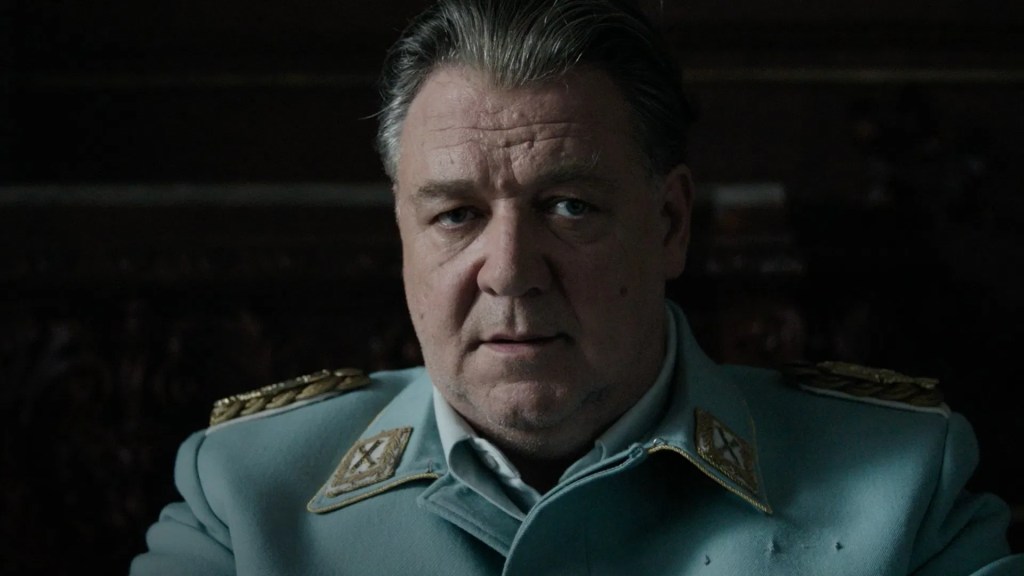

Synopsis: After the fall of Nazi Germany, U.S. Supreme Court Justice Robert Jackson (Michael Shannon) leads the prosecution at the Nuremberg Trials, seeking justice for unprecedented crimes. Meanwhile, Army psychiatrist Douglas Kelley (Rami Malek) studies Hermann Göring (Russell Crowe) and the other imprisoned Nazi leaders, becoming entangled in ethical and emotional conflicts as he confronts their humanity and his own ambition.
Just as we can be certain that tomorrow the sun will rise in the east and Mariah Carey’s voice will drive you to the edge of insanity long before Christmas, you can rest assured that as we are now closer to the winter solstice than September equinox the time has come for prestige-adjacent movies to swell at the box office and bait audiences with the grandiosity of their mission, the gravitas of their performances and the risk-averse approach towards exposing their target audiences to subject matter that might be considered uncomfortable or even remotely upsetting. Thus, along comes the James Vanderbilt-directed Nuremberg, a veritable adaptation of the Wikipedia entry for the Nuremberg Trials staged after the Allied victory over the Nazi regime in 1945 during which the surviving top-ranking German officials were publicly tried and condemned for perpetrating one of the most heinous crimes in modern history.
Predictably, this long-in-the-tooth period piece is an out-and-out exercise in prestige filmmaking cushioned from all sides by convention. It is by all accounts a movie whose mission is to educate its viewership without upsetting anyone too much and to leave them with enough to be able to start a conversation on the subject with their family members and friends over the dinner table. Moreover, as the film’s thesis alludes to the inescapable reality that the Nazis weren’t monsters but regular people with drive, confidence and inflated sense of their own place in the world and thus it is more than likely that similar patterns might emerge elsewhere at other points in history, a conversation about Nuremberg might be effortlessly turned into a righteous cudgel to beat your right-leaning uncle at the Thanksgiving table, as is now tradition. And that’s what this film is mostly good for because it honestly holds limited value otherwise.
Apart from the innate potency of the subject matter relating to the grim reality of World War II and the horrors of the Holocaust, some of which is related using archival footage that registers as bold for a movie of this sort and precisely necessary to make sure the message sinks in, there isn’t unfortunately much else about the film that would help it stand out in the wave of prestige schmaltz about to crash against the shores of the end-of-year box office. With its well-coached performances, predictably researched and emotionally-stuffed speeches punctuating the narrative and telegraphing the implicit importance of telling the story, and competent deployment of numerous prestige clichés—from myriad match-cuts and punchy Oscar moments to solemn minor chords dominating the score and several overt instances of textbook foreshadowing—Nuremberg is going to surprise exactly nobody.
However, at the same time, it is unlikely going to infuriate or disappoint anyone either. It is one of those pieces of prestige awards bait that keeps its sugar levels sufficiently moderate to keep the audience on side as it builds up to its final act in the courtroom where Göring faces off against Allied prosecutors played by Michael Shannon and Richard E. Grant, where saccharinity is superseded by good old-fashioned suspense. In fact, this is where the movie redeems some of its shortcomings as archival footage meshes with the movie and as Crowe and Shannon engage in a televised battle of wills. It also may have something to do with the simple fact that by the time the story moves to the courtroom, the character of Douglas Kelley played by Rami Malek becomes a bystander to the proceedings, which immediately elevates the movie. After all, we are no longer subjected to his signature hammy overacting that won him the Oscar for Bohemian Rhapsody where he played Freddie Mercury with equally determined heavy-handedness.
All in all, Nuremberg is most assuredly one of those prestige items that comes and goes without leaving much of an imprint on the culture at large, though I will not be surprised if it gains some momentum in the upcoming Oscar race and garners a handful of nods. In actuality, there may be some validity in acknowledging Russell Crowe’s devotion to the acting method in here, especially because it might be the only chance you will ever witness the Hollywood stalwart in a de-medalled Nazi uniform doing push-ups in his cell in a bizarre effort to look less out of shape for his appearance in court. In all seriousness, the man’s command of the German language and dialect work on the accent is unequivocally commendable as he effortlessly embodies Göring’s larger-than-life personality of a narcissist who is as manipulative as his charming.
Nevertheless, the movie as a standalone piece of filmmaking is only as good as the conversation it is likely to spark, though anyone even vaguely interested in the history of World War II won’t find much new in here to learn. It is not a scintillating character study it could have been with more emphasis placed on the interplay between Kelley and Göring and instead it finds safety in the middle of the road. Nuremberg is bound to temporarily dislocate general audiences with its emotionally manipulative competence and might push them towards educating themselves further on the subject, but it is equally likely to evaporate from our collective consciousness in short order. It just doesn’t cut deep or decisively enough to leave a mark, let alone draw blood and discomfort the viewer enough to require stitches.


 Flasz On Film
Leave a comment