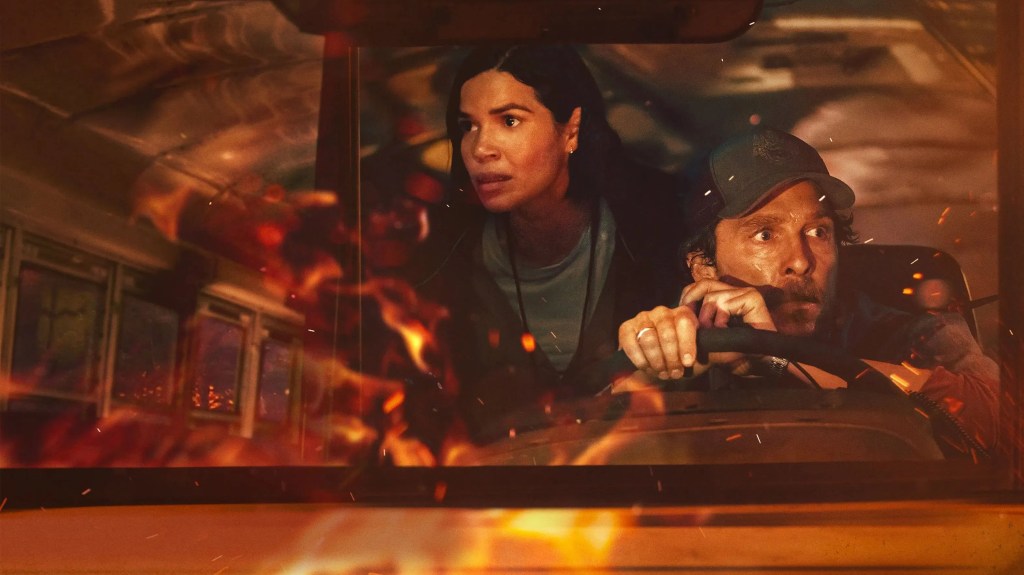

Synopsis: A bus driver Kevin McKay must navigate a bus carrying 22 children and their teacher to safety during the devastating 2018 Camp Fire in California. As they face rapidly spreading flames and chaos, Kevin and the teacher, Mary Ludwig, work together to keep the children calm while trying to find a way out of the inferno.
The filmmaking career of one Paul Greengrass has been thus far neatly and evenly punctuated by instances where his signature kind of immediate and visceral visual storytelling could be deployed in pursuit of understanding what happens at the extremes of human condition, specifically in the context of real-life events. Movies like Bloody Sunday, United 93, Captain Phillips and even the less successful 22 July had all concerned themselves with the fundamental idea of retelling compelling and unique stories of human endurance and heroism in the face of peril, chaos and oftentimes unadulterated evil.
The Lost Bus, loosely based on the book Paradise recounting the truly astounding events of the disastrous 2018 Camp Fire, one of the most devastating wildfire’s in the history of California, marks the filmmaker’s return to form in this regard. The movie starring Matthew McConaughey and America Ferrera is a thrilling and pervasively engrossing experience that finds that tricky and difficult to strike balance between satisfying the requirements of a disaster spectacle in terms of scale and scope and building a lasting connection between the viewer and that spectacle through lifelike characterizations and focus on localized drama of the people trapped amid an unfolding natural disaster. To achieve this, the film wastes no time with setting up an impending catastrophe the way many disaster films like The Towering Inferno or Volcano would have done in the past and instead—according to Greengrass’s longstanding prerogatives—it places its focus firmly on in media res procedurality of events and the fundamentally immersive concept of hanging onto the shoulder of Kevin McKay as he must navigate numerous obstacles while trying to escape what looks like certain death.
What works particularly well as far as dramatic tension is concerned is the filmmaker’s understanding of storytelling basics that has always yielded impressive results in similar contexts. Just like Tom Hanks in Captain Phillips and James Nesbitt in Bloody Sunday, the core of The Lost Bus is its protagonist who is relatable and flawed, and thus tactile and believable. Granted, you can surely detect that certain chords in this dramatic progression are elevated and broadened with addition of colorful extensions which may or may not have deviated from what actually happened—such as the emphasis placed on establishing a fraught family dynamic in Kevin McKay’s life that serves as a source of motivation and impetus for his actions—but then again life isn’t entirely original either. It frequently writes in schmaltzy clichés and it’s OK. What matters here is that these extremely familiar tropes are put to good use and work entirely in service of embellishing the drama, adding stakes and thus giving the fiery spectacle an undercoat of authenticity.
Consequently, The Lost Bus becomes a blood-curdling pressure cooker turbocharged by authentic and familiar dramatic fuel. It’s a competently crafted exercise in tension and release where Greengrass walks the tightrope of lightning-fast editing, shaky close-ups and flashes of awe to successfully put familiar clichés to work in service of dramatic catharsis. His movie, just like some of his more potent works and the works of his spiritual disciple Peter Berg (like Deepwater Horizon and Patriots Day) is a solid example of a humanist spectacle that never crosses over to the realm of preposterousness, telegraphs just enough of its storytelling to keep the viewer abreast of the unfolding narrative without slowing down to give them a chance to question anything, and most importantly probes once more the moral black box found at the extreme ends of the human experience.
McConaughey’s portrayal of a bus driver at what he saw as the rock bottom of his life who ends up listening to his conscience and does the right thing at the right time is therefore a wonderfully resonant evocation of the kind of heroism we might actually experience in our lives. In fact, The Lost Bus acts as a potent examination of the definition of bravery itself as an act of defiance of cold-hearted logic. When the logical thing to do is to run away from danger, running towards it instead might only be one of two things: stupid or brave. And bravery is when running towards danger is the right thing to do. The minute McKay chooses to do what’s right, turns the bus around and volunteers to go back to the danger zone and evacuate stranded children is a great, grounded example of just that. It is also a turning point for the entire movie after which the filmmaker forces us to watch the action with bated breath and takes the foot off the gas only when the credits are about to roll.
This film thus joins the ranks of those movies that look obvious and predictable but somehow manage to penetrate the armour of detached cynicism and warm our hearts with their authentic devotion to emotional exhilaration. It might be schmaltzy and obvious in many respects, but The Lost Bus surely earns its violins swelling in a crescendo of major chords and reminds us all what a disaster movie could and should be. After all, this is exactly what Paul Greengrass is well capable of delivering when stars align and the material lends itself to such a grounded and gritty spectacle.



 Flasz On Film
Leave a reply to 2025 in Review: 8 More Great Films I Watched – Flasz On Film Cancel reply