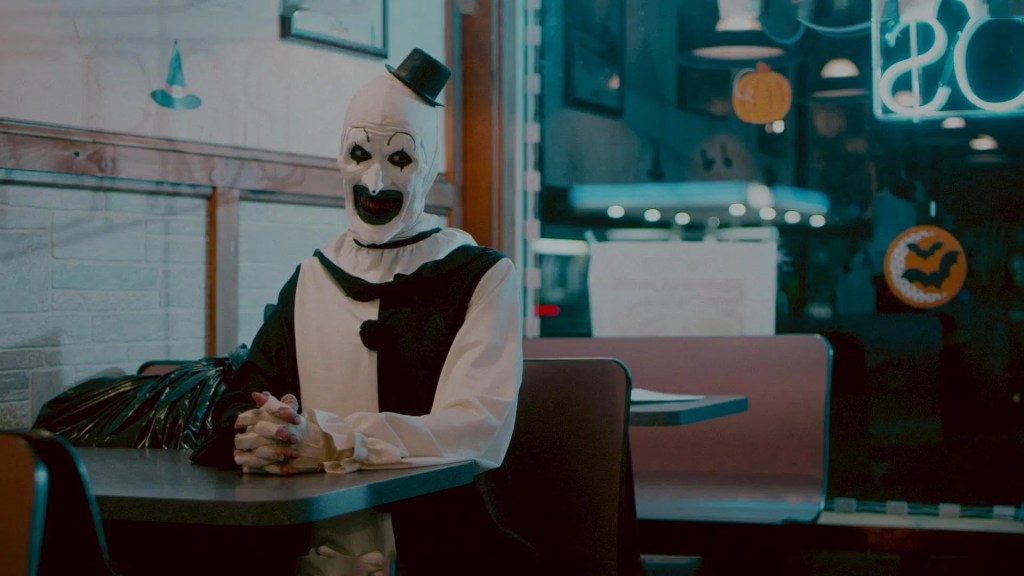
Consider the most iconic slasher villains. This list will most likely see Michael Myers, Jason Voorhees, Freddy Krueger, Chucky, Leatherface and maybe Ghostface from the Scream series. If you were to think a bit harder, you might be able to think about John Kramer from the Saw series, the winged creature from Jeepers Creepers, Candyman, Pinhead from the Hellraiser franchise and Art the Clown, the star villain of the Terrifier movies. I’m pretty sure I’ve missed out a few lesser characters, like the villain from the Hatchet series and some iconic one-offs like the guy from Black Christmas, the driller killer from Slumber Party Massacre and some others.
However, this alone illustrates that the vast majority of iconic horror villains have originated before the year 2000 and only a small handful of them have sprouted in recent years. And of those, only John Kramer and Art the Clown have been able to entrench themselves in the collective cultural consciousness. Now, the simple explanation why that is has to do with the direction in which the horror genre has evolved over the recent years and decades and it is quite frankly undeniable that slasher horror is now for the most part a concept underpinned heavily by nostalgia: revived through remakes, legacy sequels, and aesthetic callbacks rather than new mythmaking.
With movies like In a Violent Nature, Thanksgiving, Heart Eyes and the recently resurrected Halloween and Scream franchises, we can see that slashers are more likely to pay homage to their golden age instead of attempting to craft novel characters to add to the growing genre pantheon. A masked killer with a knife carries a distinct whiff of old, like a cabinet in your grandpa’s house. Meanwhile, horror has evolved away from iconic recurring characters in pursuit of more dispersed incarnations of evil to scare the wits out of paying audiences.
Still, characters like the Annabelle doll and the nun from The Conjuring movies or Sadako from The Ring series have successfully managed to leave a lasting cultural imprint, but nevertheless we now see more prestige-inflected horrors with openly metaphorical readings, as opposed to playful attempts at catharsis, which leaves less cultural space for recurring villains to take root. At the same time, as I have written separately already, the entire genre has been slowly drifting towards extremities in pursuit of viable scare tactics in a process I termed the pornification of horror, which further limits opportunities for novel horror icons to make their way into the mainstream.
And then there’s Art the Clown, the iconic star of Damien Leone’s Terrifier. He first made an appearance in his short movies, which were later incorporated into a feature-length anthology film All Hallows’ Eve. Since then, he appeared in three Terrifier movies where viewers could see him indulge in truly sadistic exploits as he hunted down, tortured, mutilated and massacred untold numbers of predominantly young women. In a way, I find the cult success of these movies quite astounding because in contrast to other historic slasher franchises, Terrifier movies are not fun to watch at all. They’re oppressive, mean-spirited and downright sadistic in places and simply do not carry the same playfulness as movies in the Child’s Play or A Nightmare on Elm Street series. They’re fun the way extremely offensive comedians might be: there definitely is an audience for what they have on offer but it sure isn’t going to mobilize masses to head out to the movies. It might be too much to handle for most.
What’s quite interesting about the Terrifier phenomenon is that it seems to have slowly permeated into the general consciousness despite its innate inaccessibility. Art the Clown costumes and masks have become more popular with each passing Halloween and you can even find little children wearing his costume if you trawl through social media and YouTube for long enough. And I can bet good money that the vast majority of trick-or-treaters who chose to dress up as Art the Clown this year have not seen a single movie this character hails from.
Now, there have always been people who’d dress up as Freddy Krueger or Chucky without having watched any of their movies either, so this phenomenon is not entirely new or exclusive to this case. However, tweens and young adolescents used to watch Halloween and Friday the 13th movies excessively anyway because despite being scary and occasionally violent and intense, they still operated within a tonal register that young viewers could process without lasting psychological stress.
Meanwhile, I don’t think I can say the same thing about the idea of sitting down and watching Terrifier or Terrifier 2 at a ripe age of thirteen. These movies are not safe at all to watch and even experiencing them as a full-grown adult comes with mental toil other slashers simply did not inflict. Art the Clown is not playful but oppressively sadistic and some of his exploits are bound to sear images in your mind, like the infamous hacksaw scene in the first movie or the bedroom sequence in the sequel. In a way, the Terrifier films are attempting to subvert the slasher playbook and remove the concept of living vicariously through the eyes of would-be victims. Instead, we are asked to observe and indulge in those atrocities as though we were supposed to root for the clown. At the same time, violence and gore are presented with such extreme intensity, grotesque specificity and lingering indulgence that Art’s crimes evoke the aesthetics of real-life mass murderers like Ed Gein, Ted Bundy and Jeffrey Dahmer… thus turning full circle because those serial killers have served as inspirations for the characters of Leatherface, Norman Bates and others. But you won’t see anyone dress as Dahmer for Halloween, now will you?
Therefore, I find the growing cultural cachet of Terrifier movies and specifically Art the Clown quite mind-boggling. Perhaps this is a simple outgrowth of a more general cultural fascination with creepy and scary-looking clowns, which again traces back to John Wayne Gacy, a real-life murderer who used to dress up as a clown, and the iconic character of Pennywise from Stephen King’s It. It might just be that there has always been a clown niche and Art the Clown has simply slipped into it without anyone realizing just how disturbing and terminally upsetting the movies he hails from truly are.
So, as Damien Leone’s Terrifier franchise grows—and it will—I can only expect that Art the Clown will formally cement himself within the zeitgeist despite the fact that most people able to identify this character will not have seen the movies. But because of the sheer inaccessibility of the Terrifier films, I expect this notoriety will quickly hit a ceiling, unless of course Leone steers the series away from self-indulgent sadism defining it thus far.
However, I don’t see any other competitors entering the fray either, so it is Art the Clown’s game to lose. Horror as a genre has moved firmly away from slasher tropes. So, as long as the series stays the current course, I can foresee that Art the Clown will become this era’s Pinhead—an instantly recognizable character whose cultural presence is strikingly hollow: aesthetically iconic yet completely devoid of meaning.


 Flasz On Film
Leave a comment