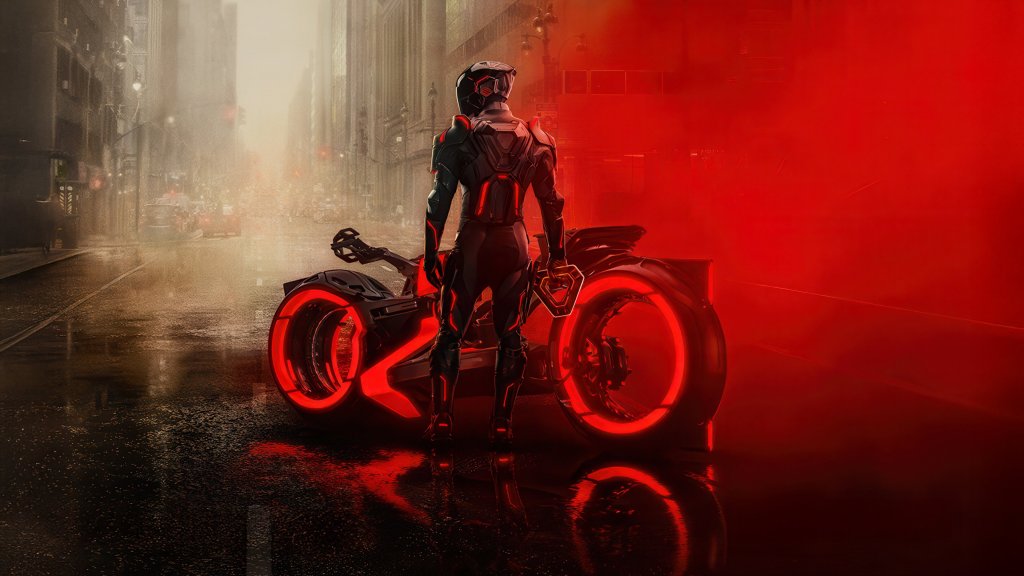

The trajectory of what we now know as the Tron series, such as it is, originates from a rather single-minded desire to become a special effects showcase inspired by the rising popularity of video games. Steven Lisberger, a young animator at the time, carried the idea of making a movie set inside a computer to a number of studios, but nobody would bite. Eventually, Disney—who were starved for new ideas at the time—gave Tron a home on their lot and Lisberger a chance to have a punt at pushing the needle of progress in the realm of CGI.
However, Tron didn’t necessarily wow its audience at the time of its release. While it was praised for its visual aesthetic, its storytelling was insufficiently compelling, and the movie was considered dull by many who ventured out to see it. After all, being mostly driven by a vision rooted in advancing technology, it wasn’t a surprise to see the completed movie as nothing more than an application of the tired hero’s journey archetype set against the backdrop of a fantastical universe. In short, those who referred to Tron as a clone of Star Wars weren’t exactly out of line. The movie had nothing but the aesthetic to claim as its own, and the rest it wholly owed to George Lucas and the seismic success of his “Saga from a Galaxy far far Away.”
Nevertheless, Tron grew a cult following over the years, mostly among programmers and other subgenera of computer nerds, presumably on the back of the simple set of associations the movie made with the world these folks identified as their own. People were programs, a little special effect was a bit, command prompts were actions on the screen. You get the gist. But it still didn’t change the inescapable reality that the movie didn’t have much meat on the bone. It was still what it always had been—a first-order Star Wars derivative. But its cult status was strong enough for ideas about a potential sequel and/or a series to begin to percolate in the biz; though these ideas never translated into actionable decision until the arrival of The Matrix hit the same nerve… only with a better implementation of the hero’s journey, an iconic aesthetic of its own that stood apart from Tron and something that Tron simply did not have—action and spectacle.
Therefore, it would have been a logical expectation placed on the producing team who went to work on what later became Tron: Legacy (and let’s try to forget that for one hot minute the movie was titled Tr2n… tee-arr-two-n… I refrain from further comments on the matter) that The Matrix template was the one to look up to. What ended up happening was that Tron: Legacy once again tapped into its innate need to push boundaries and became an early adopter of digital de-aging technology, which was used to create the movie’s villain Clu who was supposed to look like young Jeff Bridges. But as far as adding action and spectacle to the equation, I don’t think the movie succeeded. Instead, what they did add to the roster of recognizable ideas Tron movies would carry along was its music. The rest was a festival of nostalgic re-enactments of nearly all visual elements fans of the original cherished or at least identified. Still, Tron: Legacy was as slow and clunky as its 1982 papa, but it looked nice and slick, and the Daft Punk score imbued the entire experience with an incredible cool factor.
What it did however was establish, jointly with Indiana Jones and the Kingdom of Crystal Skull, the playbook for what we identify as a nostalgia sequel. Fittingly titled with “legacy” after the colon, the Joseph Kosinski movie leaned into the vibe of its protoplast, re-imagined its standout features using modern tech—the lightcycle set piece its central eye candy—and brought new cast members (Garrett Hedlund and Olivia Wilde) into the roster of returning heroes, revisited by Jeff Bridges and Bruce Boxleitner. For better or worse, Tron: Legacy remains one of the pioneers of the era we are still trudging through. At the time, though, it was a breath of fresh air and a movie that recaptured the cult magic of Tron while adding a little something of its own creation to the recipe.
And I wonder what this series would look like now if Tron: Legacy ended up materializing another sequel in close succession. Again, there were plans for that too, but they sure did fall apart in years to follow. Regardless of the film’s substantial financial success, Tron: Ascension or Tron 3 never came to fruition and the excitement fizzled out, presumably partially because Disney was busy placing all its available resources into rebooting the Star Wars franchise and thus ensuring a complete envelopment of the entertainment industry. So, once more it took several years for Tron to become viable, and the question was whether this new instalment would attempt to refresh itself, or if it would rather recapitulate and double down instead.
Admittedly, the problem the Tron series does indeed have is one I like to call a “Jurassic Park Problem” and that’s because the most intrinsically characteristic and therefore non-negotiable elements of the series had to do with its worldbuilding design. Much like Jurassic Park movies struggled progressively harder at finding legitimate reasons rooted in fundamental logic for characters to return to dinosaur-infested islands off the coast of Costa Rica, a movie set in the Tron universe needed to find reasons to send people back onto The Grid. And let’s face it: based on how the Jurassic Park/World series has evolved over the years, this logic is fraught with crippling diminishing returns.
Therefore, when Tron: Ares was conceptualized, its central conceit relied on finding a way for anthropomorphized programs to enter the real world. The vector that previously directed the story from the IRL into the grid was reversed. And that in itself is already a good enough reason to make a movie that has a chance of doing something new and interesting. Which is what happened.
Directed by Joachim Rønning, who had established himself with the Oscar-nominated Kon-Tiki and later found a landing zone in the House of Mouse where he helmed Pirates of the Caribbean: Dead Men Tell No Tales as well as Maleficent: Mistress of Evil, Tron: Legacy seems to be well-read enough to know what a Tron movie must possess in order to qualify as one, yet it opens up the world and adds that one thing neither of the previous instalments had—a dramatically compelling spectacle. In many respects, it remains tethered to the series using plays taken from the manual that Tron: Legacy co-wrote with Spielberg’s misunderstood sequel to the Indy franchise.
It’s once again an eye candy festooned with religious references to 80s pop culture. Furthermore, the aesthetic is once again bolstered by a heart-pumping score composed by this time by Nine Inch Nails, and once more the entire narrative rests on the archetypal machinations of the hero’s journey. However, this time things are different because of that IRL-Grid vector being reversed, which admittedly gives the entire narrative an amplified sense of urgency. The stakes are no longer limited to what happens on the surface of a microchip, nor is it tied to the fate of one video game company. In Tron: Ares the fate of the entire world is at stake because the CEO of the Dillinger company (Evan Peters), a descendant of the villain from the original film, is planning for advanced AI-driven software built for security and military purposes named Ares (Jared Leto) to irreversibly alter humankind’s relationship with digital technology. By combining artificial intelligence, robotics and 3D printing, he is giving AI agents a physical form, which allows the movie to take place in the real world and move well past the notions of simply re-enacting cool stuff from the old movie using new toys.
To add another layer of urgency, the movie introduces a set of complications to the narrative as the 3D-printed Ares can only survive for just under thirty minutes before decomposing, which means he’d have to be printed 186 times to binge through all ten seasons of Friends and he’d still have about ten minutes left over to decompress after the emotionally charged series finale, too. Meanwhile, Eve Kim (Greta Lee), the CEO of Encom (the good guy company, remember?) is on the hunt for the movie’s main McGuffin termed as permanence code, a few lines of software instructions that theoretically would allow Ares to assume a permanent physical form and become Dillinger’s super soldier… it shouldn’t take long for anyone versed in the current AI empire politics to see Dillinger as a fictionalized portrayal of a company that starts with a P and ends with an R whose full name I shan’t disclose for reasons of personal security.
Oh, and it also happens that Ares becomes sentient somewhere in the process and decides for himself that he’d like to live like a real human being, touch grass and travel the world, which means he’d need to find that permanence code and defy his creator. And thus, the spectacle ensues that blows the door of Tron worldbuilding wide open (which is something the previous movies never attempted) and serves the viewer a bunch of set pieces that are visually novel and only tangentially—nostalgically so—tethered to the series, while also respectfully bopping to the tune of assorted 80s references and the all-encompassing Nine Inch Nails music.
In all seriousness, as much as it may be considered a sacrilegious statement by those who hold Tron in high regard due to its formative influence on their upbringing, Tron: Ares might be the most competent entry in this series after all. It successfully incorporates the visual aesthetic of the original and the pulsating pace of Tron: Legacy while adding urgency these two movies just didn’t have, and it also finds a way to circumvent that dinosaur island problem.
Tron: Ares is a fun movie to watch, full of lush visuals the series has become known for. Its action movie provenance rests on a handful of familiar ideas and a bunch of innovative notions that make the movie look like a distant cousin of the Terminator series for a few moments, while fully utilizing the possibilities afforded by the fact the most engrossing parts of the narrative now fully hybridize the digital legacy of the series with the tactile reality of the world we live in. And it’s all just about enough to serve as a good excuse to leave the house and watch a movie in a theatrical setting.
If there’s anything I fear now, it is that once the horse has bolted, there’s no point closing the barn door. Seeing how the ending of the film promises in no uncertain terms that at least one sequel will follow in the future, the series might end up staring down a different problem the Jurassic Park series has faced in recent years. Once dinosaurs have left the islands and distributed across the world, each subsequent instalment must reckon with that fact and alter the worldbuilding in all respects to remain at least within walking distance of fundamental logic. The same will be true here and only time will tell just how far the House of Mouse will be willing to go to saturate the market with Tron offshoots, but chances are that over the coming years the series recipe might be altered further, so much that even the original 1982 Tron might eventually begin to look like a movie with a compelling plot.
Now, though? Let us bask in this reasonably competent spectacle that ironically does not feature the titular character of TRON and thrives on the legacy of the name alone, and immediately find the soundtrack on Spotify and listen to it on a loop until further notice.
 Flasz On Film
Leave a comment