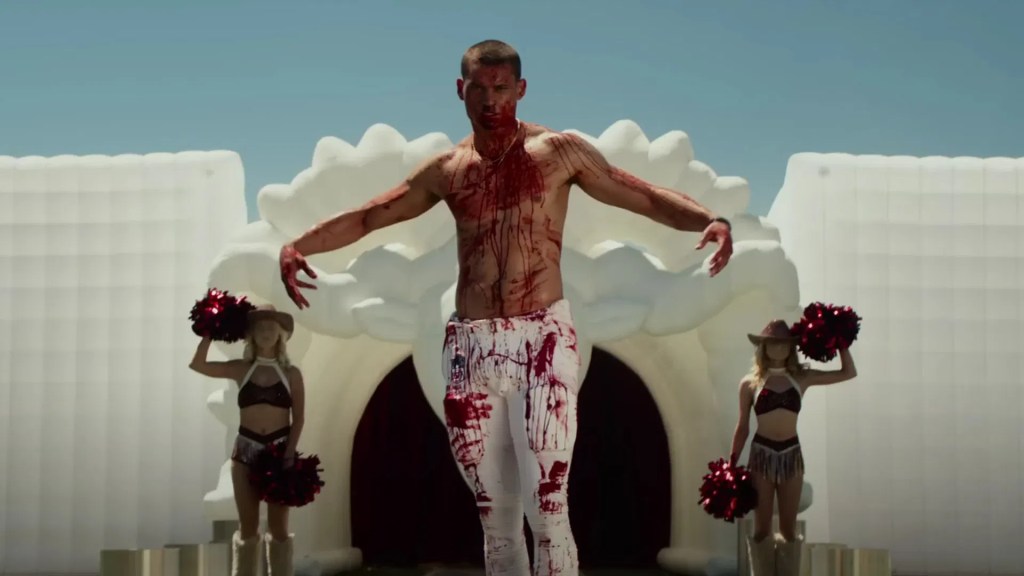

Synopsis: After a career-threatening injury derails his shot at football stardom, young athlete Cam Cade (Tyriq Withers) is invited to train with his childhood hero, legendary quarterback Isaiah White (Marlon Wayans). What begins as an opportunity to prove himself turns into a hallucinatory descent into madness and blood-soaked ritual, as Cam uncovers a sinister lineage of “Greatest of All Time” players sustained by sacrifice, violence, and blood.
Every now and again a movie would come along that would look all inspired, smart, stylized, muscular and full of things to say, only to turn out to be made of hot air, papier-mâché and electrical tape upon closer inspection. A movie that would fit Charlie Kaufman’s definition of Starbucks, which he called “a smart coffee for dumb people.” This year, this title is awarded to Him, a slick and stylish movie that applies an allegorical lens to the world of professional football directed and co-written by Justin Tipping.
The marketing promoting this unfortunate abomination suggests a lush feast resplendent with visual metaphors, lurid tones and no-holds-barred commentary that suggestively describes the world in which a young athlete is goaded by seemingly supernatural forces to sell his soul and his moral backbone in exchange for joining the long lineage of GOATs, the Greatest Of All Time. And the concept alone does indeed present itself as alluring, as it teases an intellectually titillating experience where the viewer would bask in the neon-washed locales, sway to the beat of electronic music and allow the thematic undertones of the narrative to surreptitiously seep into their subconsciousness.
No such luck, though. Tipping’s movie attempts in good faith to pitch its tent in the neighbourhood where such filmmakers as David Lynch, Charlie Kaufman, Tarsem Singh and Nicolas Winding Refn own property, perhaps hoping to absorb some of their irreverence and casual elegance by osmosis. Unfortunately, it is merely an interloper. A trespasser. An artistic vagrant who squats in people’s houses when they’re not around, wears their clothes, sleeps in their bedrooms and leaves the premises at dawn. It’s a movie that wants to look like Lost Highway or The Neon Demon but unfortunately it doesn’t have the mental and artistic horsepower to pull this off. The best it can do is approximate the Ryan Gosling-directed Lost River, a movie Gosling convinced himself he could pull off having worked with Nicolas Winding Refn on Drive and Only God Forgives and turned in a nigh-on unwatchable pile of heavy-handed slop with aspirations to visual elevation.
Brutal as it may seem to hear it, Him has way more in common with Lost River in this regard than it does with the work of filmmakers Tipping is clearly looking up to. It’s a movie that quite clearly displays a fundamental lack of courage and conviction in direction and storytelling as it does not leave one iota of its allegedly allegorical and mystical narrative for the viewer to interpret on their own. Him spells out absolutely everything and doubles down when necessary. It’s as though it was concocted by people who felt they either couldn’t trust the viewer to figure out what the message was, or they didn’t know that the language of the canonical music video would sell them short on all fronts in this regard.
Where it would be more than appropriate to simply rely on the aesthetic and symbolism embedded in elements of production design, which by the way are rather nice to look at, the characters will always—without fail—explain everything. In the context of a three-minute music video or the forty-five seconds allotted to a footwear commercial to smuggle whatever depth the creators deemed essential to the experience, it would make sense to double down. To hang a slogan over top of an image. To use an easily recognizable shorthand. This is no longer a requirement in a feature film because I would hope that we could make an educated assumption that some aspects of the message would make it through the cracks between the lines of dialogue or they would seep into our brains in consequence of sufficient visual exposure.
When characters wear pig heads, someone will tell you why. When the characters talk about sacrificing their morals in exchange for greatness, they will do it in a montage of most predictable clichés. When they want us to know that a character is unhinged, they will direct them to scream at the top of his lungs. When they want us to empathize, slow-motion backed by subdued beats will make an appearance. Nothing is left to chance here. Everything is symbolic and awash in thematic duality, but it registers like a beginner-level sudoku, rather than a work of artistic expression that trusts the audience to make up their own minds and connect the dots.
Consequently, Him is almost completely unwatchable. In fact, it is infuriating and downright offensive intellectually. Sure, it’s visually lavish and occasionally peppered with instances of self-aware levity, but it is still that Starbucks movie; a film that could have just as well been put together by film school edgelords who have yet to learn the meaning of the word “subtlety.” It looks like it wanted to belong among some of the most visually dense and intellectually invigorating works of the last couple of years, but all it can muster is a Nike commercial aping Nicolas Winding Refn’s visual toolbox or a politically-inclined Superbowl spot aiming to raise awareness of just how corrupt the world of professional sport really is and that Chronic Traumatic Encephalopathy ought not to be downplayed.
A lot of shouting, ham-fisted dialogue, unfocused direction, and a heap of heavy-handed messaging is all you will be able to extract from Him. It is nothing but a concussive blow of primary colours and tones with messaging copy-pasted from a billboard wrapped around a handful of performances that are as insufferable as they are indulgent. Avoid at all cost.

 Flasz On Film
Leave a comment