Before Stephen King published Carrie, he had written several novels already: Getting It On, Sword in the Darkness, The Running Man, Second Coming and The Long Walk. I suppose this offers some solace to all aspiring writers out there that even the seemingly superhuman genre-defining author like King struggled in his early years. Of course he did. Carrie didn’t come out of nowhere. It was that one piece of spaghetti that stuck to the wall following years of rejection and slugging it out by selling short stories to men’s magazines.
Out of the novels King wrote in his early years, Sword in the Darkness remains unpublished, though he had made it accessible to scholars at some point. Second Coming ended up reworked and renamed as ‘Salem’s Lot and published in 1975, one year after Carrie. Getting it On, The Running Man and The Long Walk stayed in the drawer, perhaps partly because King did try to get them published and failed. He submitted The Long Walk to competitions and ended up swiftly rejected with what in the world of today would be an automated email; he was also told (specifically regarding The Running Man) that in the late ‘60s there was no appetite for dystopian fantasy.
However, having become a rockstar novelist with a trifecta of hits that included Carrie, ‘Salem’s Lot and The Shining, King was no longer a guy to be rejected. He was a household name. A goose that laid golden eggs. A veritable cash cow. You get the gist. So, you’d think it would have been reasonable to assume that he should have been able to dig out his early manuscripts that had once bounced off the wall of rejection, rejig them and have them published without much ado. Well—you’d be wrong.
Stephen King was told by bean counters at Doubleday, his publisher at the time, that they wouldn’t publish his early works because it would oversaturate the market. In simple terms, with more King books available in bookstores at any given time, the overall revenue would plateau because readers wouldn’t necessarily sweep them off the shelves, so the solution to this problem would be to stagger the publication. The problem was that King—being extremely prolific—was already working on a number of projects which would make it difficult, if not impossible to find a suitable opening in the queue of prospective releases.
He sent the manuscript of Getting It On—a book that Bill Thompson, his editor at Doubleday, had unsuccessfully tried to get published in the past—to New American Library (NAL), who had just purchased mass paperback rights to his novels. With the help of Elaine Koster, editor at NAL, they came up with the idea to publish Getting It On, The Long Walk and The Running Man under a pen name to bypass the King saturation problem and to give these books a chance to live on their own, especially because they were slightly different from the stuff King had already published. They couldn’t be tagged as horrors.
Now, King himself has offered several explanations why he was Bachman, most notably in his essays Why I was Richard Bachman and On Becoming a Brand Name. These ranged from an ego-driven need to see if his works could stand on their own or if people read his books primarily because of brand association, all the way to the more prosaic notions outlined above involving nuances of book publishing, brand saturation and genre pigeonholing. You can read all about it in those associated apocrypha and make up your own mind while also availing yourself of the lore surrounding what briefly became a conspiracy theory in the genre space, because many fans suspected that either Richard Bachman was ripping off King’s style or it was King himself writing incognito.
Some experts knew the truth because they recognized some of these novels which had been submitted for publication or competitions before, like Getting It On (published as Richard Bachman’s Rage) and The Long Walk. But for a little while there, Bachman lived on his own dime, and he wasn’t doing well. It turns out that King’s brand was indispensable to the writer’s continuing success because when the secret got out and people learned that Bachman was King, Bachman’s paperback sales grew tenfold. But then again, it may have been a self-fulfilling prophecy because without King’s name attached to these publications, their market exposure was likely quite poor and the marketing effort expended by publishers was accordingly curtailed as well.
Now however, the story is different and these early Bachman books (King wrote six in total with Roadwork, Thinner and The Regulators coming out in much later) offer an indispensable look into the way King’s writing craft developed and how his writing career originated. Rage is its own little beast worthy of a separate conversation, so I will put it to one side for today, but I personally hold The Long Walk as one of King’s most underrated pieces and a classic in its own right. Written sometime between 1966 and 1967 (and likely reworked and polished for publication in 1979, a few months before King’s The Dead Zone was released), it is decidedly a work of a young writer who funneled anxieties and concerns of the time into the text.
The book takes place in a temporally ambiguous alternate universe where America is a right-wing dystopia ravaged by crises and gripped in the chokehold of an oppressive, authoritarian government. However, we never get to experience much of worldbuilding, which is mostly delivered in tangents and thin slices of backstories inserted in various places all over the narrative. What the story focuses on is the titular Long Walk, a televised event in which one hundred young men must walk continuously along a pre-designed route. Flanked by armed soldiers, they must never slow down below a certain threshold or stop. The rules are simple: anyone who slows down or stops, receives a warning. Three warnings and the contestant “gets their ticket,” a euphemism for receiving a bullet to the head. The walk continues until only one contestant remains, who is then named the victor and receives The Prize, which is literally anything they might ever want or need.
That’s it. In the book we follow Ray Garraty, a boy from Maine (how did people not clue into the fact it was written by King who famously set most of his works in Maine) and together with him we proceed at a pace of a walking human as he makes friends with other boys in the group and eventually sees them all executed in cold blood. It doesn’t require an advanced degree in literature or criticism to pinpoint that The Long Walk functioned as a thinly veiled allegory for the military draft that saw many young men plucked out of their homes and sent to Vietnam to face death and mutilation (all reported back home on the evening news) as well as a piece of staunch criticism aimed at the warmongering administrations of Lyndon B. Johnson and Richard Nixon.
King/Bachman commits wholesale to the idea of saddling the reader up on Garraty’s shoulder and having them experience vicariously what it must have been like to find yourself in a predicament where you must follow orders, put your own life and wellbeing at risk at the behest of a government you are not allowed to criticize and where life is reduced to two simple alternatives: either you die today or you live to see another day. And at that, while doing so, you bear witness to all your friends and buddies living or dying in the same manner. An allegorical proxy for being deployed overseas to fight a war for undisclosed or opaque reasons.
The book is purposefully thin with plot and plays out as mostly episodic. As we progress—again at a pace of a walking human—together with the characters, we learn about their lives and experiences and then inevitably witness their gruesome demise. This is clearly an attempt to portray how fraternal bonds are formed in men forced to stand shoulder to shoulder and face the same direction into the gaping maw of certain oblivion, how cheaply lives are wasted and how seeing these bonds ripped asunder takes inevitable toll on those lucky (or unlucky?) enough to survive to fight another day. It’s not a novel about what happens to whom and how things get done where, but rather about the experience of being there with these boys, pounding the asphalt with them for days, forging relationships, taking sides and seeing them all—one by one—turned to ashes.
Suffice it to say that it is nothing but nihilistic and bleak, both in tone and in content of its narrative. It was clearly an aggravated and furious book written by a young man who felt the need to oppose what he saw as a giant waste of life in a war that was as far from just as they come. In many ways, it was an important book at the time of writing (as it reflected the milieu of the Vietnam-era malaise), at the time of publication (as it gave King the opportunity to have a more direct conversation with the reader without the thick layer of genre covering the narrative), and now… when authoritarian governments are again rearing their heads all over the world and when we might be about to be reminded by those in power about just how little they think human lives are worth.
This is why The Long Walk is both a time-less and time-ly piece of writing and that’s perhaps why attempts to adapt it into a movie date as far back as the publication of the novel itself… or rather to the time when the cat got out of the bag and King had to come out publicly and admit he had been Bachman all along. After all, I don’t think anyone would have been interesting in turning it into a movie without the explicit association between King and Bachman. Bachman didn’t seel well enough to make Hollywood moguls giddy. King did. However, in contrast to the more popular and well-regarded King novels, this one never gained enough traction despite being on the radar of at least two directors King remained on friendly terms throughout the years.
George A. Romero thought about directing The Long Walk in 1988 before passing the book along to Frank Darabont, who kept the rights until the mid-2000’s hoping to get to it one day. Shortly after that, New Line Cinema acquired the rights to the novel and as recently as 2018-2019, the project was in development with André Øvredal at the helm. Eventually, the rights passed to Lionsgate and in 2023 the movie went into production with Francis Lawrence directing.
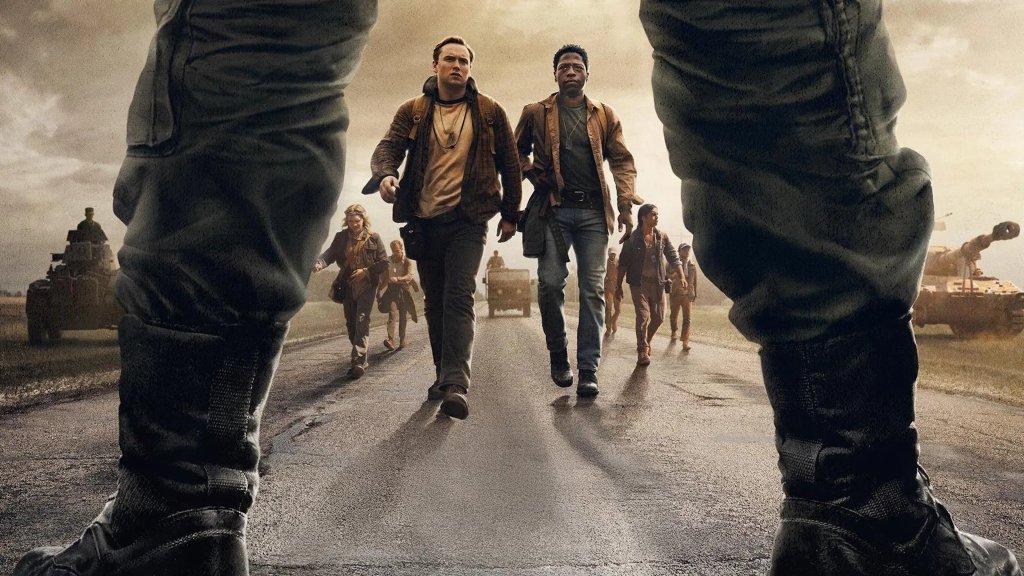
Finally, forty-five years after the original publication, the adaptation of The Long Walk saw the light of day in September 2025 with Cooper Hoffman in the lead role as Garraty, flanked by David Jonsson as McVries, Garrett Wareing as Stebbins, Ben Wang as Hank Olson and Charlie Plummer as Gary Barkovitch, the agent of chaos. And just within five minutes it will become abundantly clear to those who went to the theaters to watch it that adapting The Long Walk for the screen was not… a walk in the park. In fact, in many ways, this material is practically unadaptable.
After all, the structure of the novel and its central conceit do not lend themselves to being translated into cinematic language directly, as it is incredibly episodic. Building a simple three-act framework built around a classical inciting incident, rising action and dramatic climax based on the available material would have required some serious changes to King’s writing. And we all know how the author has always felt about people messing with his work. Not to mention the fans of the book, of which there are many as The Long Walk has grown to become a cult favorite among King aficionados the world over.
The whole point of the book was its repetitive nature and how rifle reports—each indicating one contestant “buying his ticket”—served as a counter-rhythm to the main beat of the novel, calibrated to the pace of a marching human. It was also most certainly indispensable to the experience for the reader to spend time with the book, which is only natural for the medium. For someone like yours truly who casually reads two or three hundred pages a week, The Long Walk represents a commitment of just over one week, which is more than enough to become friends with the characters and to grow progressively cynical and burned out having seen all but one of them terminated in the course of the walk. In fact, while it’s longer than the actual walk in the book, it’s within the same order of magnitude; therefore, the reader has all the opportunity in the world to spend as much time with the characters as the characters did with each other.
This is naturally impossible in a movie setting, and even if The Long Walk was adapted by Lav Diaz or Bela Tarr (both known for crafting movies that require a full working day to get through), it would still be impossible to recreate that kind of intimacy. However, movies govern themselves according to different rules and where timeframes must be hastened to get the viewers in and out of the cinemas within a two-hour turnaround, adjustments can be made.
The movie does indeed make specific choices to simplify the structure, or better yet, to reduce the risk of a two-hour movie looking repetitive and thus tedious by extension. Instead of one hundred boys, a cast of fifty contestants was chosen. Garraty was given a more substantial backstory and a narrative reason to apply to join The Walk, while The Major (played here by Mark Hamill) is less an elusive presence akin to General-McArthur-meets-Uncle-Sam and more of a play on Gunnery Sergeant Hartman from Full Metal Jacket in aviator glasses with Donald Trump’s mannerisms and vocal idiosyncrasies.
These are not the only changes made to the narrative, the most important of which pertain to the ending which was rewritten wholesale. Nevertheless, the episodic nature of the story and nearly all of its memorable beats—from the first ticket, a bout of diarrhea and Barkovitch’s kill to one contestant attempting to escape and two others storming the heavily armed soldiers—remained untouched. At the same time, the breadth of conversation and hangout time the book affords the reader was truncated to a minimum, which severely reduces any chance of the viewer developing similar kinship with the characters on the screen. In truth, this represents a squandered opportunity to rely more heavily on visual immediacy and intimacy to aid immersion, something movies like Beau Travail or Son of Saul managed to accomplish. Time is pliable in a movie format.
This of course is possible with the right direction from the filmmaker and engagement coming from the cast, but this is also where the movie displays its true weaknesses. It’s impossible to overlook the simple reality that Francis Lawrence was probably not the best choice to helm this movie and he might have been chosen on the back of his reputation as “that guy who directed all those Hunger Games movies.” I think the logic behind this decision was that simple: The Long Walk was seen as a piece of writing that broadly resembles The Hunger Games and Squid Game (which remain eminently popular currently) and it made sense to hire a guy who had done a movie like this before without necessarily giving the requisite time of day to understanding what The Long Walk was at its core.
Sure, superficially it stands a protoplast to The Hunger Games, but its core is elsewhere. Its heart is in the relationships between people whose lives are ultimately both expendable and expended, in sitting with their chats about their pointless hopes and dreams—because we know that in time they will all end up shattered—and not in recreating specific moments from the book. The horror of the book lied in the fact that we could immerse ourselves in relatable conversations between Garraty, Olson, McVries and others only to be violently awakened from this immersion by rifle reports cutting through the air like scalpels. This unfortunately did not translate from the novel at all. It is as though the filmmakers missed the point of the book entirely.
Granted, in 2025 it is even more difficult to pull off a successful adaptation of this novel because of its thematic space being so Vietnam-centric. While it is not impossible to make a modern movie about Vietnam in the current climate, and Spike Lee’s Da 5 Bloods is a great example of just how it can be achieved, King doesn’t extend any favours towards the filmmaker in this regard either. King’s characterizations are so naturalistically of the time with the melody of their speech, their cultural inferences and micro-inflections all coming through the text that it becomes insurmountable to decouple these characters from that setting. The book remains timeless, but only by dint of symmetry between how the book reflected its own timeframe and how it continues to rhyme with the current times. It’s a temporally displaced world, sure, but it’s still written in the 1960s and reworked in the 1970s. Which is why adapting this book for the screen is a way more complex task than I think anyone on the production team ever imagined it would be. It’s not an adapt-and-run job but a think-adapt-and-pay-attention gig. It’s not necessarily about getting all the details right as it is about transposing the spirit and soul of the novel to the screen.
The Long Walk was a nihilistic, bleak and depressing treaty that regurgitated the moral darkness of its time by way of letting the reader hang out with people whose days were numbered. The movie we got in 2025 is merely a postcard on the subject. Even though its changes to the ending and a more definitive resolution to the narrative make it an interesting companion to the book—after all, the movie ends up saying a fair bit more about America’s racial politics with McVries being black and also the ultimate victor of The Walk—it lacks the bite of the novel.
I’m sure the filmmakers did what they could to retain as much fidelity as they could, but maybe this book simply shouldn’t have been made into a mainstream Hollywood picture in the first place. Maybe this is where the problem really is, as the book simply cannot be converted into a familiar piece of entertainment without compromising its values. What it probably needs is freedom afforded to independent filmmakers who are not bound by fiduciary duties towards paying audiences. A movie like this should never be expected to provide entertainment. Instead, it should become a lived-in experience that upsets the viewer and gives them something to think about both on their way home and during the movie.
Therefore, the conversation about giving The Long Walk the kind of adaptation it most assuredly deserves is not over yet. It probably needs a team of artists who are brave enough to stretch the parameters of the cinematic form to accommodate this book, which in its own way evaded the familiarity of a typically structured novel. Maybe someone needs to give Spike Lee a call and ask him if he’d like to direct this movie. Or Cary Fukunaga. Or Jeff Nichols. Or even Denis Villenueve. They wouldn’t treat this assignment as a conveyor belt dystopia with muted colours and characterizations ripped straight out of The Hunger Games. Perhaps they’d turn this book into a timeless soul-churning cinematic classic instead of opting for mainstream chum. Or maybe they’d end up imposing their own vision and obstructing the subtle genius of King’s book.
At the risk of repeating myself, it is not a walk in the park.

 Flasz On Film
Leave a comment