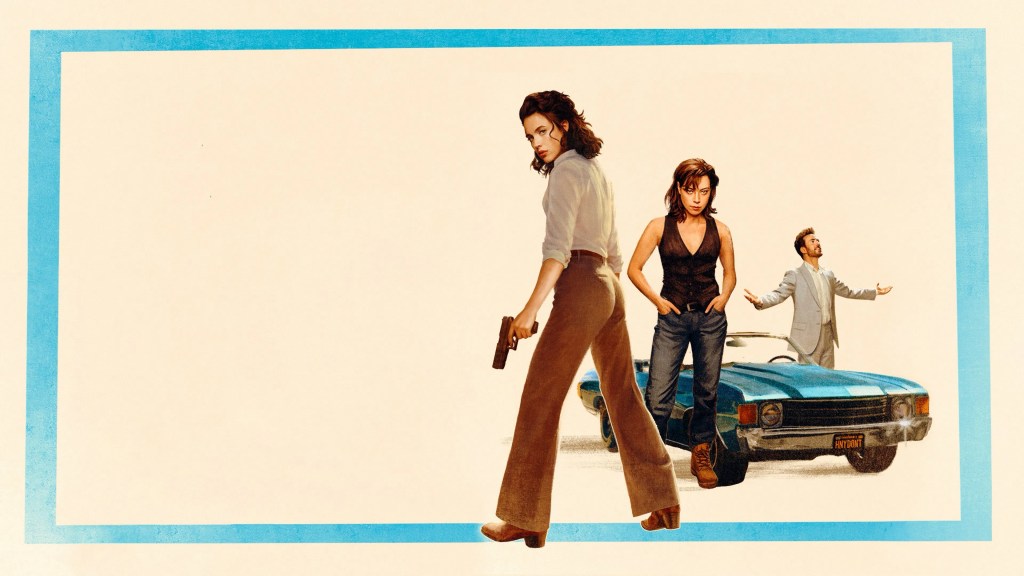

I’ve mused on several occasions about how Wes Anderson’s movies have recently morphed recursively into parodies of themselves (with titles like Asteroid City, The French Dispatch and The Phoenician Scheme being particularly egregious examples of the man’s progressive descent into diorama-like obscurity) and how they no longer resemble the work of the man who once directed Rushmore, The Royal Tenenbaums and Bottle Rocket.
But why am I telling you this? Why am I opening what I intend to be a text about the Ethan Coen-directed Honey Don’t! with what looks like an off-the-cuff remark on a filmmaker that had nothing to do with this movie? Well, that’s because for the purposes of what I’m about to ramble about for the next thousand words or more, Wes Anderson is the key to my thesis. Particularly, the notion I once wrote about that the reason Wes Anderson’s work has changed so dramatically over the years might have something to do with the fact he no longer collaborates with Owen Wilson, who might have been a grounding force for his quirky antics—a bottle to his rocket, so to speak.
See, we like to think of cinema as an authorial medium, in no small part because of the work of Andrew Sarris, Francois Truffaut and others who pushed the concept of “auteur cinema” into the culture and stipulated that a film, despite requiring input from many people, would carry its director’s signature. Even though someone else may have been commissioned to write the script, yet another person operated the camera and a whole team of artists and craftspeople scoped out locations, built sets and made costumes for another large number of performers to use while acting, it is the director who would bring it all together and adorn it with his or her style that carries across their entire body of work.
I’m not here to dispute the validity of any such claims, as I can see it as a useful tool while discussing a movie, but there’s no debate that cinema is a collaborative medium. However, I find opportunities to experimentally examine the influence of a director over the medium quite intriguing, as well as those of their collaborative partners. Michael Haneke’s work on remaking Funny Games remains a great example of the power of the auteur who would consciously and willingly embark on a journey to retell the same story while collaborating with a different cast and crew and under different cultural circumstances.
Nevertheless, the picture muddles considerably when it comes to directorial teams, like The Coen Brothers, The Safdies and others. I hope I’m not the only person out there to have wondered while watching films like The Big Lebowski, Blood Simple or No Country for Old Men whether the movies were more Joel or Ethan’s to claim. What was their process? How did they arrive at artistic choices, direction or on-set decisions. Did they take turns? Which elements of their movies could trace back to Ethan more than Joel and vice versa?
Therefore, as much as it was a momentous decision in its own right—after all, it is unlikely we will ever see another movie directed by The Coen Brothers as a creative team—the idea of Joel and Ethan each going their own way and pursuing directing solo afforded us an incredible opportunity to retroactively understand more about the nature of their artistic relationship. And while I am fully aware it is still quite early in the game as a good scientific experiment requires good quality robust data to draw confident conclusions, but based on what’s available, we might be able to make some preliminary estimations and perform some educated guesswork.
In 2021, Joel Coen directed The Tragedy of Macbeth (his only solo completed solo effort thus far) and between 2024 and now, Ethan has directed Drive-Away Dolls and Honey Don’t! Granted, one has to be careful before jumping to conclusions because of one of the Coens doing one Shakespeare adaptation, which comes with certain parameters, and the other jumping head-first into B-movie pulp that also carries its own genre expectations. So, all told they haven’t made too many movies for any speculations to be statistically relevant and there may have been extenuating circumstances to the movies they did make. However, just the idea of Joel gravitating towards the Bard and employing a terse and minimalistic approach while Ethan was happily dabbling in fun-first idiosyncratic entertainment is enough to give you some background as to how you might want to look at movies like Miller’s Crossing, Raising Arizona and Inside Llewyn Davis; all three being equally characteristically “Coen-esque” while being distinctly different from one another in terms of overall tone.
Granted, the matter is further complicated by the fact that Ethan Coen has collaborated on both of his solo features with Tricia Cooke, to whom he is married and who also served as the editor on a number of their previous joint efforts, like Miller’s Crossing, The Big Lebowski, and Fargo, among others. Hence, teasing out the truth out of this predicament is less like trying to understand what makes sweet and sour chicken sweet or sour and more like attempting to understand the influence of each of the five spices in the Chinese five spice by selectively deleting each of the spices and seeing what it does to your stir fry. But I think it’s enough to boldly assume that Ethan is the quirky one and Joel is the serious one, so in the tug of war between two artistic visions, I can only assume that The Big Lebowski and O Brother, Where Art Thou? are more Ethan-esque, No Country For Old Men and Blood Simple are more Joel-esque, while stuff like Fargo hints at a consensus of visions… and that’s only because Honey Don’t! looks like a movie made by someone who did leave his pawprints on The Big Lebowski and Barton Fink rather than someone who made Inside Llewyn Davis, if that makes any sense.
This may be completely bogus, and my speculations could be way off the mark. I do reserve the right to be wrong on occasion, but it sure is something to think about after watching Honey Don’t! (and Drive-Away Dolls too, if I’m being honest) because the movie itself does not necessarily have enough meat on the bone to facilitate a meaningful conversation of any kind. It’s as slight as they come and it sure looks like work of pure aesthetic quirk underpinned by seriously sassy humour. Think The Big Lebowski on crack. Similar vibes, tone and visual toolbox but cranked up to eleven. Which is where my Wes Anderson connotation comes in handy because if I were to map the Coen movies on a Wesandersonian spectrum of idiosyncratic exultation ranging between Bottle Rocket and Phoenician Scheme as the two extremes, this movie would fall within walking distance of the latter.
Thus, I can only apply to it the same yardstick and tell you that if you do in fact enjoy the more quirky and outlandish Coen efforts, Honey Don’t! is a movie you will dig. It’s funny, light on its feet and extremely lean—like, under ninety minutes kind of lean—the characterizations are bombastic and big, the plot appropriately weird and effusive and it’s all tied together with Margaret Qualley’s aptly idiosyncratic performance to boot. As a side note, the more I watch movies with her, the more I am convinced she might be secretly related to Timothée Chalamet. But then again—curiouser and curiouser—I don’t think they have ever been sighted in the same room, have they? Think about it.
On a serious note, Honey Don’t! remains an intriguing specimen precisely because of what it might illuminate about the Coen Brothers style and aesthetic and not necessarily because of what the movie itself has to offer. It’s just slight and forgettable with its appropriately B-movie pulp noir murder plot, a wildly big villain character played by Chris Evans who clearly must have enjoyed his time on set, a French hitwoman on a Vespa and oddly shocking visuals of Margaret Qualley giving her anal beads a good wash after a night of steamy lovemaking with Aubrey Plaza.
In fact, simply recounting the elements of the story and how outrageously everything seems to be woven together makes me think that Ethan Coen and Tricia Cooke, when unencumbered by Joel’s vision grounding the end product, were able to produce a movie that has much more in common with The Grand Budapest Hotel than it does with Blood Simple. Nowhere near as self-indulgent as the recent Andersonian efforts have been and clearly more fun to experience, but nonetheless the comparison is inescapable. And in all honesty, the relationship between Ethan and Joel may have carried similar artistic ramifications as the one between Wes Anderson and Owen Wilson. Joel has always been the bottle and Ethan the rocket—the fountain of energy that needed someone else to ground him and direct him towards the sky.
Thankfully, he has a great screenwriter and editor to keep him on the straight and narrow, which results in the simple observation that while eminently pulpy, quirky, heightened and rambunctious, Honey Don’t! never crosses over to the land of tedium where Wes Anderson has seemingly bought real estate and laid down his roots. It could be less forgettable, though, but alas—you can’t have it all.

 Flasz On Film
Leave a comment