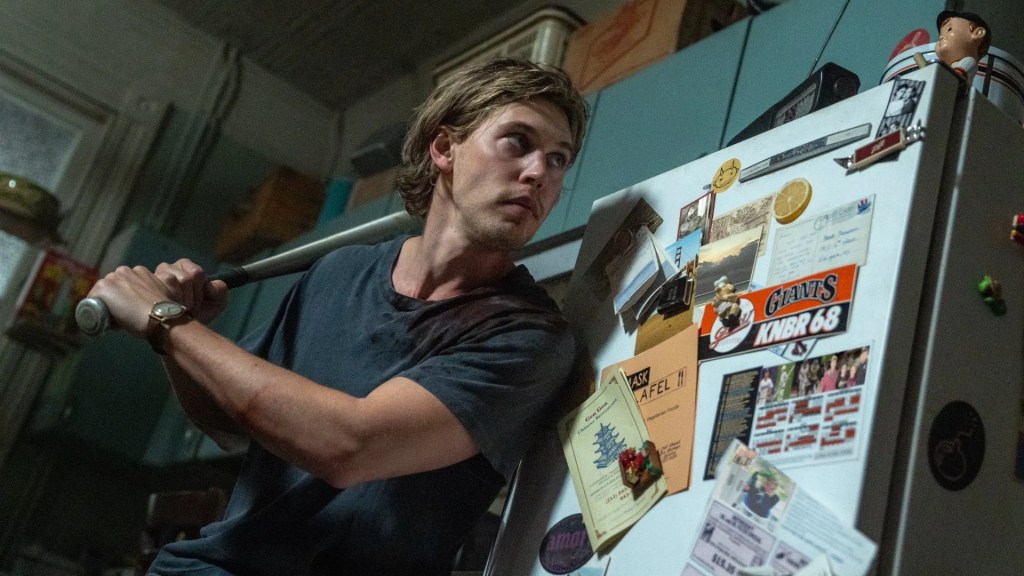

If I told you that Darren Aronofsky had a new movie out in cinemas which was a darkly comedic action thriller with Austin Butler, Matt Smith, Zoë Kravitz and a bag of money based on a pulpy novel and set in the late ‘90s, you would have no clue what to expect. After all, all throughout his career, Aronofsky has frequently worked on movies that successfully evaded—or, better yet, subverted—genre expectations, and somehow the concept behind Caught Stealing sounded almost too uncomplicated to pass the Aronofsky muster.
Cerebral and mind-twisting, these are adjectives that you’d commonly find in the vicinity of Aronofsky movies, even those more straightforward than others like The Wrestler or Noah. He’d relish in body horror in Black Swan, travel through multiple timelines in the vastly underrated The Fountain, get under your skin in Requiem for a Dream and go head over heels with all-encompassing biblical allegories in mother! and if there had always been anything you’d come to expect from Aronofsky spectacles, it would be sensory titillation, intellectual stimulation and the gentle pushing of boundaries in the ways of bringing the viewer into the headspace of characters going through utter turmoil. Even the clunky The Whale follows in this tradition despite being predominantly preoccupied with succeeding as a stage-to-screen piece revolving around Brendan Fraser’s long-awaited (yet brief, alas) comeback to the forefront of cultural conversation.
Therefore, Caught Stealing is a movie you probably wouldn’t expect a guy like Darren Aronofsky to direct. In fact, the trailer alone suggests that the energy exuding from the movie is more consistent with a new Guy Ritchie gig while the visual aesthetic screams profoundly of the Safdie brothers. But no. This is a pivot for the director who once asked Jennifer Lawrence to play Mother Earth trapped in a house invaded by throngs of strangers and who gave us all nightmares involving Natalie Portman and fingernails. By the looks of it, Caught Stealing bears very little resemblance to what the filmmaker used to do in the past and indeed it does look like a piece of homage to the late-90s post-Tarantino wave of slick crime movies with a funny bone and cocaine dependency. In many ways, it is by all means a modern-day collage of references and vibes pointing to Lock, Stock and Two Smoking Barrels and Snatch with a noticeable whiff of the Safdie-directed community favourite Uncut Gems.
The ingredients are all there: a hapless-yet-lovable rogue who finds himself in over his head and insists on making the worst decisions one after another, a convoluted plot involving multiple parties vying for the same MacGuffin, a bunch of feckless henchmen who are as incredulous as they are savage, frequent flashes of extreme violence that in that Tarantino tradition carry an element of levity within them and, most importantly, a relentless and frenetic energy permeating the entire experience that makes damn sure your ass would stay bolted to the seat and that you wouldn’t be asking any questions that could undermine the logic of what’s on display. That’s what you sign up for, at least superficially, and you’d be right in asking what the filmmaker’s interest in picking up this movie actually was.
And I don’t have a good enough explanation for this myself. I can only point my finger at the movie like the rest of the critical community and tell you that Aronofsky has decided to try something new and that it’s a good thing because (1) it’s nice to change your scenery every once in a while, and (2) the movie actually works well. Like, really well. In fact, I’d press my tongue into my cheek and tell you that somebody had to make a movie like that since Guy Ritchie has long abandoned this mode of filmmaking and the Safdie brothers have also gone their separate ways to pursue other things. But that’s not the whole picture either.
Granted, Caught Stealing is not a movie an auteur filmmaker would find easy to manipulate to suit their aesthetic or thematic proclivities, not with a thick layer of plotting covering the narrative and an assembly of characters in need of juggling by a focused storyteller. In fact, for the most part, it is the story proper that carries the movie along and forces the viewer into a state of perpetually frustrated cheerleading for Austin Butler as he accidentally finds himself in the crosshairs of the Russian mob, Ukrainian henchmen, corrupt police and a pair of bearded Jewish sicarios with a penchant for elaborate torture. But underneath it all lies an element of the story that seems to be at least tangentially more congruent with what I’d have expected out of an Aronofsky film than everything else in the movie. And it relates to the fundamental idea of setting at least a part of the narrative in the protagonist’s headspace.
As we follow him through the boobytrapped maze of gangsters, mobsters and stone-cold killers, we learn that Butler’s character is an alcoholic who uses the fog of inebriation to cope with unresolved guilt of his youth. Over the course of the movie, the filmmaker allows us to see his past unfold in short chapters and reveals in vivid detail that he was in fact responsible for the death of his close friend because he drove drunkenly into a pole and that this accident also left him incapable of pursuing his dream career in baseball. These flashbacks are what the director uses to—as Werner Herzog would say—let his hog loose and bring the viewer straight into the protagonist’s troubled mind using his signature techniques of aural and visual envelopment. Which is what I think might have drawn him to the story and, by extension, it constitutes a piece of connective tissue—thin as it may be—that tethers Caught Stealing to his wider filmography.
Consequently, this lens through which the filmmaker allows us to observe the unfolding story that splits between following the plot and remaining firmly placed within Butler’s point of view, gives the entire film what I can only call a distinct aroma. It’s not a piece of wholesale genre reinvention but rather an attempt to recreate the kind of moviemaking you’d recognize in a Guy Ritchie or a Safdie brothers movie with just a scent of freshness perfuming the experience. Still very much a loud and proud post-90s piece of homage that harks back to the days when violence and action were fun in a mature kind of way, but also a conversation that these kind of movies would rarely carry in their undercarriage, and if they did, they’d reserve it for the critic in the room who looks way beneath the surface layer of the narrative. Lock, Stock and Snatch would probably sustain this kind of scrutiny, and you’d be able to find a commentary on class within them. The same goes for Uncut Gems, Underneath the primary story about how Adam Sandler attempts to outfox the world and get rich there is a conversation about fatherhood, failure and masculinity. But in either of these cases, it is completely superfluous, and you can—and many did—watch those movies to just have fun.
In Caught Stealing, this thematic layer is no longer subcutaneous. You’re very much invited to chew on what’s happening to the character the way you’d likely be able to do whilst following this story by reading the novel. I suppose there is no other way to describe what the filmmaker has done here than to call it a rather inventive way of getting around many typical problems associated with adapting novels for the screen where either a lot of the internal monologue or character thought process would have to be nixed or delivered in bits of clunky exposition. It’s quite honestly refreshing to see how a movie effortlessly and creatively utilizes the ability of the viewer to perceive the story in a way that’s inaccessible while reading it, which is what Aronofsky does best and has done so consistently ever since he decided to direct movies.
So, is this really a pivot for him? Only partially. Sure, he’s never made a bona fide action thriller, but he clearly has what it takes to put one together. Caught Stealing is not a case of a filmmaker attempting to shoehorn a directing assignment into the parameters of his own comfort zone, but rather a piece of evidence that he can pull off this assignment and make it work as a canonical piece of genre entertainment and give it a bit of personality as a result of having to use his own toolbox to assemble it. It’s a beautifully crafted, kinetic, frenetic and engrossing movie that capitalizes on those Safdie/Ritchie vibes while still ensuring that the “directed by Darren Aronofsky” label at the top of the end credits makes sense to those who know what’s what.



 Flasz On Film
Leave a comment