
Much like the genre of horror, which—at least in its mainstream incarnation—has consistently and reliably added a handful of IQ points in the last decade or so and saw braindead slasher fare outcompeted by elevated horror or self-aware incarnation of 90s slasher revival, we might be on the cusp of the same phenomenon repeating in the landscape of canonical romantic comedy. Granted, you’d be right to point out that both genres have always been “smart” enough to accommodate inspired works in their midst. Just as there has always been space for The Exorcist, Rosemary’s Baby, and The Shining among less enlightened products flooding the horror market, the rom-com world could produce such icons as Annie Hall, When Harry Met Sally or the Before trilogy among conveyor belt direct-to-video and streaming originals slop as well.
But with the recent victory of Sean Baker’s Anora—a modern take on Pretty Woman on its own terms—there might be enough cultural momentum to precipitate a revivification of this genre template that would appeal not only to overstimulated mums half-watching during prosecco breaks from attention-seeking rugrats, but to viewers of all stripes who might find out that a well-made romantic comedy transcends the quasi-sexist moniker of “a chick flick” and stands a solid chance of earning its keep in the broader cultural space.
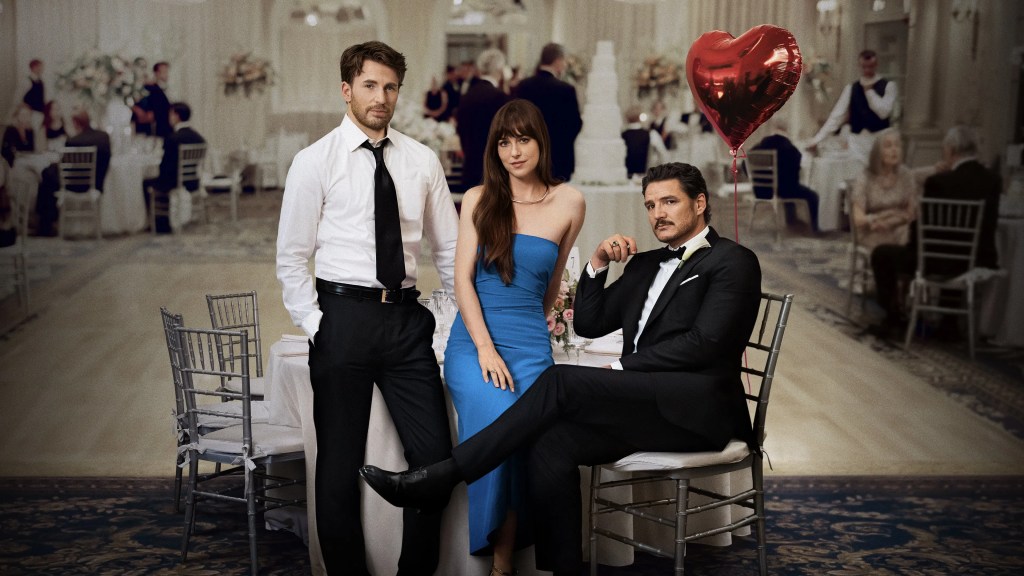
Celine Song’s Materialists is definitely one such specimen that, with a little bit of curation and a positive word-of-mouth coverage courtesy of the critical community, could end up seen as one of the early heralds of what I hope might be referred to in the future as the elevated rom-com movement. In fact, Song’s previous movie Past Lives, which I personally hold as the best film of its year, could function as an early indicator of this shift in sensibilities, as it clearly defies the expectations of a typical love story with its tone and starkly real-yet-poetic approach to unveiling its narrative and engaging with the viewer. But here, in Materialists, is where Song engages with the genre directly and challenges its form while contributing to a relevant discussion on how the dating market has evolved since the days of Annie Hall, let alone Billy Wilder’s The Apartment.
What the movie deals with is what you will most assuredly discover yourself the minute you set up a brand new social media account—pick your poison: TikTok, Facebook, Instagram; it honestly does not matter one jot—and start scrolling through reels. You might see this phenomenon from different angles depending on who you are and what your fundamental interests might be. But the longer you stay glued to the screen, the more likely it is that you will witness someone commenting on or describing the sad state of the dating market in the current age of app-enabled low-energy hookup culture, which is increasingly seen as an unintended byproduct of the sexual revolution supercharged by the invention of the social media and a pocket-sized device we call a smartphone.
We now live in a world that overindexes on status: young women slay-queening into their thirties while holding out for tall, six-figure Prince Charmings; men feeling invisible unless they’re high-earning and high-status; and curated influencers selling the lie that you must be a millionaire before twenty-five to have a chance in the mating game. That’s the kind of world Song’s movie wants to describe—a dystopian perversion of what we were promised in Sex and the City that anyone who isn’t lucky enough to be in a committed relationship would have to navigate in order to find someone to start a relationship with. After all, people don’t meet in coffee shops anymore apparently. Men don’t want to approach women and women don’t wish to be approached. Yet they still somehow yearn for connection despite the fact the platforms they have been provided with that are supposed to facilitate the process of establishing this connection optimize for short-term dopamine hits of casual one-night stands and emotionally fraught situationships instead of offering a shot at long-term peaceful happiness with two-and-a-half children, a retriever and a little house in the suburbs.
Enter Dakota Johnson’s Lucy, a professional matchmaker who offers a high-class and steeply priced service of finding suitable mates for rich and successful people, who in the modern hypergamous dating marketplace would stand little to no chance of finding anyone they’d be happy to date. Not with their abnormally overinflated expectations of what their perfect partner should be and the fact that, as the movie shows as well, their priorities are completely orthogonal. Rich and successful women Lucy is hired by to desperately seek out a partner before their biological clock runs out of time want to date tall billionaire philanthropists, while tall billionaire philanthropists want to date young women. Meanwhile, their average-sized peers become desperate enough to undergo surgical procedures to give themselves a few more inches of height to alleviate their sense of inadequacy and soothe their acute body dysmorphia. Meanwhile, Lucy must also navigate the dangerous possibilities that this dysfunctional dating marketplace may be used by predatory men who wish to gain access to desperate rich women and enter the dating ring with rape on their minds.
At the same time, while catering to her clients, Lucy finds herself swept off her feet by one of her clients played by Pedro Pascal who seems to be the perfect specimen. A real-life unicorn: rich, tall, well-mannered. McDreamy. Big from Sex and the City. You get the picture. Instead of setting him up with one of her other clients who’d pay good coin to be paired with this final boss of the dating game, she begins a relationship with him herself… while also rekindling an old relationship with her ex-boyfriend (Chris Evans) who is the literal antithesis of what modern successful women seem to want. He’s broke, shares an apartment with a bunch of human raccoons who leave used condoms in the middle of the kitchen floor, moonlights as a caterer and clings onto a dream of becoming a theater actor. In a world obsessed with status, money and power, this guy is invisible—barely qualifying for basic human rights.
Yet, Lucy finds herself torn between pursuing those materialistic dreams peddled by the social-media-fuelled hypergamous dream and reconnecting with a man who might not have two dollars to rub together or a long-term plan for his career, but he has a heart that doesn’t know how to forget a love that got away.
And he’s also Chris Evans, which definitely helps.
Thus, Song’s Materialists weaves a canonically simple rom-com narrative—a woman forced to choose between two men in a world that favours material possessions and status over warmth and human connection—around a conversation that attempts to critique the world around us. In a way, it is her way to show us just how far we have strayed from the days of familiar romantic comedy templates reflecting base human desires, much like Sean Baker’s Anora illuminated the many ways in which the canonical Cinderella story would fail to match the reality of the current era of transactional relationships revolving around seeking status, power and short-lived relevance. However, Materialists opts for an approach that is aesthetically antithetical to the expectations of a romantic comedy. This movie is tonally subtle, visually tempered, subdued and paced so that you’d have enough time to reflect on Lucy’s central conflict as it was happening. Where the genre instruction would call for excitement, Song’s movie chooses delicately paced introspection. It’s as tender as you might expect a movie that came out from under the knife of the filmmaker who gave us Past Lives, a veritable poem on loneliness and longing for closure.
All things considered, I think that Song’s Materialists continues the tradition of intellectual romantic comedies peppering sparsely the cultural timeline (from The Apartment and Annie Hall to Linklater’s Before movies, Punch-Drunk Love and Silver Linings Playbook) and offers an elevated alternative to what you’d expect from this utterly stale template. In fact, with its ingrained potential to facilitate a broader cultural conversation about how the dating market has devolved to index transactionality and short-term hookups while leaving people desperate for real connection that they have lost the ability to articulate, it’s a movie that engages the world it’s in and the landscape of other elevated romantic comedies we have seen recently.
One can only hope that between Materialists, Anora, Past Lives and even such examples like Enough Said, The Big Sick, Cat Person and other movies that seem to have accumulated in recent memory, we might be witnessing a revival of a trend and— just like horror that grew a brain fifteen years ago—rom-com might do the same, thanks to inspired filmmakers like Song who are expressing themselves in this space, subverting the template and engaging audiences in ways that respect their intellect and challenge their worldview, even as they smuggle those challenges in under the sugar-coating of genre convention.



 Flasz On Film
Leave a reply to On the Demise of “Actually” Movies Under Algorithmic Pressure – Flasz On Film Cancel reply