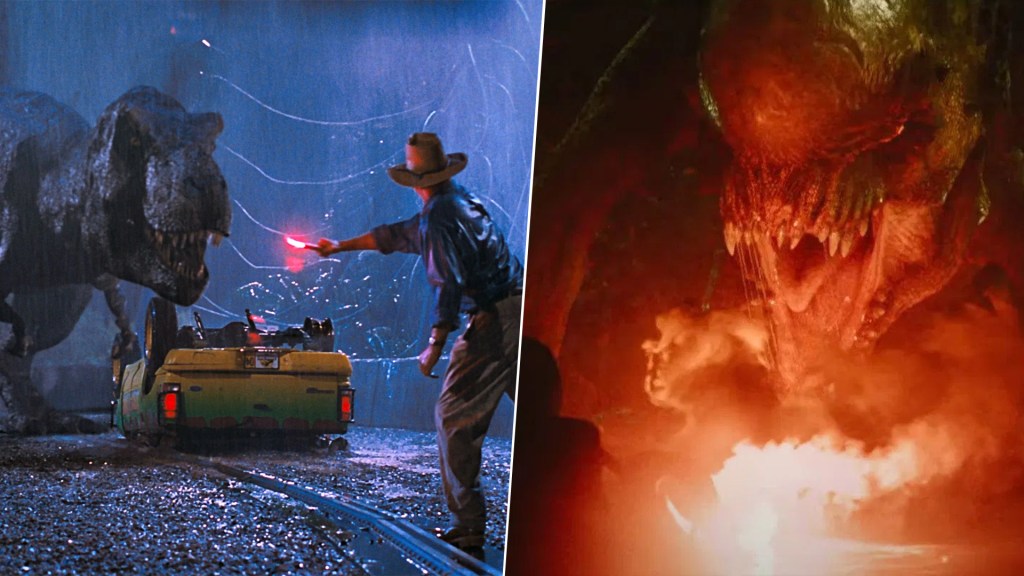
When Michael Crichton was working on what would eventually become Jurassic Park, I don’t think he had any idea of the scale of success this book would foster, both as a bestselling novel and a progenitor to a multibillion-dollar multimedia franchise. In fact, at one point he almost stopped working on it because—as he apparently observed—the world was going through what he thought was a brief obsession with dinosaurs and he didn’t want it to look like he was jumping on the bandwagon and cashing in on the craze. He then realized this was not a temporary fad, but rather a sustained cultural trend, so he went back to writing.
What Crichton also struggled with was his own doubts about the originality of the story he was putting together. The early iterations of the story involved a single graduate student doing some genetic engineering or something and bringing to life a dinosaur in his basement, which probably would have made a good subject for an 80s comedy starring Michael J. Fox. Because his modus operandi was to stay as close as possible to what science could plausibly deliver, he re-jigged the idea and came up with the concept of an amusement park built and maintained by a well-funded corporation with a solid R&D division handling the genetic splicing and cloning and stuff. Which is where the problem was because the core of Jurassic Park looked frighteningly close to Crichton’s earlier screenplay he ended up directing himself, Westworld, which was about an amusement park run by a tech corporation and where robot cowboys would go berserk and massacre the guests.
But Crichton persevered and anchored the central idea behind Jurassic Park around the intriguing concepts of chaos theory and ethical limits of genetic engineering and cloning, all in addition to playing well into the hands of that sustained dinosaur craze taking over the world. He sold the adaptation rights for a hefty 1.5 million dollars and bagged five hundred thousand for the privilege of writing the first draft of the screenplay that was to be directed by Steven Spielberg himself. Then, David Koepp got involved, a lot of changes were made, ILM came into the picture with their stunning CGI effects, John Williams tooted his horn and the rest was history. Jurassic Park immediately became the biggest movie of all time and cemented Spielberg as the most profitable director ever; three of his movies (Jaws, E.T. and Jurassic Park) carried the world championship belt for the highest-grossing movie of all time, briefly interrupted by Spielberg’s pal George Lucas and his pesky Star Wars, until Jimmy Cameron came into the fray with Titanic in 1997.
Seeing how big a hit Jurassic Park became and just how much of a cultural phenomenon it ended up being, probably comparable in size and reach to Star Wars and Superman, it was a no-brainer that Universal would insist on putting together a sequel and launching a whole franchise off the back of Crichton’s novel. However, the author had never been too keen on following up on the book himself. In fact, since the publication of the novel in 1990 he had been shooing away fans demanding a sequel, suggesting he had no interest in revisiting this world and mining it for another narrative to publish. But the story became a bit different when the residuals came flying through the letterbox and when Steven Spielberg himself (with David Koepp flanking him like a good wingman) started begging him to write another book that he would turn into another dino-cash cow. Which he did.
But the real problem with The Lost World wasn’t that it strayed too far from Crichton’s novel — if anything, it stuck too close to the logic Crichton had already explored. In doing so, it unwittingly set the franchise on a repetitive track. From that point forward, nearly every film in the series would revolve around the same premise: find a contrived reason to return to an island (either the original or a newly revealed one), encounter some shady corporate science, and run from dinosaurs. That blueprint — more corporate hubris, more escaped creatures, more CGI mayhem — became both the series’ safety net and its creative cage.
And it turns out that with the small exception of Jurassic Park: Dominion, all movies in the series revolve around the concept of finding a good enough reason to send people to Isla Nublar or some other island in the region and for people to run away from giant lizards, mostly with great financial results. Even the less successful movies in the series, like the aforementioned Dominion and Jurassic Park III, which is frequently dismissed as the true nadir in the franchise, ended up making enough money to keep the bean-counting brigade happy; though, when measured against some of the biggest movies of all time—which Jurassic Park and Jurassic World were—even a relatively popular box office success will look like a trifle or even a bomb. But the point remains that the franchise remains rather faithful to the post-Westworld template put forth by Spielberg, Koepp and Crichton.
In 2025, it is honestly fascinating to see another entry in the franchise, Jurassic World Rebirth, that doesn’t even pretend to ask what new directions a Jurassic movie could take.. In fact, it unwinds some of those attempts we have witnessed at the end of The Fallen Kingdom and all throughout Dominion as it just looks odd (with most movies in the series following the logic of the original with only minor deviations) as though it had never been interesting to see Velociraptors running amok in the streets or a T. Rex laying waste to urban environments the way The Lost World suggested.
It turns out that audiences crave the familiarity offered by the series. Naturally, since the 2015 Jurassic World effectively staged a soft remake disguised as a nostalgia sequel, it reinforced those simple visual ideas viewers wanted to witness in the Jurassic Park series. They wanted to go back to the island. They wanted to see dinosaurs they had not seen before. They wanted to see a T. Rex doing some cool things. They wanted Spielbergian action and a few memetic nods to the original, either in the form of old cast members returning to the screen or in the form of a visual nod to an iconic scene. And that’s what they’ve been getting.
However, there’s a ceiling on some of these elements because eventually you will run out of cast members willing to come back for more and the more dinosaurs you bring back from extinction, the more difficult it becomes to up the ante in each passing instalment. The introduction of the Mosasaurus in 2015 was a memorable one, but we all knew that it would be hard to find dinosaurs that are cooler than Velociraptors and the T. Rex. Which is why with the rebooted Jurassic World, filmmakers decided to indulge their imaginations and introduce fake mutant dinosaurs of increasing grotesqueness, if only to raise the stakes and make the movies bigger and more interesting than the preceding ones, while remaining faithful to the “back to the island” template. I think we can all agree that it would have been way easier to open the formula and let in some fresh air. Granted, Dominion tried it, but just because one movie didn’t work as well as it should have (and I do have my own reservations towards Colin Trevorrow as an artistic voice capable of pulling it off), it doesn’t mean we should immediately retreat to the comfort zone. It’s like deciding after one bad date to go back to celibacy instead of finding someone else to go out with.
Nevertheless, here we are. Jurassic Park or World is now a franchise with seven instalments, mostly reliant on delivering on the same set of expectations. It’s nearly a genre. And it’s fine because it’s honestly difficult to make a truly unwatchable movie in this franchise, if what we’re signing up for is an experience with people and dinosaurs. Sadly, the direction of travel points toward full MonsterVerse territory, where real dinosaurs are no longer “cool” enough, and mutant hybrids take center stage. With every sequel, the franchise inches closer to self-parody—more islands, more shady cloning, and more grotesque dino-chimeras designed to satisfy audiences who’ve forgotten they could ask for something different.
I bet that Michael Crichton had no clue what his innocent little book about a billionaire setting up an amusement park in Costa Rica would turn into. In fact, I don’t think he understood the power of Westworld when he was pitching it as a movie that he wanted to direct himself. It only goes to show that the fear of technology escaping our control and science untethering itself from ethics are such well-ingrained concepts that not only can they bring multiple billions of dollars in revenue but they can sustain themselves in the culture for many decades while slowly, recursively, morphing into its own grotesque aberration. A watchable aberration, but an aberration, nonetheless.

 Flasz On Film
Leave a comment