
One of the prerequisites for being handed a directorial job on the upcoming sequel in the Jurassic Park franchise is to be at least distantly related—stylistically speaking, that is—to Steven Spielberg himself. For a while in the mid-90s the series was inextricably linked to him much in the way the Indiana Jones series was until the most recent entry directed by James Mangold came out and added to the swirling flurry of nostalgia sequels laying waste to the blockbuster landscape. And even there the requirement to have a “Spielbergian touch” was quite prominent as James Mangold’s work is also deeply informed by Spielberg’s work.
However, coming back to Jurassic Park, Spielberg understood at some point during the production of The Lost World that he would not be coming back to direct any more entries in the franchise while also knowing that the series would in fact go on without him. Being a savvy Hollywood insider with an unmatched box office record, he knew that you do not slaughter a cow that gives chocolate-flavoured milk; you milk it dry instead. Therefore, the 2001 Jurassic Park III ended up directed by Spielberg’s protege Joe Johnston and the resurgent Jurassic World legacy series followed this rule by engaging Colin Trevorrow twice (Jurassic World and Jurassic World: Dominion) while giving the reins of Jurassic World: The Fallen Kingdom to J. A. Bayona who is as Spielbergian as he is Del Toro-esque, just to mix it up a little bit.
And here we are now, in 2025 when the inevitable happened and a new instalment in the series has made landfall. After all, a franchise that makes a billion dollars in global ticket sales on each go will not fade into obscurity at all. And at a time when studios are more risk-averse than ever while the audiences struggle through a cost-of-living crisis, you can expect that some people out there in Hollywood will put their heads together and concoct a way in which to add another chapter to the ongoing saga about dinosaurs brought back from extinction for the purposes of entertainment and how people’s grand plans get smacked in the noggin by reality before they’ve even taken a breath. And since the recent Jurassic World trilogy has kinda-sorta come to its natural conclusion, the opportunity for a clean-ish break was out there for the taking.
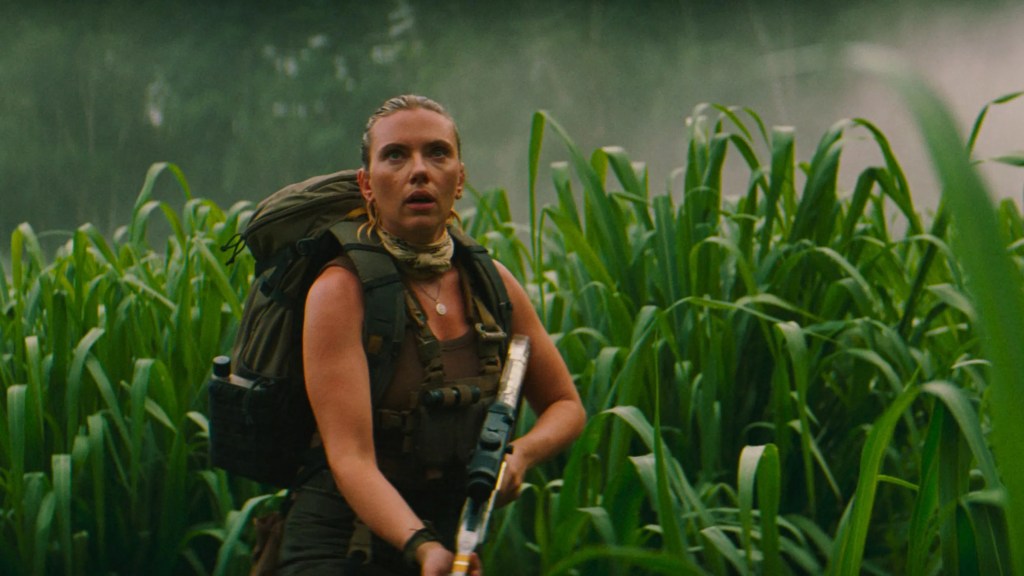
Therefore, David Koepp was hired to put together a new chapter in the series and he was apparently partially inspired by an idea supplied by Steven Spielberg himself. He went back through the available material, which includes all six movies, two books and some change, all in pursuit of identifying a fresh avenue to go down and to see if there were any scraps of lore left unused. It turns out that both goals were achievable… at a cost. Yes, there was some material left over in one of the books, which ended up turned into one of the highlights of the movie—a sequence with a T-Rex and a raft—and there were after all ways to bring some freshness to the operation. But it included putting dinosaurs to one side and turning what was going to be titled as Jurassic World Rebirth (at this point I am myself confused as to whether there should be a colon between “world” and “rebirth” or if we have entered a new era of colon-free subtitling) into a de facto cousin of Kong: Skull Island.
Gareth Edwards (Monsters, Rogue One, The Creator) was quickly identified as the Spielbergian-enough director to helm this. A cast of bankable faces (Scarlett Johansson, Mahershala Ali, Rupert Friend) with some relatively fresh names of more decidedly TV-esque provenance mixed in (Jonathan Bailey, Manuel Garcia-Rulfo, Luna Blaise, David Iacono) was brought on. This was perhaps also an attempt to tip the hat to ol’ Spielberg-o who has always had a knack for casting his movies in a similar manner, and the movie came together in time for you to sit down this summer, watch it and see exactly what these folks did to make Jurassic Park/World fresh.
And what did they do?
Bupkis. That’s what. But… Is it a problem?
Look, if at this point in the game you buy a ticket to see a movie titled Jurassic World Rebirth (you have to admit that subtitling these movies has always been a clever way to pretend a movie like this is not the seventh sequel in a franchise spanning three decades) and expect to be surprised, it’s you who is the problem; not the movie. Especially at a time when nostalgia combined with brand recognition can still generate enough momentum for Hollywood moguls to dish out a nine-digit sum on producing a movie, you’d be better off expecting a game of Easter Egg whack-a-mole rather than a subversive reinvention of the series. Seven movies in, Jurassic World is not a franchise, but a genre and it goes for any series as long as this one. So, you have to ask yourself if you like these movies enough to enjoy them for what they are and clap a tiny bit when you see them recursively reference their predecessors; and if the answer is no, then you’d be better off buying a ticket to watch F1 instead. In fact, please go watch that movie anyway. It’s so good.
But if you choose to stay and give Gareth Edwards a chance, you might find that Jurassic World Rebirth isn’t all that bad. Sure, you have to swallow a few good handfuls of David Koepp-branded retroactive screenwriting convenience to establish some rudimentary grounds for the story to work, but it’s all plain sailing from there. After all, it’s not like the events of the Trevorrow-verse have been completely forgotten. No-no-no. The genie is out of the bottle and now dinosaurs have reclaimed the planet, so we have to wrestle with that. Conveniently, it turns out that they don’t like our climate, so they are mostly found in the equatorial regions, so again like in previous instalments, going to see dinosaurs involves travelling to do so.
Which is what happens. Predictably, we are introduced to an island where dodgy science is taking place and where events have gotten out of hand while making dino-mutants. At the same time, we have a group of mercenaries led by ScarJo who are on the hunt for blood samples from a bunch of prehistoric monsters because allegedly their DNA might be instrumental in developing new heart medicines. And also we have a family out on a boat accosted by aquatic dinosaurs and rescued by the aforementioned mercenaries. We get to the island. We see dinosaurs we have never seen. We see some classics. We see some dinosaurs that never existed and then we see some mutants nobody should ever have to see. Fight. Escape. The end.
What I think makes this experience passable at the very least—and the same can be said for most of the entries in the series—is Edwards’ Spielbergian hand at the wheel. He’s quite clearly a guy who worships at the altar of Amblin and who knows when to lean on nostalgic winking and referencing and when to press through with ideas Spielberg would have come up with himself. As a result—albeit predictable as a whole—the movie fulfills its mission as a suspenseful action blockbuster of an appropriate scale. Reliant on a handful of high-quality set pieces, like that one I already brought to the table with a T-Rex and a raft, a clearly Jaws-inspired hunt for a big dino-shark, and the final escape from the island’s more wretched creatures, it simply does its job. Some of its ideas might be quite worn at this point, as it doesn’t take a genius to see the parallels between the iconic moments from the original Jurassic Park recreated here by Edwards and Company, but it’s not that big of a deal.
Put together, Jurassic World Rebirth manages to pull back just far enough to make good use not only of the lore left behind by previous movies like some nasty dino-droppings, but it predominantly taps into that Spielbergian spirit of using child actors with great precision, going for goofy comedy to cut through the suspense, and getting as close to the line of acceptable intensity for a four-quadrant blockbuster as possible without alienating anyone and ensuring the movie is exciting. That’s what I believe Gareth Edwards brings to the equation in addition to corralling a bunch of watchable actors and dropping them into the eye of this Spielbergian storm.
Therefore, while completely unoriginal and categorically braindead in the narrative department, Jurassic World Rebirth is a solid enough blockbuster capitalizing on its scale, the likability of the cast and those cool moments of magic that makes it abundantly clear just how much we all owe to Great Steve. At the same time, I cannot vouch for how rewatchable this experience might end up being in the future or how whatever comes next might shape up. After all, the second- and third-wave Spielbergian nostalgia might be a bit short-legged and at this point I fear that Jurassic World [Insert Noun] might dispense with the idea of dinosaurs all together and instead morph into a weirdo second-cousin to Godzilla.
Which might actually be kind of cool, to be perfectly honest. At least conceptually. However, we have already witnessed at least two Spielbergian Godzilla movies, one of which Gareth Edwards has directed already.


 Flasz On Film
Leave a reply to Michael Crichton and the Franchise that Cloned Itself to Death – Flasz On Film Cancel reply