For as long as I can remember, perhaps dating back to the invention of a camera miniaturized enough that it could be smuggled past the usher into the cinema or at least to the day when someone figured out it was possible to hook up two VHS players together and copy a tape rented from a local Blockbuster, the ritual of watching movies in a public setting has always been prefaced with at least one public service announcement pertaining to the etiquette of movie-watching. Piracy is not a victimless crime! Don’t talk! Turn off your phone! It’s now accepted that once an announcement like that makes an appearance on the screen, it means the ritual of pre-show ads and trailers is about to come to a close and the movie you paid to see will begin.
And I’m not here to lament the fact I have to sit through twenty-five minutes of advertising before I watch a movie every week, even though I am tempted to add up how many days of my life I have wasted thus far watching ads and trailers before movies, nor am I here to bemoan the fact that announcements pertaining to etiquette shouldn’t be part of the experience because cinemas should hire enough staff to police their screenings and promptly eject those who break the rules of engagement. I know that some do, but most theater chains don’t have the financial headspace to do so, and they can’t afford to hire more people because it would mean raising the prices of concessions, tickets or their now ubiquitous monthly membership fees, all of which are quite expensive already. I think I’ve lived on this planet long enough to realize that any society is as strong as its weakest link, and we can only progress as a species at a pace dictated by the slow coaches dragging at the far end of the civilizational peloton.
Therefore, I don’t object to an anti-piracy ad before I watch a movie even though I’ve never considered bringing a camcorder into the cinema, nor do I have any strong feelings about having to start a home viewing of any of my Blu Rays by watching a nice FBI logo informing me that pirating a movie I have already paid for is a crime. I know this information is not aimed at me, but it equally is aimed at someone who did buy (or otherwise procured) that same Blu Ray with an intention of converting it into a compressed file and sticking it on the Internet for others to download. What I do object to, however, is that some of the in-theater etiquette ads are now completely out of step with the public at large, and this specifically refers to phone usage during the screening.
Most if not all etiquette announcements relating to phone usage these days are still focused on either asking the audience to turn off their phones completely, which nobody ever does, or to turn them silent… which almost everyone does by default these days anyway. In fact, the days of brandishing a cool new ringtone in public are long gone and if you do hear a phone ring out, you are most likely going to hear one of the default chimes Apple offers with their iPhones rather than a hand-made bite of someone’s favourite Taylor Swift song or a meme of any kind. Phones are more likely to vibrate now than they are to make a sound… unless you’re on a bus and someone chooses to inflict their music choices on the unsuspecting public in a bout of unprovoked cultural aggression.
My own cinema-going experience confirms this, too. Over the years of consistent cinema attendance I don’t think I have experienced a single instance of being disturbed by someone’s phone going off in a flurry of Wagnerian horns. Well, there was this one time when someone sitting directly next to me at an evening screening of the 2019 Child’s Play remake answered his phone and engaged in a full-on conversation. What I found particularly jarring was that, when I immediately challenged him on this affront, he immediately retorted with “Excuse me, I’m on the phone!” It took me a second to pull back from that volley and when I told him that it was precisely the problem and he should step out of the cinema to take that call instead of inconveniencing me and three other patrons distributed evenly across the auditorium, he finished his call and put his phone away. But the phone in question was set to silent, as requested by the pre-show ads.
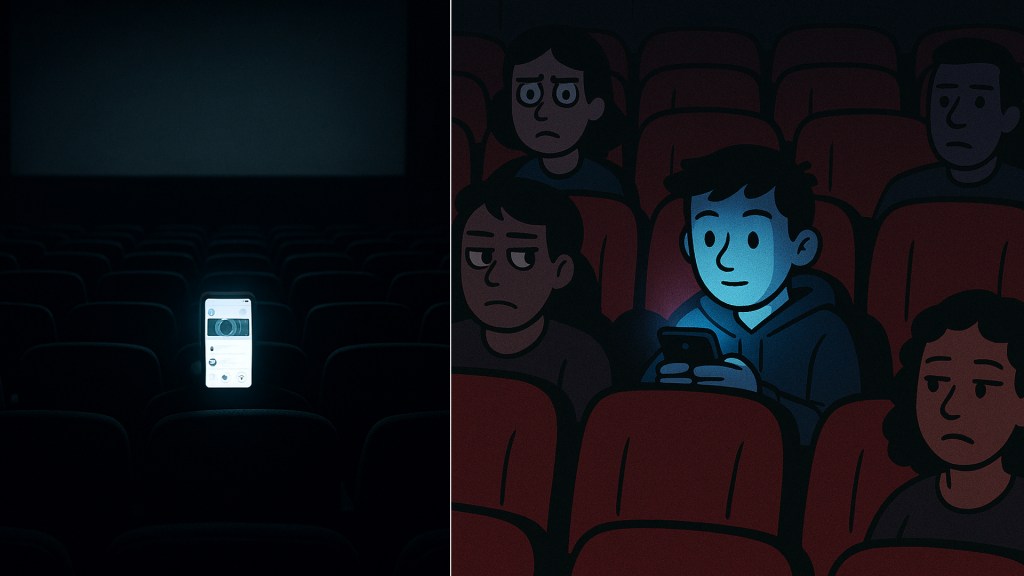
Most of my own experiences, though, have to do with patrons who choose to look at their own devices while the movie is on, not patrons who engage in loud conversation or whose devices emit sounds. This is particularly abundant during screenings of movies whose target audience are children, as if to prove that the parents of those children really don’t want to be there and they truly don’t wish to set the right example and show their own progeny what good cinema etiquette looks like. There are few things I find more distracting than seeing someone’s phone light up like a Christmas tree in an otherwise completely dark room full of strangers.
Now, I have frequently confronted such ill behaviour and so far, I’ve been batting a solid thousand. Without fail, when pointed out that their device usage is distracting, people immediately put their phones away and correct their posture. However, please do not take this as invitation to engage in cinema vigilantism because your mileage may vary. I am fully aware of what I look like and that having a six-foot-five bearded man emerge from the darkness to ask if you’re going to put your phone away on your own or if you’d like me to do it for you may be an intimidating experience. It is part of the point I am making to them and hoping it would become a formative experience that leads to corrective measures on their part.
Confronting people should never be an expected course of action, especially because, as I just mentioned, not everyone will get the same results as I do. A petite little woman might get completely different feedback, and a similarly sized male might end up in a fight they didn’t think would take place in a public setting. This isn’t advice I want you to come away with. It’s like following dating advice dispensed by someone who looks like Henry Cavill and tells you that you need to just walk up to a girl you fancy and introduce yourself because it works for him 100% of the time.
What I think matters here is the psychology underpinning this behaviour, which is a combination of the sad reality that many of us persist in a state of complete addiction to small jolts of dopamine courtesy of mindlessly doomscrolling through other people’s heavily curated content and the implicit assumption some people have that they are the only ones around with complex lives full of questions and problems and that everyone around them is an NPC, a non-player character. Therefore, without even thinking about the possibility that their behaviour might inconvenience other people, they would just do what’s best for them—not even second-best, only the best—at any given moment, like lighting up their goddamn phone in the middle of a screening because the world would come to a grinding halt if they didn’t reply to that WhatsApp message or scrolled through seven pictures on Instagram.
I could assume a strict stance in here and insist that if you can’t stay away from your device for two hours, then it’s a problem you should work on and maybe turn off that device altogether or refrain from attending public screenings of movies. But that’s not how the world works, and lasting cultural change cannot be instigated through tough enforcement of regulations alone. That’s where I think the pre-show ads should adapt to the changing times and instead of telling us to put our phones in silent mode (which they are by default in many cases), they should illuminate (pun intended) the fact that whenever you check your phone, you can be seen from the rows behind you and that it is distracting to other patrons who paid for the ticket to see the movie, not to look at someone else’s Instagram feeds.
Therefore, a low-energy solution to this problem is reminding patrons to lower the brightness on their devices to a minimum and if possible, to turn on the blue filter mode. I am aware that I am in a way conceding that other people will use their phone on occasion—and it would be futile to fight this because it’s like telling heroin addicts not to shoot up when they have a gram of the good stuff in their pocket—but at the very least the risk of distraction to other viewers would be minimized. I think it’s a small price to pay because as things are now, the minute I see a screen light up during a screening, my experience is ruined, and it doesn’t matter if I confront the person or not.
Raising awareness in cinemas and reminding people that others around them will be distracted by the glowing screen of their phones the minute they pick it up to check whatever they feel is so important to check before the credits roll might be the way to go. I assume that most people would eventually learn a thing or two about awareness of their surroundings and make sure their freedom to interact with their screen doesn’t come at a cost of other people interacting with that big screen upon which the movie is playing.






 Flasz On Film
Leave a reply to Jimbo Cancel reply